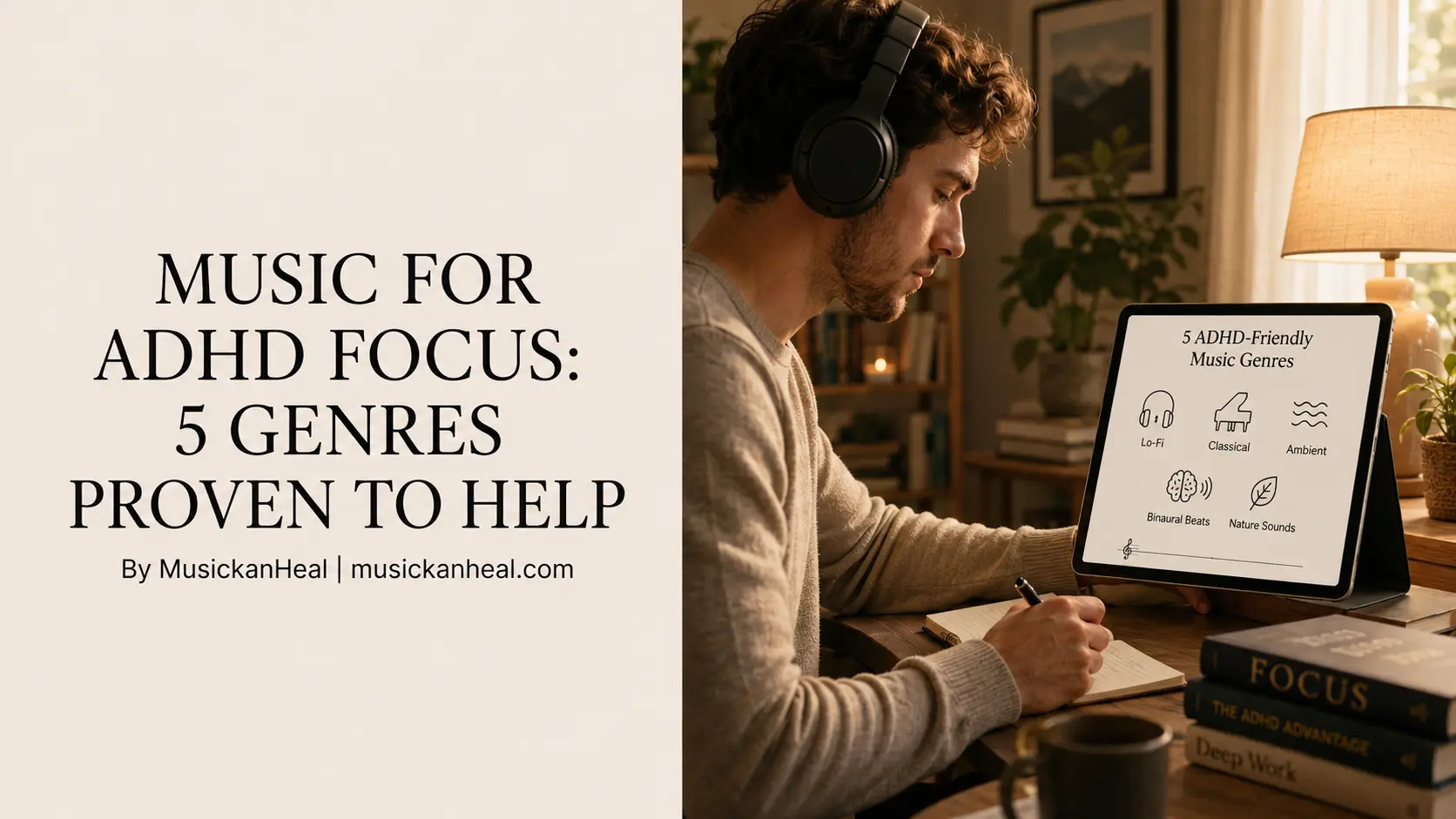
Music for ADHD Focus: 5 Genres Proven to Help
If you’ve ever been told to “just focus” in a quiet room and felt your brain do the exact opposite, you’re not broken — you’re probably not neurotypical, and silence might be working against you. A growing body of research backs up what a lot of ADHD adults already do by instinct: reach for music before starting a task.
But “put on some music” isn’t specific enough to be useful advice. Music for ADHD focus works when the genre, tempo, and lyrics match how your brain actually processes sound — and works against you when they don’t. This guide breaks down what the current research says, which genres hold up, and the mistakes that quietly undo the benefit.
What the Research Actually Says About Music and ADHD Focus
The most direct evidence comes from a 2025 study in Frontiers in Psychology, where researchers at the University of Montreal surveyed 434 adults aged 17 to 30 — half screened positive for ADHD, half neurotypical — about their background music habits during daily tasks. Both groups relied on music for focus and mood. What differed was the “why”: ADHD-screened participants leaned on stimulating music even for demanding cognitive work, while neurotypical participants tended to prefer calmer sounds for the same tasks.
A separate 2025 analysis published in PLOS ONE took a different approach entirely. Researchers pulled 9,215 tracks from three years of the r/ADHD Reddit community — sorted into focus music, “stuck songs,” and general listening — and ran them through audio-characteristic analysis. The strongest pattern to emerge wasn’t genre. It was instrumentalness: tracks with little or no vocal content showed up disproportionately in the focus category, more than any other single audio feature measured.
That lines up with older findings too. A 2007 Swedish study (Söderlund et al.) found that background noise improved memory task performance in children with ADHD, while it hurt performance in neurotypical children — early evidence that ADHD brains may need a different baseline level of stimulation than everyone else’s advice assumes.
Why ADHD Brains Respond Differently to Music for Focus
The short version: ADHD involves lower baseline dopamine activity in the brain’s attention and motivation circuits. Music — especially music you enjoy — triggers a dopamine release, a mechanism covered in detail by ADDitude. For a lot of ADHD adults, that’s not a nice bonus; it’s compensating for a chemical shortfall that makes sustained attention difficult in silence.
This is sometimes explained through the optimal stimulation theory: everyone has a baseline level of arousal their brain needs to function well, and ADHD brains often run below that baseline at rest. Silence, instead of feeling calm, can feel like understimulation, which shows up as restlessness, mind-wandering, or an urge to check your phone. The right music brings arousal up into a workable range without tipping into overstimulation.
That’s also why the “just use white noise” advice that works for a lot of people doesn’t fully apply here, and why it’s worth treating music for ADHD focus as its own category rather than a subset of general background-noise advice. Structured sound and unstructured sound do different jobs in an ADHD brain, which is exactly why picking the right music for ADHD focus takes more thought than grabbing any “focus playlist” off Spotify.
The Best Music Genres for ADHD Focus (Backed by Research)
Genre matters less than the underlying audio characteristics — tempo, instrumentalness, and predictability — but certain genres consistently deliver the kind of music for ADHD focus that research and real-world reporting both back up.
Lo-fi and chillhop
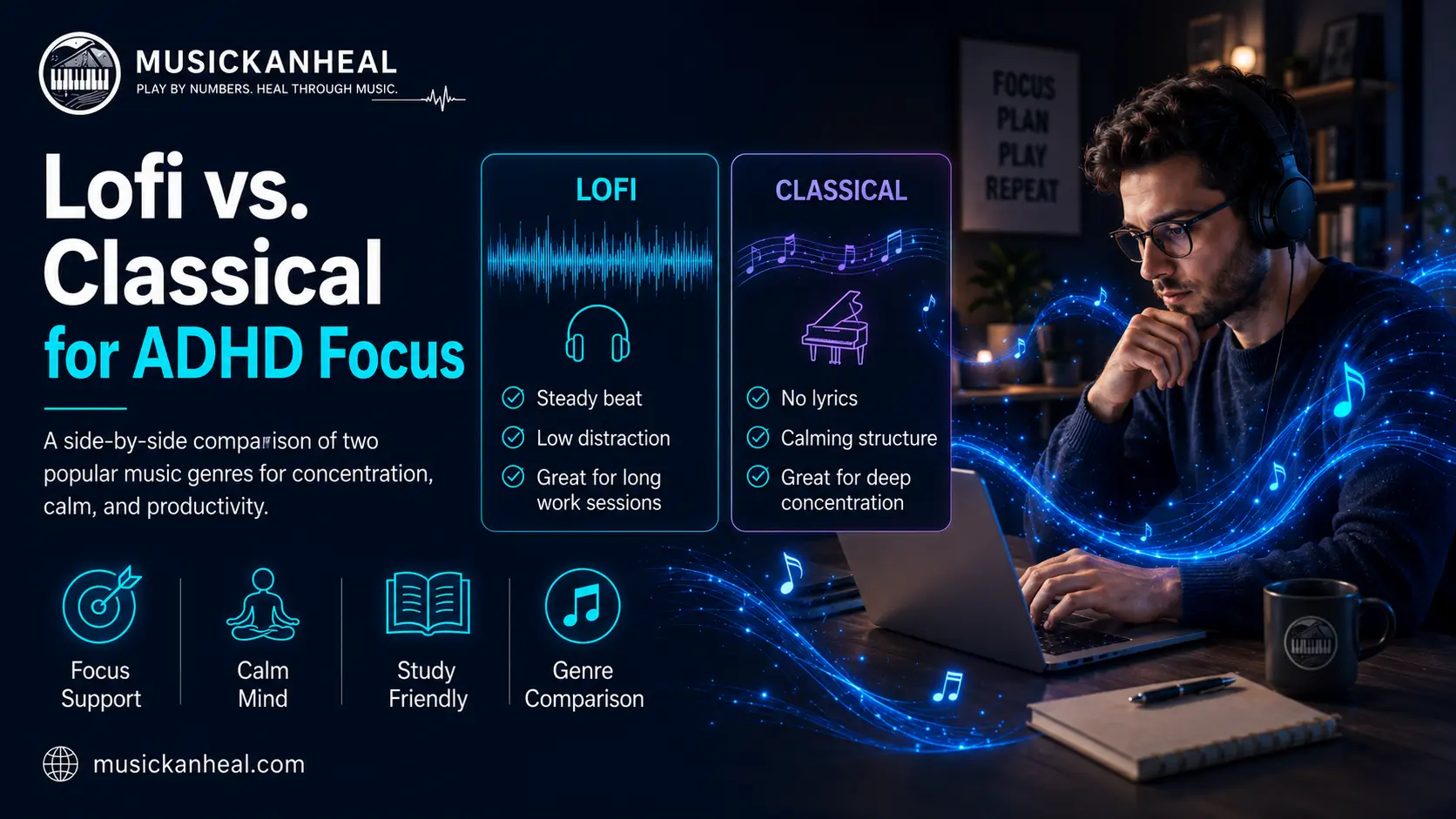
Steady, repetitive beats with minimal variation give the brain a predictable rhythmic anchor without demanding attention. This is the most commonly reported favorite among ADHD adults in both survey data and informal reporting.
Classical and Baroque
Structured, mathematically predictable pieces — Bach and Vivaldi come up often — provide the same kind of rhythmic scaffolding as lo-fi, with more melodic complexity for people who find lo-fi too flat to hold their attention.
Video game and film soundtracks
Built specifically to support sustained attention without becoming the center of it, these tracks are engineered around the exact goal a focus session needs.
Upbeat instrumental electronic
House, techno, or EDM without vocals. Counterintuitive for some, but a meaningful subset of ADHD adults report better focus with higher-energy instrumental tracks than with anything calm — consistent with research showing some ADHD brains need more stimulation, not less, to settle in.
Ambient and minimalist soundscapes
For overstimulation-prone days, low-complexity ambient tracks provide just enough auditory input to block silence-driven restlessness without adding new distraction.
None of these is universally “the best.” The Frontiers data is explicit about this: which type works is highly individual, tied to your baseline arousal level more than your taste in music, generally.
Why Lyrics Are the Biggest Focus-Killer for Most ADHD Brains
This is the one point nearly every study and clinician agrees on: vocals compete directly with the language-processing part of your brain, which is also the part you need for reading, writing, or following a conversation. For most people using music for ADHD focus during cognitively demanding work, lyrics are the single most common thing quietly sabotaging the session.
It’s not absolute. Some ADHD adults report that music in a language they don’t speak works fine, since their brain doesn’t try to parse it as language. Others find that songs they know by heart function almost like instrumentals because there’s no new information to process — the lyrics are already memorized, so they don’t pull attention the way a new song would.
The practical rule: if you catch yourself singing along, mouthing words, or getting pulled into what a lyric means, that track has just switched from focus tool to distraction, whether or not you consciously noticed the shift.
Tempo and Structure: Finding the “Just Right” Zone for ADHD Focus
Too slow, and attention drifts — the brain has room to wander between beats. Too fast or chaotic, and the music itself becomes the primary stimulus instead of a backdrop, pulling focus away from the actual task. Getting music for ADHD focus right often comes down to tempo more than genre: the sweet spot research points to is a steady, moderate-to-upbeat tempo with a clear, repeating structure — predictable enough that your brain stops actively monitoring it and present enough that it keeps baseline arousal from dropping into understimulation.
This is also where music for ADHD focus differs meaningfully by task type. Reading and writing tasks generally tolerate less musical complexity — closer to ambient or classical. Repetitive manual tasks or busywork can often handle higher-energy, more rhythmically complex music without losing focus, since there’s less competition for language-processing resources.
Common Mistakes That Undo the Focus Benefit of ADHD Music
Even the right genre can fail if it’s used the wrong way. These are the habits that most often quietly cancel out the benefit of music for ADHD focus:
- Choosing music because you love it, not because it works. Strong emotional attachment to a song pulls attention toward the music itself. The most effective focus music tends to be a track you neither strongly love nor dislike — familiar enough to predict and forgettable enough not to compete.
- Letting algorithmic playlists drift into new releases. Auto-generated “focus” playlists often slip in unfamiliar tracks with unpredictable structure, which resets the brain’s rhythmic prediction and briefly pulls attention every time a new song starts.
- Using top-40 or high-arousal pop for deep work. Music engineered to be emotionally exciting works against sustained attention on anything that requires reading or writing, regardless of how energizing it feels.
- Assuming today’s playlist will work tomorrow. Baseline arousal shifts day to day — with sleep, stress, and medication timing all playing a role. The genre that locked you in yesterday can feel like static today, and that’s a normal feature of variable attention, not a sign you did something wrong.
Music vs. Noise: Which Should You Use for ADHD Focus?
Music and colored noise solve slightly different problems, and it’s worth knowing which one you’re actually reaching for. Structured music — with its rhythm, melody, and predictable pattern — tends to raise arousal and engagement, which is useful when the problem is understimulation and mind-wandering. Unstructured sound like white or brown noise works more by masking distracting sounds in the environment than by actively engaging attention.
If your main problem is a noisy office or house, comparing brown noise and white noise for focus is the more relevant guide. If your problem is understimulation in an otherwise quiet space, structured music is generally the better starting point, since it gives the brain something to actively track rather than just something to block out.
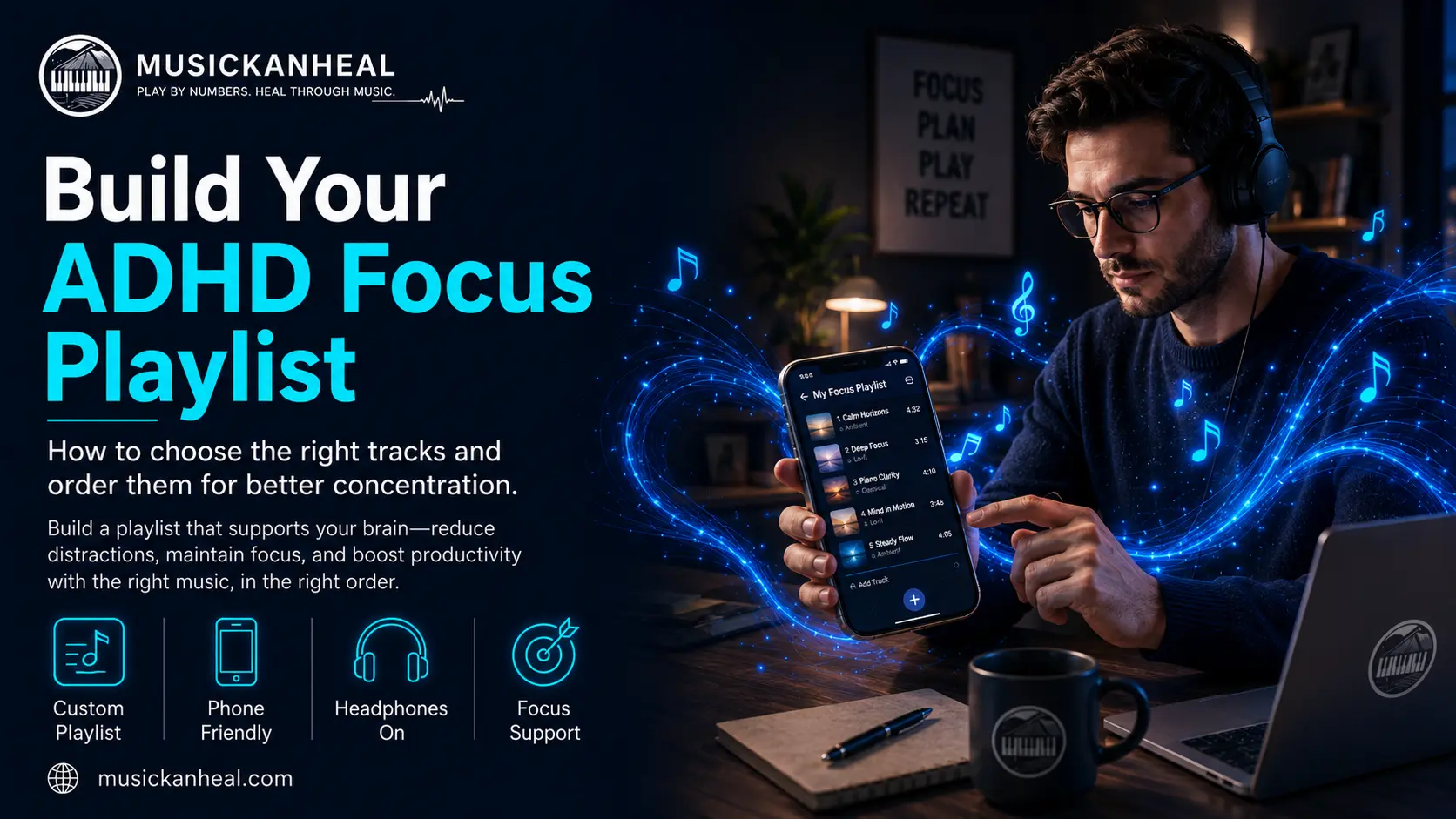
How to Build Your ADHD Focus Playlist
Here’s a practical, step-by-step way to put this research to work and actually build a music for ADHD focus routine that holds up day to day:
Start with instrumentals only
Strip out the lyrics first — it’s the single change most likely to produce an immediate, noticeable difference.
Match energy to task type
Ambient or classical for reading and writing; higher-energy instrumental for repetitive or manual work.
Build a “known but not loved” rotation
Familiar enough to predict, unremarkable enough not to pull focus toward the music itself.
Keep sessions to a single genre or playlist per block
Switching styles mid-task resets your brain’s rhythmic prediction, the same way a jarring new song does.
Notice when it stops working
If a normally reliable playlist suddenly feels distracting, that’s a signal to adjust for the day, not a signal the whole strategy is broken.
Playing an instrument yourself takes this further than listening ever can, since active engagement pulls in motor and attention systems that passive listening doesn’t touch. If that’s a direction you want to explore, the mental health case for learning piano as an adult covers the research on why active music-making does more for focus and mood than listening alone — and practicing piano specifically as a focus and anxiety tool is a practical next step if structured practice sounds more useful to you than another playlist.
Frequently Asked Questions About Music and ADHD Focus
What is the best music for ADHD focus?
There’s no single best genre for ADHD focus — research points to instrumental tracks with a steady, moderate tempo as the strongest common thread, with lo-fi, classical, and video game soundtracks reported most often. Which one works best for you depends on your individual baseline arousal level more than genre preference alone.
Does music actually help people with ADHD concentrate?
Research suggests it can, particularly instrumental music with predictable rhythm. A 2025 Frontiers in Psychology study found ADHD-screened adults use music more deliberately for focus than neurotypical adults, and a separate analysis of ADHD listening habits found instrumentalness was the strongest audio predictor of focus-music tracks.
Why do lyrics make it harder to focus with ADHD?
Lyrics engage the brain’s language-processing centers, the same regions needed for reading, writing, and following instructions. That overlap creates competition for cognitive resources, which is why instrumental music consistently outperforms lyrical music for concentration-heavy tasks.
Is loud or fast music ever better than calm music for ADHD focus?
For some people, yes. Because ADHD often involves understimulation, a meaningful subset of adults concentrate better with higher-energy, faster-tempo instrumental music than with calm background tracks. This isn’t universal, so it’s worth testing rather than assuming calm music is automatically the right choice.
Should I use music or white noise for ADHD focus?
It depends on the problem you’re solving. Music tends to help more with understimulation and mind-wandering in a quiet space, while white or brown noise works primarily by masking outside distractions. If noise from your environment is the bigger issue, colored noise is usually the better starting point.
The Bottom Line
Music for ADHD focus isn’t a single hack — it’s a set of variables — instrumentalness, tempo, structure, and how much you already love the song — that either work with your brain’s need for stimulation or quietly work against it. The research consistently points to instrumental, moderately paced, predictable music as the strongest starting place for ADHD focus, with real individual variation in exactly how much energy your particular brain needs.
All rights are reserved. Copyright 2026 MusicKanHeal | musickanheal.com