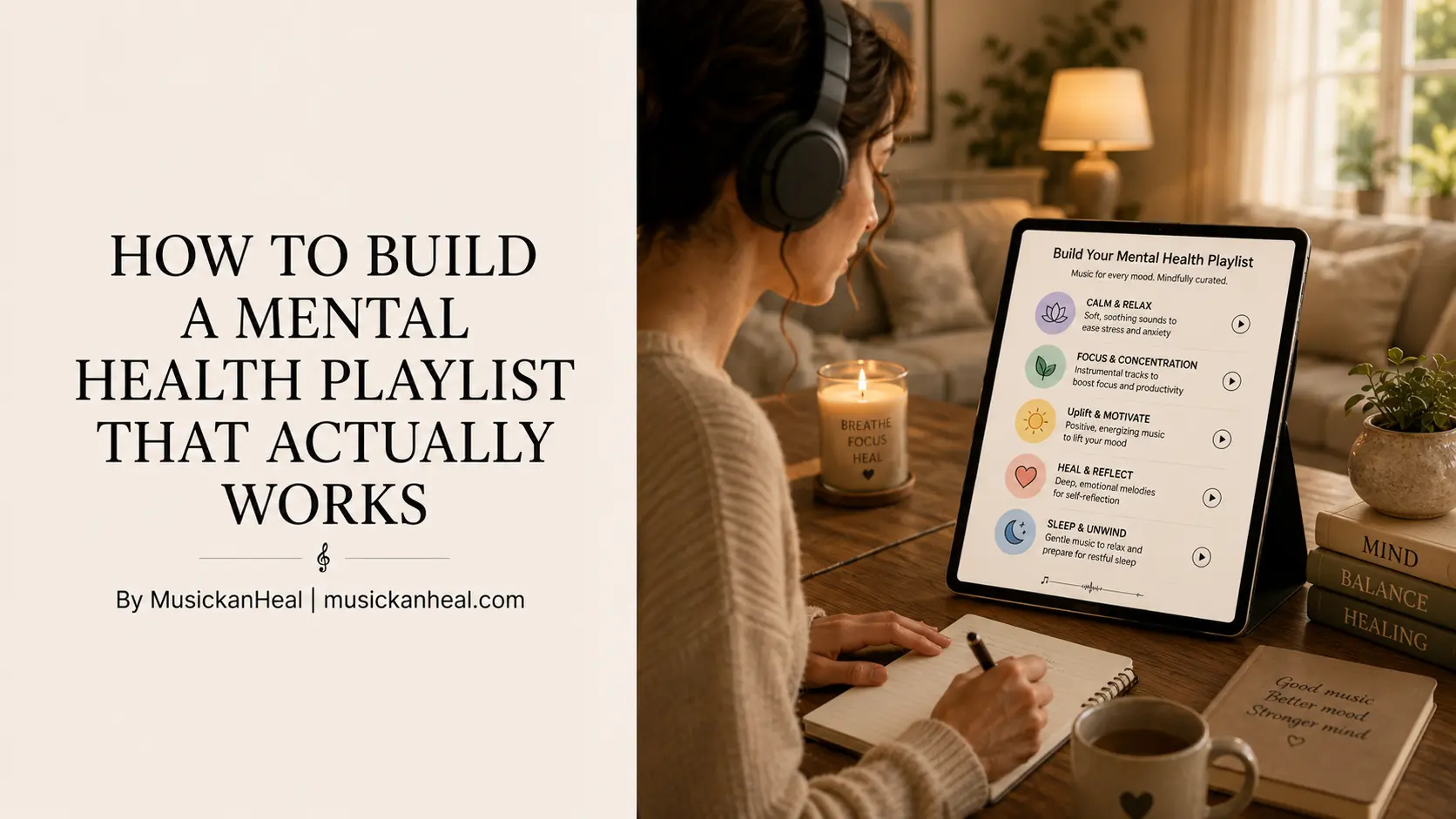
How to Build a Mental Health Playlist That Actually Works
Most “mental health playlists” are just sad songs or spa music thrown together in whatever order they were saved. That’s not what actually works, and it’s not what trained clinicians do when they build one with a client. Music therapists have used a specific structure for decades called the ISO principle, and building your own mental health playlist around it is the difference between one that helps you feel understood and one that quietly keeps you stuck in a mood you’re trying to get out of.
This guide walks through exactly how to build a mental health playlist — the structure, the science behind why it works, the mistakes that undo it, and a simple template you can fill in today, no music therapy training required.

The ISO Principle: The Framework Behind Every Good Mental Health Playlist
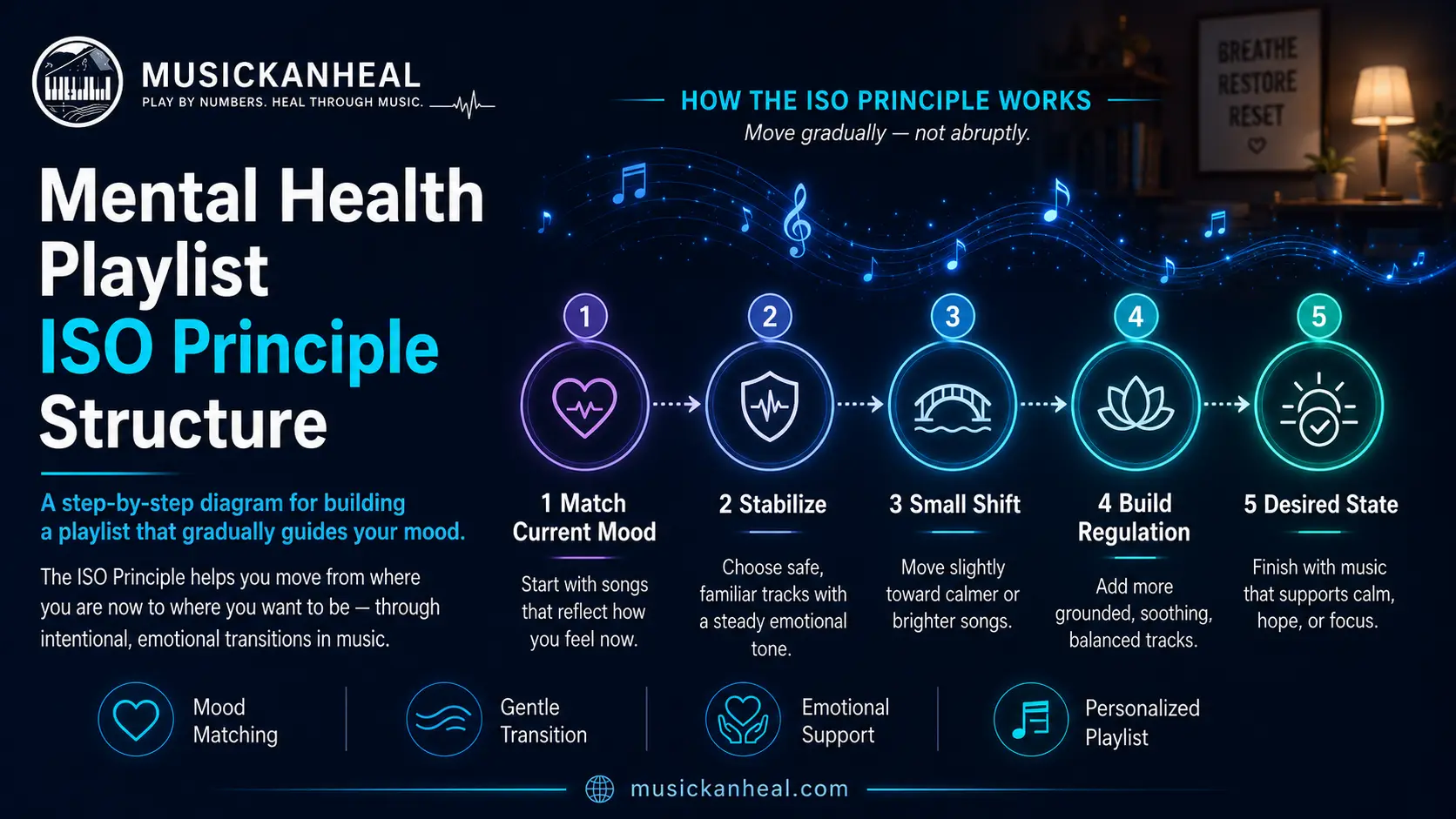
The ISO principle is a music therapy concept: start by matching music to the mood you’re actually in, then gradually shift the music toward the mood you want to be in. The name comes from “isomoodic” — matching mood — and it’s the backbone of how trained music therapists build playlists with clients.
The mechanism is simple but easy to skip past. If you’re anxious and angry and you jump straight to upbeat, happy music, it usually feels wrong — tone-deaf to what you’re actually feeling, which makes it harder to engage with rather than easier. A mental health playlist built on the ISO principle validates the current mood first, then moves you forward in stages, so the shift feels earned instead of forced.
Step 1: Name the Mood You’re Actually In
Before picking a single song, get specific about what you’re feeling right now. “Bad” isn’t specific enough to build a mental health playlist around. Anxious, angry, numb, and sad all call for different opening tracks and different transition paths — an anxious mood usually needs a busier, more complex opening track, while a flat, numb mood often needs something with more presence and warmth than pure quiet.
Step 2: Name the Mood You Want to End On
This is your last track, and it should be specific too. “Better” isn’t a destination. Calm, energized, grounded, and hopeful are all different endpoints that call for different closing songs — a calm ending wants something slow and sparse, while an energized ending wants tempo and momentum building through the last few tracks.
Step 3: Build the Bridge Between Them
This is where most people either overthink it or skip it entirely. Once you know your starting mood and ending mood, you need songs that gradually close the gap — not a hard cut from sad to happy, but a handful of tracks that each move slightly further toward where you’re headed.
- For a short playlist (6–8 songs): 2–3 songs that match your current mood, 2–3 transition songs, and 2–3 songs at your target mood.
- For a longer playlist (15+ songs): the same structure is stretched out, with more gradual steps between each mood — useful for longer-term issues you’re working through over days or weeks rather than a single sitting.
The tempo of each song matters more than the genre. A song’s beats per minute is a rough proxy for the energy level it will nudge you toward, which is why tracking tempo — even loosely — makes the transition section far more effective than picking songs by vibe alone.
Should You Include Sad Songs? Here’s What the Research Actually Says
This is the most common question people have about building a mental health playlist for depression or grief, and the honest answer is it depends on what the sad song is doing for you.
Research distinguishes between two very different uses of sad music: processing and rumination. A study on music and mental health recovery found that processing is when a sad song makes you feel understood, gives shape to a feeling you couldn’t otherwise name, and then lets you move on. Rumination is when the same song keeps you circling the same painful thought without resolution — the difference isn’t the song; it’s what happens in you after you’ve listened to it.
The practical test: after a sad song ends, do you feel a little more able to move, or do you feel more stuck than when it started? If it’s the former, sad songs belong in the opening section of your mental health playlist. If it’s consistently the latter — especially if a specific song is tied to a specific painful memory — that track is probably working against you, not for you, and it’s worth swapping it out even if it “feels right” to keep playing.
The One Song With Actual Clinical Data Behind It
Most mental health playlist advice is intuition-based. One track has been through a real controlled study: “Weightless” by Marconi Union, engineered specifically with sound therapists to slow heart rate through a gradually decelerating tempo — starting around 60 beats per minute and easing down to roughly 50. A widely cited study by Mindlab International found it reduced participants’ anxiety by 65% and outperformed every other track tested, including well-known relaxation staples, with measurable drops in heart rate and blood pressure alongside the self-reported anxiety scores.
That doesn’t make it universally the “best” song — a music professor quoted in coverage of the study made the fair point that musical response is deeply personal, shaped by memory and culture, so no single track works identically for everyone. But it’s a legitimate, well-documented option for the calm end of a mental health playlist if you don’t already have a go-to.
Common Mistakes That Undo a Mental Health Playlist
Even a well-intentioned playlist can quietly work against you if it falls into one of these patterns. Most of these aren’t obvious until you’ve been using the playlist for a while and notice it isn’t helping the way it used to:
Starting at your target mood instead of your current one
Skipping the validation step is the single most common reason a mental health playlist feels hollow or forced — it asks you to fake a feeling you’re not in yet.
Making one playlist for everything
A playlist built for anxiety and a playlist built for grief need different structures entirely. Build separate playlists for separate moods rather than one all-purpose list you reach for regardless of what you’re actually feeling.
Loading it exclusively with songs tied to a specific painful memory
Even a beautiful, “fitting” song can function as a trigger rather than a comfort if it’s too closely tied to a specific loss or trauma. A song doesn’t have to be permanently retired, just moved out of heavy rotation for a while.
Ignoring tempo in favor of vibe
Two songs can feel similarly “sad” while having completely different tempos and energy levels. Tempo is what actually drives the transition — pay attention to it specifically, not just genre or mood tags.
Never revisiting the playlist
A mental health playlist isn’t a one-time build. What worked during a stressful week at work might not fit a grief playlist six months later. Treat it as a living document, not a finished product.
Your Mental Health Playlist Template
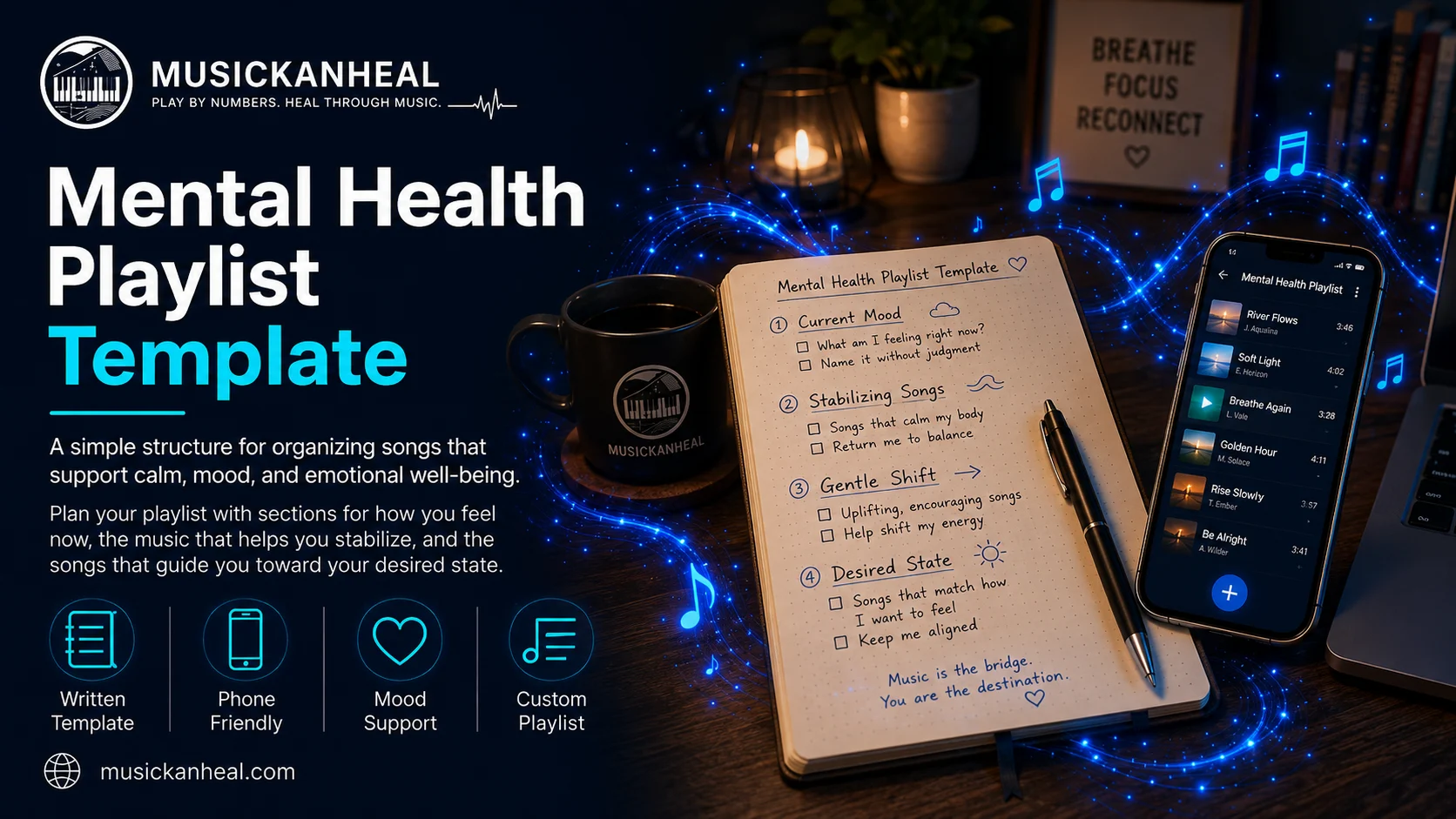
Use this as a starting structure — fill in the blanks with your own songs:
Opening (2–3 songs)
Match your current mood exactly. Don’t reach for upbeat yet — this section is for feeling heard, not fixed.
Bridge (2–4 songs)
Each song nudges slightly toward your target mood — a little less heavy, a little more tempo, and a little lighter.
Arrival (2–3 songs)
Songs that fully match your target mood. This is where you land, not where you start.
One anchor track
Pick one song you always include, regardless of mood — a consistent touchstone that becomes familiar enough to signal “this playlist is working” the moment it plays.
A revisit date
Set a rough reminder — a few weeks out — to check whether the playlist still fits or whether your current mood and target mood have shifted enough to need a rebuild.
If building something more active than a listening playlist interests you, the mental health case for learning piano as an adult covers why actively making music does more for mood regulation than listening alone — and for anxiety specifically, practicing piano as an anxiety-management tool walks through a practical routine built on the same active-engagement principle. If your playlist work is more about focus than mood, the research on music for ADHD focus covers a related but distinct structure built around attention rather than emotional regulation.
Frequently Asked Questions About Mental Health Playlists
How many songs should a mental health playlist have?
There’s no fixed number, but 6–10 songs works well for a single-sitting mood shift, while 15–20 songs suits a longer-term playlist for an ongoing issue like grief or a difficult life transition. What matters more than count is making sure all three sections — current mood, bridge, and target mood — are represented.
Should a mental health playlist include sad songs?
Often, yes — as long as the sad songs help you process the feeling rather than ruminate on it. The test is how you feel after the song ends: more able to move forward is processing; more stuck in the same thought loop is rumination, and that’s a sign to swap the track.
What is the ISO principle in music therapy?
The ISO principle is a technique where music is first matched to a person’s current mood, then gradually shifted toward their desired mood. It’s the standard framework music therapists use for playlist-building interventions, and it works the same way for a self-built mental health playlist.
Does a specific song actually reduce anxiety?
“Weightless” by Marconi Union is the most studied example — a 2011 Mindlab International study found it reduced anxiety by 65% in test conditions, more than any other track tested. It’s not a universal fix, since musical response is personal, but it’s a solid starting point for the calming section of a playlist.
How often should I update my mental health playlist?
Treat it as a living document rather than a one-time project. A playlist built for a specific stressful period may stop fitting once that period passes. Checking back in every few weeks — or whenever the playlist starts to feel like it doesn’t match your mood anymore — keeps it useful instead of stale.
The Bottom Line
A mental health playlist works when it’s built with structure, not just vibes: start where you actually are, end where you want to be, and use the songs in between to make that shift feel earned instead of forced. Sad songs aren’t automatically the enemy, tempo matters more than genre, and the single most useful habit is checking in on whether a song is helping you process a feeling or just loop it.
All rights are reserved. Copyright 2026 MusicKanHeal | musickanheal.com