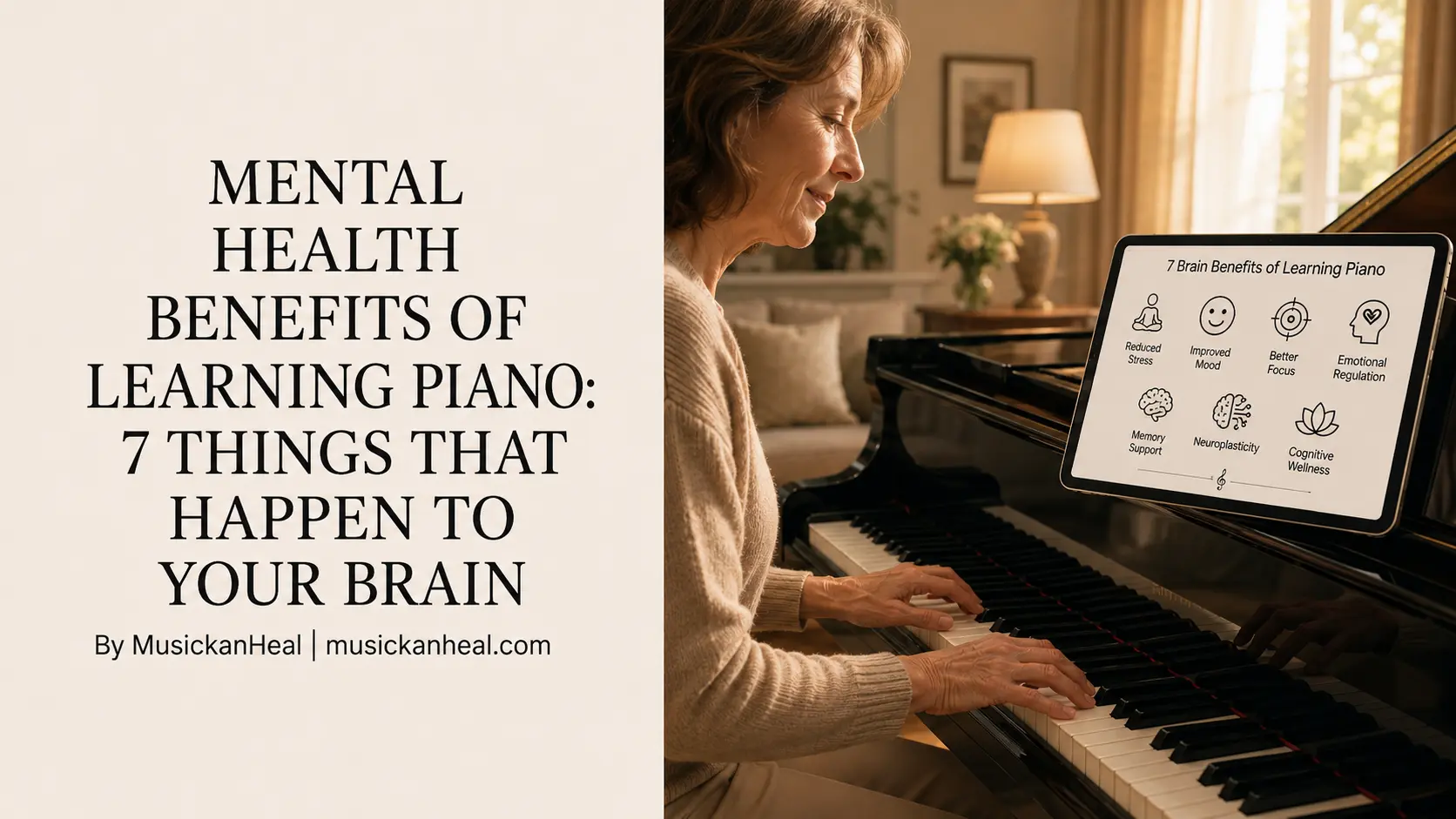
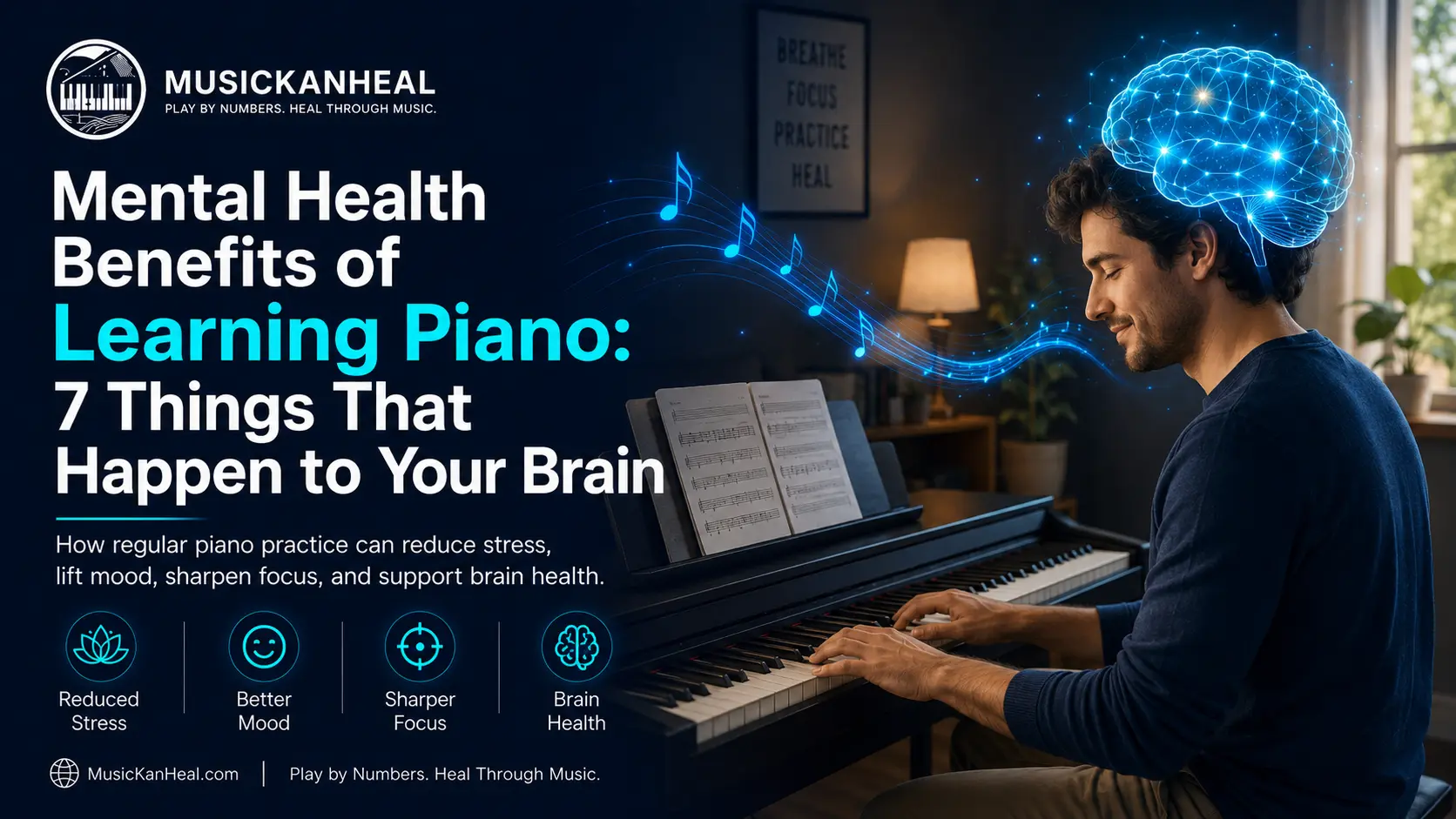
Mental Health Benefits of Learning Piano: 7 Things That Happen to Your Brain
Most people who sit down at a piano for the first time have no idea what’s happening inside their skull while they fumble through their first few notes. The mental health benefits of learning piano aren’t vague or inspirational—they show up on brain scans, in clinical depression scores, and in measurable cortisol readings taken before and after practice sessions. They also kick in faster than almost anyone expects.
This isn’t a feel-good piece about music being beautiful. It’s about what the research actually shows, with real studies and real numbers, so you can decide whether learning piano belongs in your mental health toolkit.
What Happens to Your Brain When You Start Learning Piano?
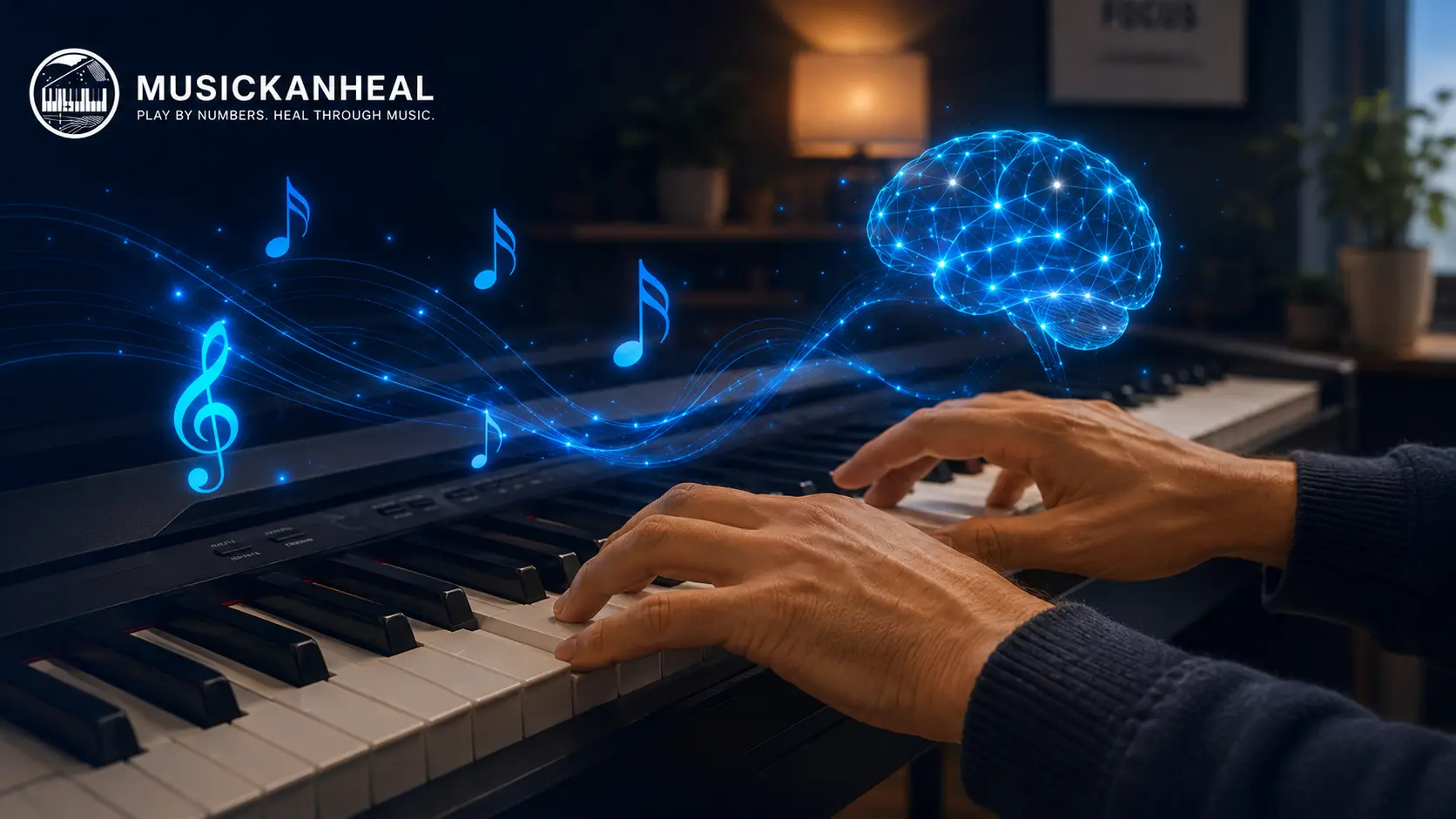
Piano is unusual among hobbies because it forces every major region of your brain to work at the same time.
Your motor cortex coordinates your fingers. Your auditory cortex processes what you’re hearing and compares it to what you intended. Your prefrontal cortex handles planning, timing, and error correction. Your limbic system—the emotional engine—runs continuously throughout. That simultaneous, multi-region activation is not something reading a book, solving a crossword, or even playing most other instruments produces at the same scale.
The result is what researchers describe as a whole-brain workout. And like any workout, it produces measurable physiological and psychological changes — some of which appear within a few weeks of starting.
7 Mental Health Benefits of Learning Piano
Your Cortisol Drops — Even in Your First Session
Cortisol is the body’s primary stress hormone. Chronically high levels are linked to anxiety, poor sleep, weight gain, immune dysfunction, and cardiovascular risk. Piano practice measurably lowers it.
Research reviewed in a comprehensive clinical report published by the National Institutes of Health found that playing piano was significantly more effective at reducing salivary stress markers than calligraphy or clay modeling—two activities routinely recommended for relaxation. Importantly, the reduction wasn’t confined to experienced players. Beginners showed the same drop.
After just 30 minutes at the keyboard, cortisol levels fall in ways that are physiologically measurable, not just self-reported. That matters because most evidence-backed stress interventions—meditation, therapy, exercise—require either years of habit-building or external infrastructure to access. Piano works from session one.
Dopamine and Serotonin Start Moving
When you successfully play a chord sequence you’ve been working on, or get through a full phrase without stopping, your brain’s reward circuit fires. Dopamine—the neurotransmitter tied to motivation, pleasure, and mood regulation—is released in response to that small win.
Serotonin follows a similar pattern during musical engagement. Both chemicals are directly implicated in depression and anxiety. They’re also what antidepressants work to regulate, pharmacologically. Piano doesn’t replace medication. But it engages the same underlying chemistry through effort and sound rather than a prescription.
Functional MRI studies confirm this link. Musical performance consistently activates the dopaminergic reward pathway, and over time, the brain begins to associate sitting at a piano with that reward signal. The habit becomes chemically self-reinforcing — which is a meaningful advantage for people who struggle to maintain mental health practices consistently.
Clinical Trials Show Real Drops in Anxiety and Depression Scores
This is where the evidence moves from interesting to hard to argue with.
A March 2025 study published in the Journal of Nervous and Mental Disease followed 30 adults between the ages of 60 and 70 through six months of twice-weekly piano lessons. The Taylor Anxiety Scale dropped by 19 points — more than half its original value. The Beck Depression Inventory dropped by 21.5 points. Well-being, activity, and mood scores all improved significantly. These aren’t marginal lifestyle shifts. They’re clinical-level changes produced by piano lessons.
An earlier but equally important study from the University of Bath, published in Nature Scientific Reports, found that complete beginners who took just one hour of piano lessons per week for 11 weeks reported lower depression, stress, and anxiety scores compared to people who only listened to music or used the time for quiet study. The piano group also showed enhanced multisensory processing — improvements that extended to non-musical tasks entirely.
Eleven weeks. One hour a week. With no prior experience.
Your Brain Builds New Neural Pathways — and Keeps Them
Neuroplasticity is the brain’s capacity to form new connections and reorganize itself. It was once assumed to peak in childhood. It doesn’t.
Adult brains retain significant plasticity, and piano learning is one of the more effective ways to stimulate it at any age. The reason comes back to that multi-region activation: when multiple brain areas fire together repeatedly, the connections between them strengthen. White matter density increases. The corpus callosum — the tissue bridge between the brain’s left and right hemispheres — measurably thickens in pianists compared to non-musicians.
Research published in Frontiers in Psychology found that older adults who took piano lessons for six months showed significant improvements in mood, attention, and overall quality of life, with specific decreases in psychological distress and fatigue that were not seen in a control group doing other leisure activities. Learning piano in adulthood may actually have stronger protective benefits than learning as a child, because the novelty of the challenge demands more adaptive effort from an aging brain.
Piano Creates a Flow State That Interrupts Anxiety’s Rumination Loop
Flow is the state of complete absorption in a task — what psychologists call being in the zone. It’s linked to reduced self-consciousness, lower perceived stress, and elevated positive emotion. It’s also difficult to reach deliberately. Most people chase it through gaming, running, or years of meditation practice.
Piano induces it almost automatically, because the task demands exactly the right level of attention. You must focus enough to stay present — reading notes, coordinating both hands, and maintaining rhythm — but the auditory feedback is immediate. You hear what you’re doing in real time. That feedback loop pulls the mind away from internal noise and into the current moment.
For people managing anxiety, this is one of the most practically useful mental health benefits of learning piano. Rumination — the repetitive cycling of worried thoughts — is a core feature of anxiety disorders. Piano interrupts it structurally. Your hands require your brain’s full attention. There’s nothing left over to fuel the worry loop. This is also likely why improved sleep is one of the most commonly reported side effects of regular piano practice.
You Get an Emotional Outlet That Doesn’t Need Words
Grief, sustained stress, and emotional overload are often impossible to translate into language — particularly for people who don’t process well through talking or writing. Piano offers a channel that bypasses language entirely. Dynamics, tempo, touch, and the choice of what to play all carry emotional content that words frequently can’t hold.
This isn’t a soft claim. Music therapy research consistently shows that non-verbal emotional expression through active music-making reduces psychological distress, especially in people who struggle with traditional talk therapy. The structured freedom of piano — there are rules, but enormous room for personal expression within them — makes it a particularly effective emotional processing tool.
For anyone carrying stress from work, relationships, or grief, sitting at a piano and playing even a simple sequence can function as genuine emotional processing, not just a distraction from it.
Self-Esteem and Sense of Control Come Back
One of the least discussed but most consistent findings in piano and mental health research is the effect on self-esteem. Depression, specifically, erodes the sense that effort leads to outcomes — that you can do things, that you’re capable of progress.
Learning piano challenges that directly. You practice something. You get better. You play it. The relationship between input and output is concrete and audible. You did something yesterday that you couldn’t do the day before.
Clinical research referenced in NIH’s database found that adults who took piano lessons reported increased self-esteem, greater independence, and fewer feelings of isolation. Those aren’t incidental side effects — they’re the direct result of a skill that takes real effort and delivers real, measurable progress. That’s a fundamentally different psychological experience from many other mental health interventions, where improvement is slow, invisible, and hard to measure.
Does Learning Piano for Mental Health Work the Same as Just Listening to Music?
No — and this distinction is worth understanding clearly.
The University of Bath study specifically compared piano learners against a group that only listened to music. The listeners gained some benefit. But the mental health improvements were significantly stronger in the group that actively played. Active music-making engages the brain differently and more intensely than passive reception. Neuroplasticity, cortisol reduction, and the full mood effects require your hands on the keys.
If you’re exploring the healing audio and music therapy side of MusicKanHeal alongside active playing, that’s a sensible dual approach. Passive listening has genuine value — especially for sleep and acute stress regulation. But it’s a different mechanism from what active piano practice produces, and it doesn’t deliver the same depth of neurological benefit.
How Long Does It Take to Feel the Mental Health Benefits of Piano Practice?
The University of Bath research found measurable mood improvements within a few weeks of starting. The 2025 Journal of Nervous and Mental Disease study showed clinical-level anxiety and depression changes after six months of consistent practice.
Practically speaking, most people notice something within two to four weeks — better focus, slightly lower baseline tension, improved sleep — if they’re practicing regularly. The deeper structural brain changes, including neuroplasticity and cognitive reserve building, develop over months. Neither timeline requires you to be skilled. The clinical research was conducted on beginners.
The biggest barrier for most adults is not the time commitment or the cost. It’s the assumption that piano requires reading sheet music, which most people tried once, found frustrating, and abandoned. That assumption is wrong, and removing it makes starting far easier than it looks. The Nashville Number System is one method that gets complete beginners playing recognizable music within hours — which matters, because you can’t benefit from piano practice you’ve quit out of frustration.
You Don’t Need to Be Good. You Just Need to Start.
The biggest misconception about the mental health benefits of learning piano is that they arrive later — once you’re good enough, once you’ve been playing long enough, once your playing sounds like something worth hearing. The research says otherwise. The benefits are embedded in the act of learning itself. In the focus, the small failures, the incremental wins, and the neurochemistry that fires every time you get something right.
If you’ve been waiting until you have the time or the talent to start, you’ve been thinking about it backwards. The mental health return on 20 to 30 minutes of piano practice is measurable, well-documented, and accessible from your first session. What matters is starting before the hesitation calcifies into never.
Frequently Asked Questions About Mental Health Benefits of Learning Piano
What are the mental health benefits of learning piano for adults with anxiety?
For adults with anxiety, learning piano produces two primary effects. Physiologically, practice sessions lower cortisol and trigger dopamine and serotonin release. Cognitively, the focused attention required to play interrupts the rumination cycles that sustain anxiety. Both effects appear within weeks of starting, even for complete beginners with no prior musical experience.
Does learning piano help with depression?
Yes, according to multiple clinical studies. A 2025 study in the Journal of Nervous and Mental Disease found that six months of piano lessons cut Beck Depression Inventory scores by 21.5 points in participants aged 60–70. A separate University of Bath RCT published in Nature Scientific Reports showed reduced depression scores after just 11 weeks of one-hour weekly lessons. The mechanisms include dopamine and serotonin release, a restored sense of self-efficacy, and the concrete experience of progress that depression typically removes.
How long does it take to feel the mental health benefits of learning piano?
Most people report noticeable mood and focus improvements within two to four weeks of regular practice. Deeper changes — including neuroplasticity effects, cognitive reserve building, and sustained anxiety reduction — develop over three to six months. Consistency matters more than skill level or session length, and 20 to 30 minutes of practice most days produces better results than longer, irregular sessions.
Do you need to be good at piano to get mental health benefits of learning piano?
No. This is one of the clearest findings across the research. The neurological and mood benefits occur during the learning process, not as a reward for achieving a particular skill level. Beginners in the clinical studies received the same cortisol reduction and mood improvement as more experienced players. The effort of learning — not the standard of performance — is what produces the benefit.
Can the mental health benefits of learning piano help with ADHD and focus problems?
Emerging evidence suggests yes. Piano practice strengthens executive function, working memory, and sustained attention — the specific cognitive domains that ADHD disrupts. The focused, feedback-rich environment of piano practice may be particularly well-suited to people who struggle with attention in low-stimulation contexts. The immediate auditory feedback of piano keeps engagement higher than most quiet cognitive tasks. Targeted clinical research on ADHD specifically is ongoing, but the neurological overlap is strong.
All rights are reserved. Copyright 2026 MusicKanHeal | musickanheal.com