AI Healing Music
Most people assume the debate is simple: human music is more healing, AI music is a cheap imitation, end of story. The actual research is more uncomfortable than that and a lot more interesting.
A 2025 MIT Media Lab study put this assumption to the test. Participants were exposed to both AI-generated and human-composed music. Here is where it gets strange: people said they preferred the AI music overall, yet they rated human-composed music as more effective at producing the target emotional state. When researchers measured actual emotional responses, though, the difference was not statistically significant. In other words, what people believed about their experience did not match what was happening inside them.
So where does that leave AI healing music? The honest answer is somewhere more useful than most wellness blogs will tell you.
What Is AI Healing Music, and Why Is Everyone Suddenly Talking About It?
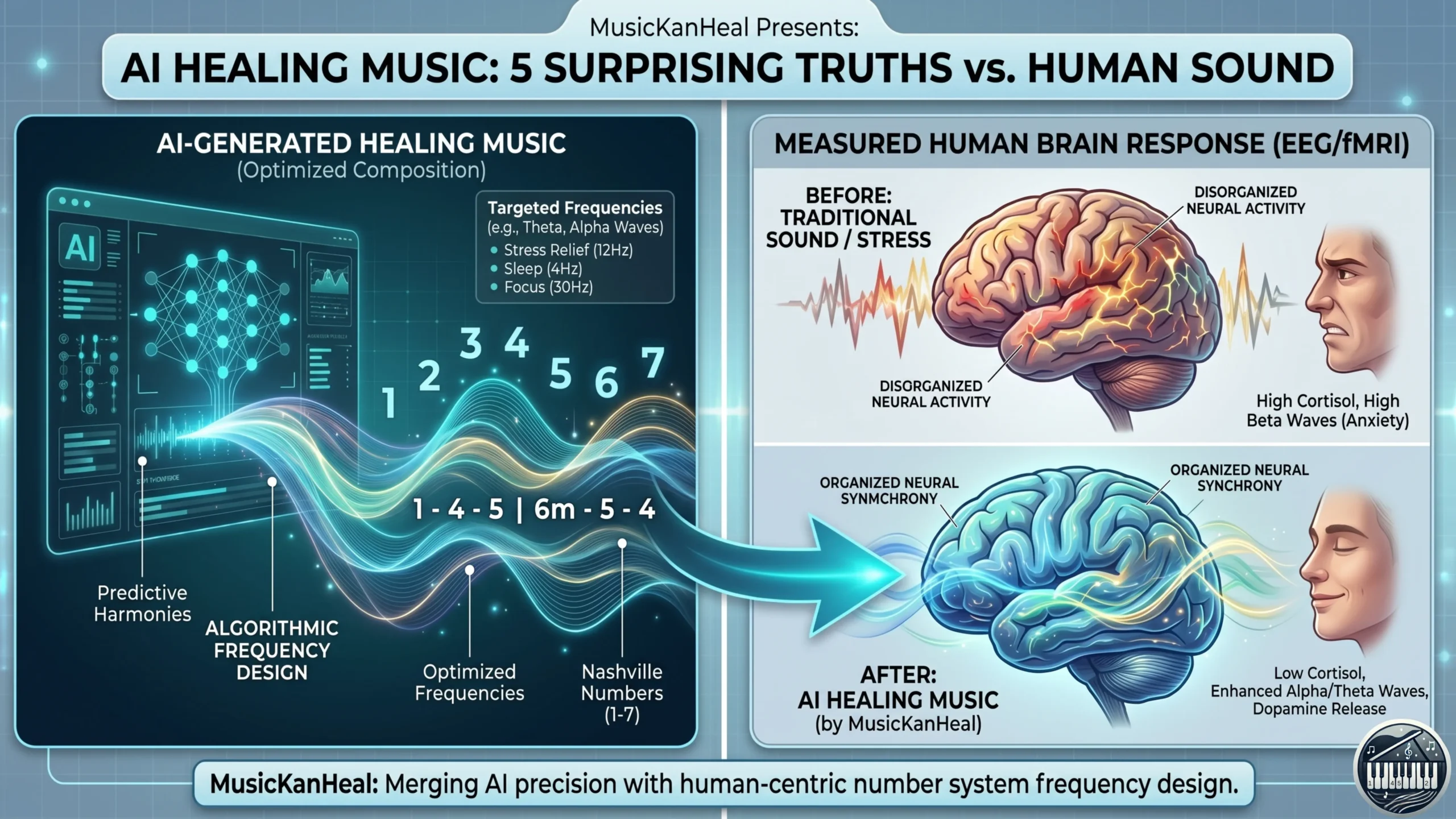
“AI healing music” refers to therapeutic audio tracks—ambient sound, binaural beats, frequency-based compositions, and calming melodies—generated or assembled by artificial intelligence rather than written by a human composer.
It has exploded in popularity for a straightforward reason: cost and access. Traditional music therapy requires a trained practitioner, scheduled sessions, and often a significant out-of-pocket expense. AI tools can generate a 30-minute meditation track in under two minutes, tuned to specific frequencies like 432 Hz or 528 Hz, adapted to a stated mood, and available free or cheaply to anyone with a phone.
Platforms like LUCID Therapeutics have taken this further, building deep learning systems that analyze emotional responses to musical features—essentially trying to figure out which sounds produce which internal states and then generating music engineered to hit those targets.
Whether that constitutes genuine therapeutic sound or just a sophisticated version of background noise depends entirely on what you think therapeutic music is actually doing.
What Does the Science Actually Say About AI Healing Music?
There is legitimate research here, not just product marketing.
Several institutions are running serious studies on the intersection of AI and sound therapy. Stanford’s Center for Computer Research in Music and Acoustics (CCRMA) has explored how AI can create personalized music that adjusts based on listener biometric data—heart rate, brain activity—in real time. The University of Edinburgh’s AI and Sound Research Group has investigated how AI-generated soundscapes influence cognitive and emotional states. UCSF has run clinical studies on AI-powered music therapy for patients with PTSD, depression, and anxiety.
What these studies generally show is that calming music — regardless of origin — does measurable things to the human body. It lowers cortisol, the stress hormone. It slows breathing and heart rate. It activates the limbic system and triggers dopamine release. Music does not care who wrote it. Your nervous system responds to what it hears.
The more specific question — whether AI music does this as well as human-composed music — is harder to settle. The MIT Media Lab research mentioned earlier found that people’s perception of efficacy favored human music, but their measured responses did not line up with that perception. That is a meaningful finding. It suggests that a lot of what people attribute to “human touch” in therapeutic music may be psychological framing rather than acoustic reality.
Where AI Healing Music Falls Short — And It Does Fall Short
The case against AI healing music is not emotional protectionism. There are real, practical limitations.
The first is what researchers call the “soul” problem. In the MIT study, participants consistently described human-composed music using words like “imperfection,” “flow,” and “soul.” They were not being mystical — they were noticing something real. Human musicians make micro-variations in timing, dynamics, and phrasing that AI systems, for all their sophistication, still tend to flatten or over-regularize. For deep emotional work, those micro-variations matter. A slight hesitation before a chord resolves can carry weight that a quantized AI note cannot.
The second limitation is the absence of relationships. Live therapeutic music—played by a certified practitioner in the room with a patient—operates on a channel that recorded audio, AI, or human simply cannot access. A 2024 review from the Music for Healing and Transition Program put it bluntly: while AI-generated therapeutic music might be acceptable in many health circumstances, it is difficult to imagine choosing AI over a real human when someone is truly suffering or actively dying. That is not sentiment. That is an honest assessment of what presence contributes.
A third issue is that AI music tends to be optimized for the generic listener. It can be tuned to frequencies and moods, but it cannot know your particular history with sound—what memories certain chord progressions carry and what instruments feel safe versus activating. A human therapist builds that knowledge over time. The contextual awareness gap between AI music tools and trained practitioners is still wide.
Can AI Healing Music Work for Anxiety, Sleep, and Stress Relief?
Yes — with the right expectations.
For everyday stress management, sleep support, and anxiety reduction, AI healing music is a legitimate and practical tool. If you are not in a clinical setting, if you do not have access to a music therapist, or if you simply need something to decompress after a long day, AI-generated ambient music with calming tempos and layered frequencies can do what it claims to do.
The science on this is reasonably solid. Slow-tempo music and specific frequency ranges have demonstrated effects on cortisol levels and heart rate variability. Whether those tracks were assembled by a human composer or an algorithm is a secondary question for this kind of everyday use.
Where AI healing music is not an appropriate substitute is in clinical music therapy—the treatment of trauma, severe depression, PTSD, dementia, or end-of-life care. These contexts require professional training, ethical judgment, and the kind of real-time human responsiveness that no AI system currently provides.
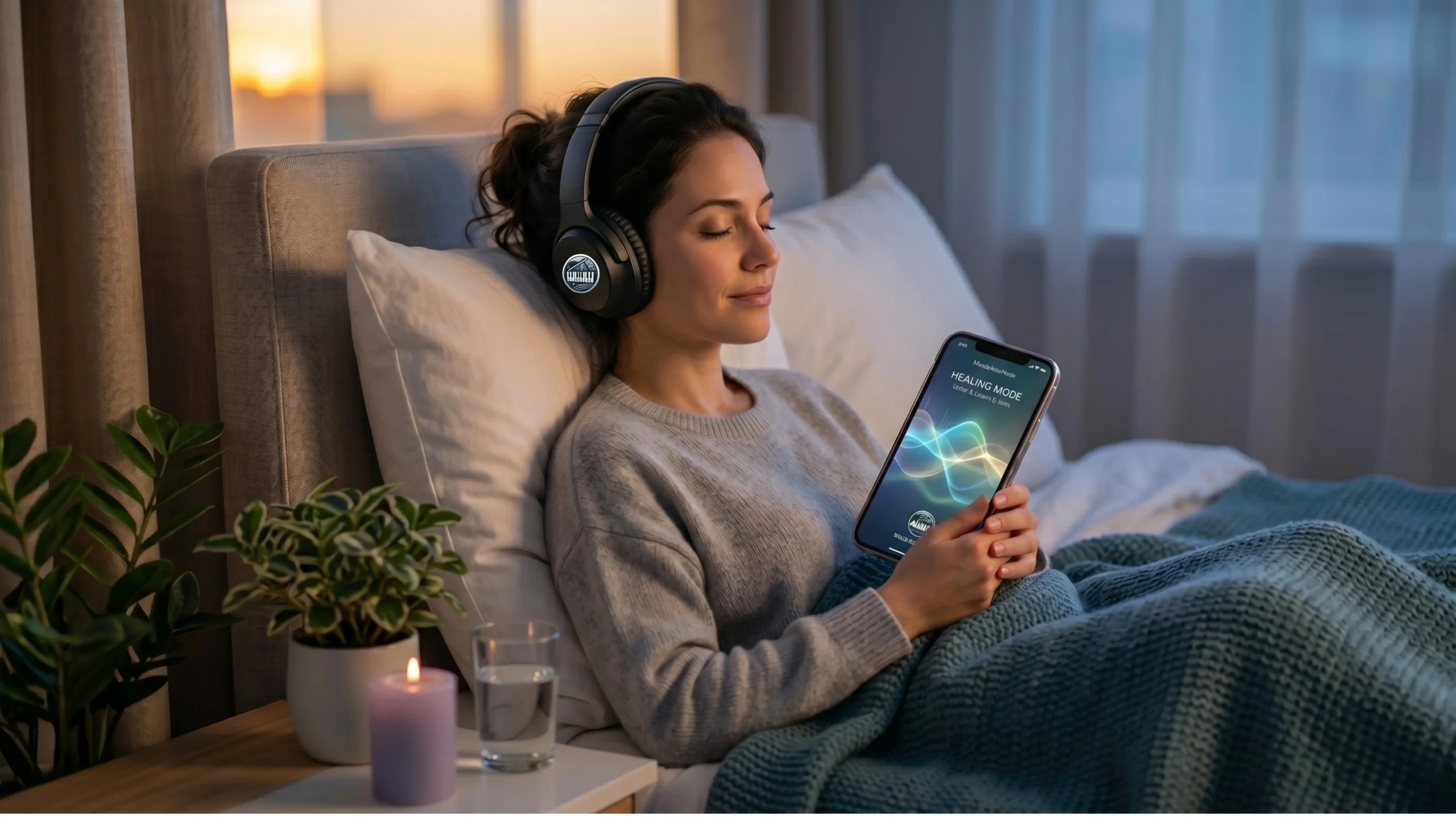
If you are using a healing music app for personal wellness, the calming audio tools available through the Musickanheal healing therapy platform are designed with exactly this use case in mind—not as a clinical replacement, but as a genuine daily tool for stress relief, focus, and sleep.
The Smarter Question: Should You Choose AI or Human-Made Therapeutic Sound?
Wrong question. The better one is: What are you trying to accomplish, and what is your access situation?
If you want deep, clinical therapeutic work for a diagnosed condition, see a professional. If you want music to help you fall asleep faster, reduce baseline anxiety, or find a quiet moment in a loud day, AI healing music is genuinely useful, and the gap between it and human-composed alternatives is small in those contexts.
There is also a third option that most people do not consider: making music yourself. This is not about talent. It is about the documented psychological benefit of active music-making, which consistently outperforms passive listening for mood regulation and stress reduction. Playing even simple patterns on a keyboard activates different brain regions than listening, engages your hands and your attention simultaneously and shifts your nervous system in ways that passively consuming audio—AI or human—does not.
This is the principle behind active healing approaches like the MKH Method, which uses the Nashville Number System to get complete beginners playing music quickly, without years of theoretical study. The goal is not performance. It is engagement—giving your brain a positive task that pulls attention away from anxiety and toward the present moment.
There is strong logic to this. The research on music-making and mental health points in a clear direction: creating music is more healing than consuming it. AI healing music is a useful tool. Making music yourself may be a better one.
Frequently Asked Questions
Is AI healing music as effective as human-composed therapeutic music?
For physiological outcomes like cortisol reduction and heart rate lowering, current research suggests the gap is smaller than most people expect. A 2025 MIT Media Lab study found that while listeners perceived human-composed music as more effective, the actual measured emotional responses were not significantly different. For clinical therapy, however, human practitioners remain superior due to the relational and contextual dimensions of real-time therapeutic music.
What frequencies are most commonly used in AI healing music?
The most widely used are 432 Hz (associated with calm and natural harmony), 528 Hz (claimed to support emotional repair), and binaural beats in the delta and theta ranges for sleep and deep relaxation. These are not magic—they are frequency ranges that align with known neurological responses—but the science behind some specific frequency claims is thinner than marketing suggests.
Can AI healing music help with anxiety and sleep disorders?
It can be a useful support tool for everyday anxiety and sleep difficulty. Slow-tempo music and ambient soundscapes have well-documented calming effects. AI healing music should not, however, be used as a substitute for clinical treatment of diagnosed anxiety disorders or sleep conditions. It works best as a complementary daily wellness practice.
Why do people perceive AI healing music as less authentic?
Research shows listeners associate authenticity with “imperfection, flow, and soul”—qualities they attribute to human musicians. AI-generated music often lacks the micro-variations in timing and dynamics that make human performances feel emotionally alive. This perception gap is real, though it does not always translate into a corresponding difference in measurable therapeutic effect.
How is AI healing music different from traditional sound therapy?
Traditional sound therapy involves a practitioner using live instruments—singing bowls, voice, and strings—in direct response to a patient’s state. AI healing music is pregenerated or algorithmically adapted audio that is consumed passively. The relational element of traditional sound therapy, the presence of a trained human responding in real time, is absent in AI-generated approaches. For personal wellness use, that distinction may matter less; in clinical settings, it matters significantly.
All rights are reserved. Copyright 2026 MusicKanHeal | musickanheal.com