Social Music Mental Health
A hospital just co-authored a peer-reviewed study with a Grammy Award–winning musician and called it a prescription. That sentence alone tells you how seriously the medical world is starting to take this.
In March 2026, researchers from the Mount Sinai Health System published a landmark paper in Voices: A World Forum for Music Therapy. The study, co-authored by Dr. Joanne Loewy of the Louis Armstrong Center for Music and Medicine and musician Jon Batiste, formally defined “social music” as a health intervention—something that can be prescribed like medicine to fight depression and social isolation.
For anyone using an app like MusicKanHeal to explore music therapy and healing, this research is about as relevant as it gets. It validates what many musicians and worship leaders have known intuitively for years: playing music with others, and for others, does something to the brain that passively streaming a playlist simply cannot replicate.
This article breaks down the Mount Sinai findings, explains exactly how social music mental health benefits work, and tells you what it actually means for your day-to-day practice.
What Is “Social Music” and Why Did Mount Sinai Decide to Study It?
Before this research, “social music” was a term Jon Batiste had been developing through his own performance philosophy—the idea that music isn’t just entertainment you receive, but a participatory act that builds connection between people.
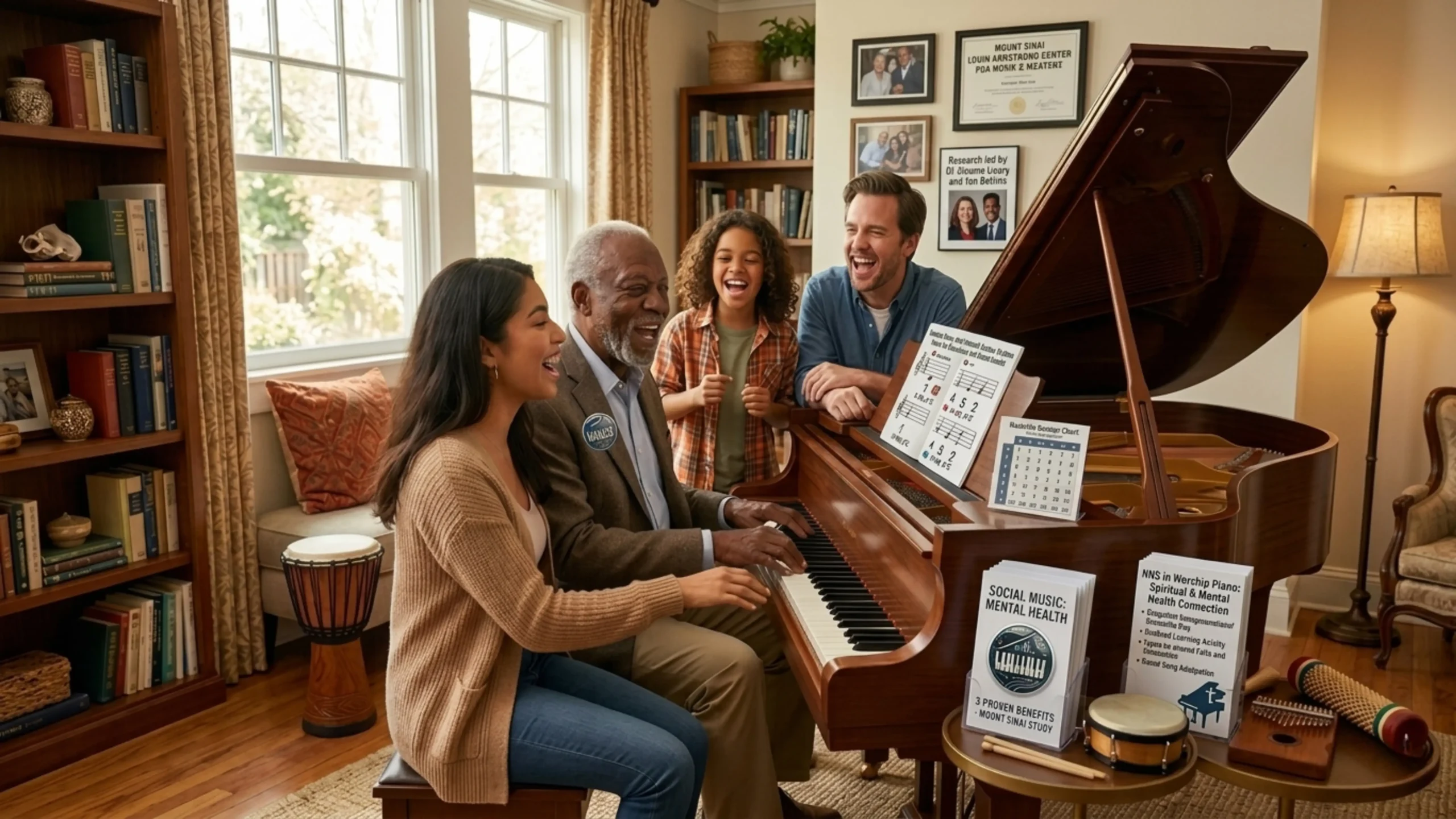
Dr. Loewy’s team took that concept and gave it a clinical framework. Their paper defines social music as participatory, culturally rooted musical experiences that include call and response, shared movement, and interactive performance. The key distinction from regular music listening? It requires engagement—you’re not an audience member, you’re a participant.
The reason Mount Sinai studied it comes down to one uncomfortable trend: despite all the technology that’s supposed to keep us connected, people are more isolated than ever. Dr. Loewy put it plainly in the press release: while technology has transformed how we connect, many people now have limited opportunities for meaningful social engagement—and that lack of connection damages health.
The study was built on the AMEND initiative (Assessment of Music Experiences in Navigating Depression), funded by the National Endowment for the Arts. AMEND examines how individual, group, and blended music experiences impact people with depression or those at elevated risk. What it found across multiple cohorts—adolescents, college students, and older adults—is that music used socially produces measurably better outcomes than music used in isolation.
In parts of Europe, music is already written into social prescribing frameworks, where GPs refer patients to community arts programs instead of (or alongside) medication. This study shows the United States beginning to catch up.
What the Mount Sinai Research Actually Found About Social Music Mental Health
The study doesn’t claim music cures depression. It does something more careful and arguably more useful: it defines how and why social music mental health outcomes differ from passive listening.
According to the research, the key mechanisms are:
- Social connectedness — participating in shared music creates bonds that reduce the neurological impact of loneliness
- Collective release—call-and-response structures and group rhythm allow emotional expression that doesn’t require words
- Cultural identity — music that is culturally rooted activates a sense of belonging that generic relaxation audio does not
The AMEND initiative measured outcomes including mood, resilience, sleep quality, and quality of life. Across vulnerable populations, music-based group interventions consistently outperformed control conditions on these measures.
A separate meta-analysis of 55 randomized controlled trials, published in PLOS ONE, found that music-based interventions — particularly those with longer sessions and group formats — showed significant improvement in depression scores compared to standard care. The Mount Sinai framework builds on that body of evidence.
What makes the 2026 paper distinct is its argument that social music can be a scalable, non-medical intervention—one that doesn’t require a therapist in every room. A church worship session, a community sing-along, or even a structured music learning app with shared repertoire can carry real therapeutic weight if it involves participation and connection.
How Does Social Music Help Depression? The Neuroscience
This is where “social music mental health” stops being a nice idea and starts being biology.
When you participate in music—playing an instrument, singing, clapping, playing call and response—your brain does several things simultaneously:
- Dopamine release. Music that you engage with actively triggers the nucleus accumbens, the brain’s reward center. Research confirms that this dopamine release is stronger during active participation than passive listening.
- Oxytocin. Synchronized group music-making — where people are moving and playing together — produces oxytocin, sometimes called the “bonding hormone.” This is the same neurochemical released during social bonding, and it directly counteracts the effects of social isolation on the body.
- Cortisol reduction. Multiple studies show that group music participation reduces cortisol (the primary stress hormone) more effectively than solo listening.
- Neocortex regulation. The rhythmic and repetitive nature of music engages the neocortex, which calms the nervous system and reduces the kind of ruminative, circular thinking that characterizes depression.
The reason social music matters — not just any music — is that it adds the bonding layer on top of the neurological layer. You’re getting the dopamine hit and the oxytocin hit at the same time. That combination is what makes the difference for people with depression, who often struggle with both reward-pathway deficits and social withdrawal.
Is Passive Listening Enough, or Do You Need to Play?
Here’s where the research gets uncomfortable for the streaming-playlist-as-self-care crowd.
Passive listening—putting on lo-fi beats while you work or playing a calming playlist before bed—does have documented benefits. It can lower blood pressure, reduce perceived pain, and temporarily improve mood. This is real and not nothing.
But the Mount Sinai research is clear that passive listening doesn’t generate the social connectedness effects that make music a legitimate mental health prescription. You need participation. You need to produce sound, not just receive it.
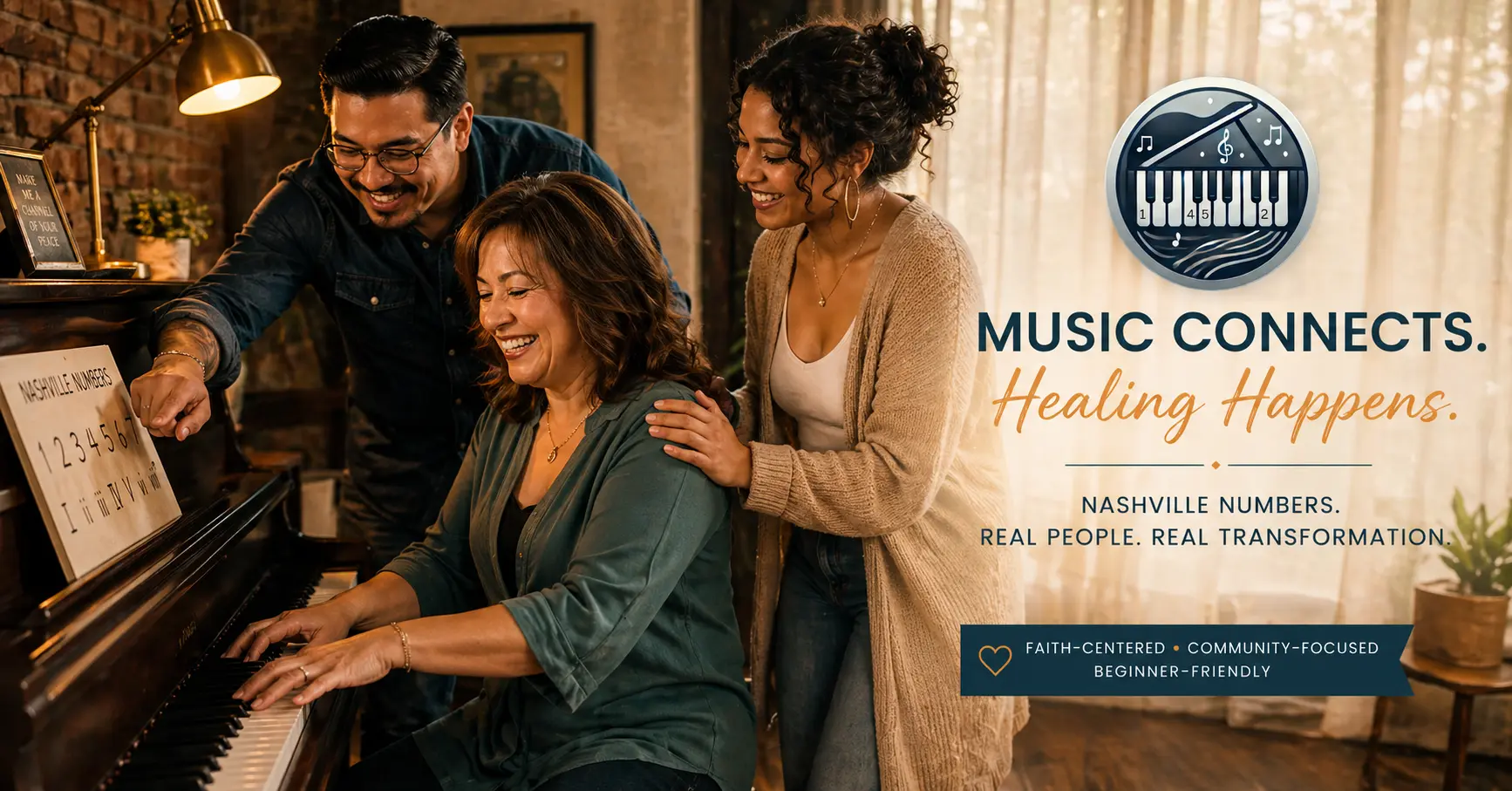
This is good news for people learning piano through the MKH Method (Nashville Number System). The NNS approach is built around playing by ear in groups—whether that’s a worship band, a small ensemble, or even a study session with a friend over FaceTime. That’s not coincidentally therapeutic. That structure is precisely what the social music model describes.
It’s also good news for beginners who feel like they need to be proficient before music can help them. The research doesn’t require polished performance. Call and response, shared rhythm, playing simple chord progressions alongside other people — these carry the same neurological weight as a concert-level performance, because the benefit comes from the connection, not the technical execution.
5 Ways to Practice Social Music Mental Health in Your Daily Routine
Given the research, here’s what actually moves the needle:
- 1. Play for someone, not just by yourself. Even a 10-minute session where you play piano while a family member listens—and responds—activates the social music dynamic. The audience doesn’t need to be large. It needs to be present.
- 2. Join or build a shared practice context. Worship bands, community choirs, online jam sessions — any environment where you’re making music alongside others qualifies. The AMEND research specifically highlighted community-based music programs as the highest-impact setting.
- 3. Use call-and-response structures. These don’t require advanced skill. A simple repeated chord pattern where one player responds to another’s phrasing is enough. The back-and-forth is the mechanism, not the complexity of what’s being played.
- 4. Choose culturally meaningful music. The research explicitly highlights cultural resonance as a factor in social music’s therapeutic effect. Playing gospel, worship music, or music from your heritage works better than playing random repertoire you have no connection to.
- 5. Make music at regular intervals, not just when you’re already feeling good. This is the hardest one. People tend to pick up instruments when they’re in a good mood. The evidence says the intervention works best as a consistent practice, including on the days when motivation is lowest.
If you want to build this kind of practice without the barrier of sheet music, the MusicKanHeal app’s number system approach is built for exactly this use case—getting you playing real music in real social contexts without years of theory prerequisites. Learn more about building your MusicKanHeal Piano Skills to start practicing.
Frequently Asked Questions
What exactly is social music and mental health as defined by the Mount Sinai study?
The Mount Sinai paper defines social music mental health as the use of participatory, culturally rooted shared musical experiences as a “social prescription”—a non-medical intervention to improve health outcomes, particularly for people experiencing or at risk for depression. It’s distinct from music therapy in that it doesn’t require a licensed therapist; structured community music participation qualifies.
Can social music mental health benefits replace antidepressants?
No — and the research doesn’t claim otherwise. The Mount Sinai framework positions social music as a complement to medical care, not a replacement. It’s classified as a social prescription, which sits alongside (not instead of) medication or psychotherapy. People with clinical depression should always work with a qualified healthcare provider.
Does playing piano alone count as social music if I’m using a music app?
Solo practice without any social component doesn’t fully activate the mechanisms the research identifies. However, apps that connect you to a shared musical tradition—like worship or gospel repertoire—create cultural resonance, which is one of the three key mechanisms. For full social music benefits, pair solo practice with at least some group context, even informally.
How is social prescribing different from traditional music therapy?
Music therapy requires a credentialed therapist and typically involves a structured clinical relationship. Social prescribing—which is where social music sits — is a non-clinical referral to community-based activities. Social music can be delivered through a church, a community choir, a structured music learning program, or even a consistent peer group, without clinical oversight. This makes it far more scalable.
Why did Jon Batiste co-author an academic paper on social music and mental health?
Jon Batiste originally developed the concept of social music as a performance philosophy rooted in participatory, community-centered music-making—something he describes as central to traditions in jazz, gospel, and African diasporic music. Dr. Loewy recognized this framework aligned with clinical evidence and brought him on as a co-author to formalize the model. The collaboration bridges practice and research in a way that gives the model cultural depth it wouldn’t have from either party alone.
What This Research Means for You
The Mount Sinai social music mental health paper isn’t a wellness trend. It’s a peer-reviewed clinical framework, funded by the National Endowment for the Arts, built on years of AMEND trial data across vulnerable populations. When a major academic medical system publishes that shared musical participation can function as a prescription-level mental health intervention, that’s worth paying attention to.
The implication isn’t that you need to book music therapy sessions or join a professional choir. It’s that the music you’re already interested in—playing piano, leading worship, jamming with friends—has documented neurological and psychological value specifically because it connects you to other people.
All rights are reserved. Copyright 2026 MusicKanHeal | musickanheal.com