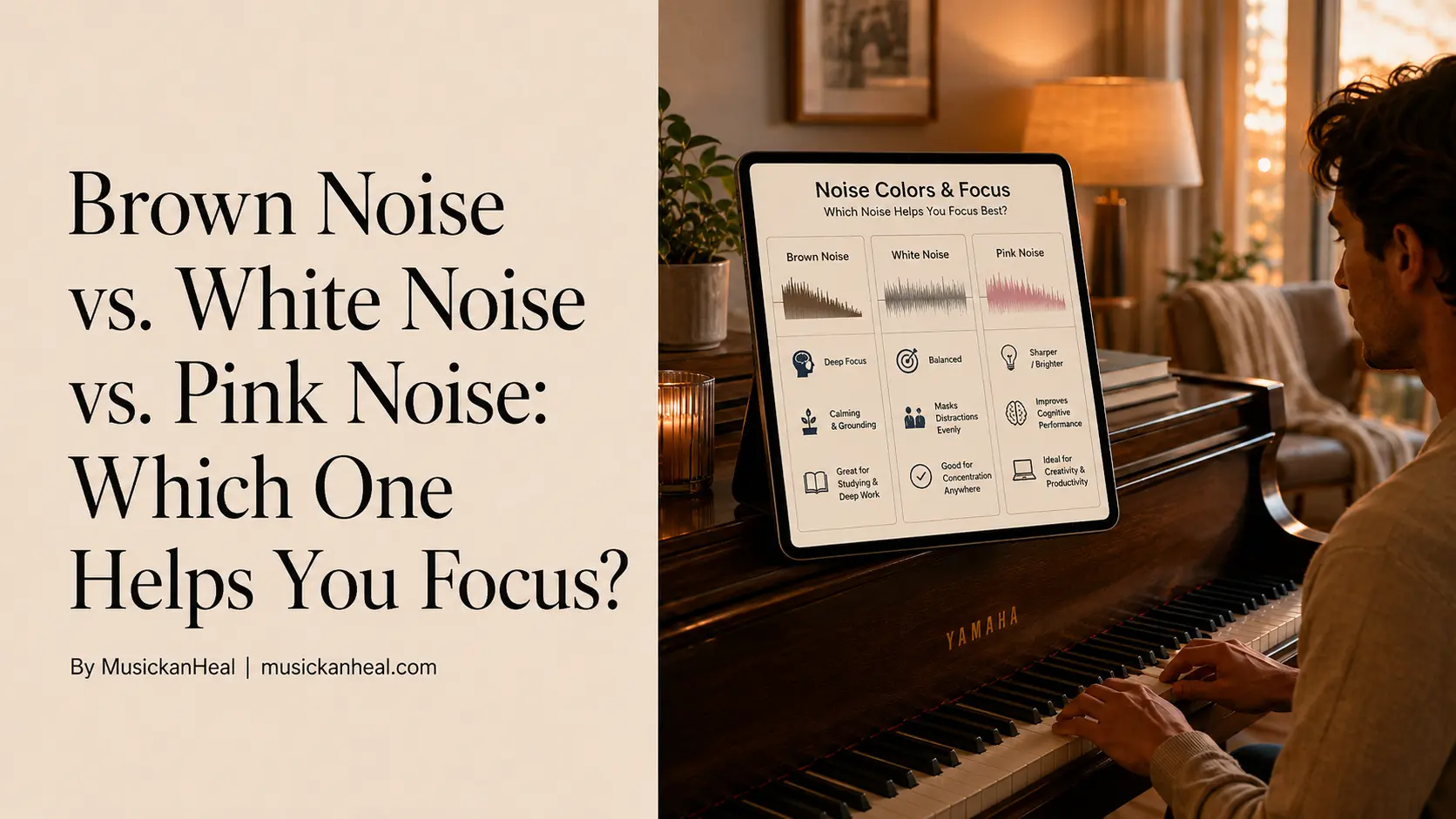
Brown Noise vs. White Noise vs. Pink Noise: Which One Helps You Focus?
Brown noise has racked up hundreds of millions of views on TikTok, mostly from people filming their own reaction the first time they play it: eyes wide, jaw dropped, some version of “Where did my racing thoughts go?” White noise and pink noise get less hype but have quietly built up real research behind them.
Here’s the part most of that content skips: the noise with the most viral moments has the least evidence, and the noise with actual peer-reviewed backing only seems to help a specific group of brains, not everyone scrolling past the videos.
This piece goes through what a 2024 meta-analysis, the largest review of this research to date, actually found, why brown noise has zero qualifying studies despite the hype, and how to figure out which one is actually worth trying for you specifically.
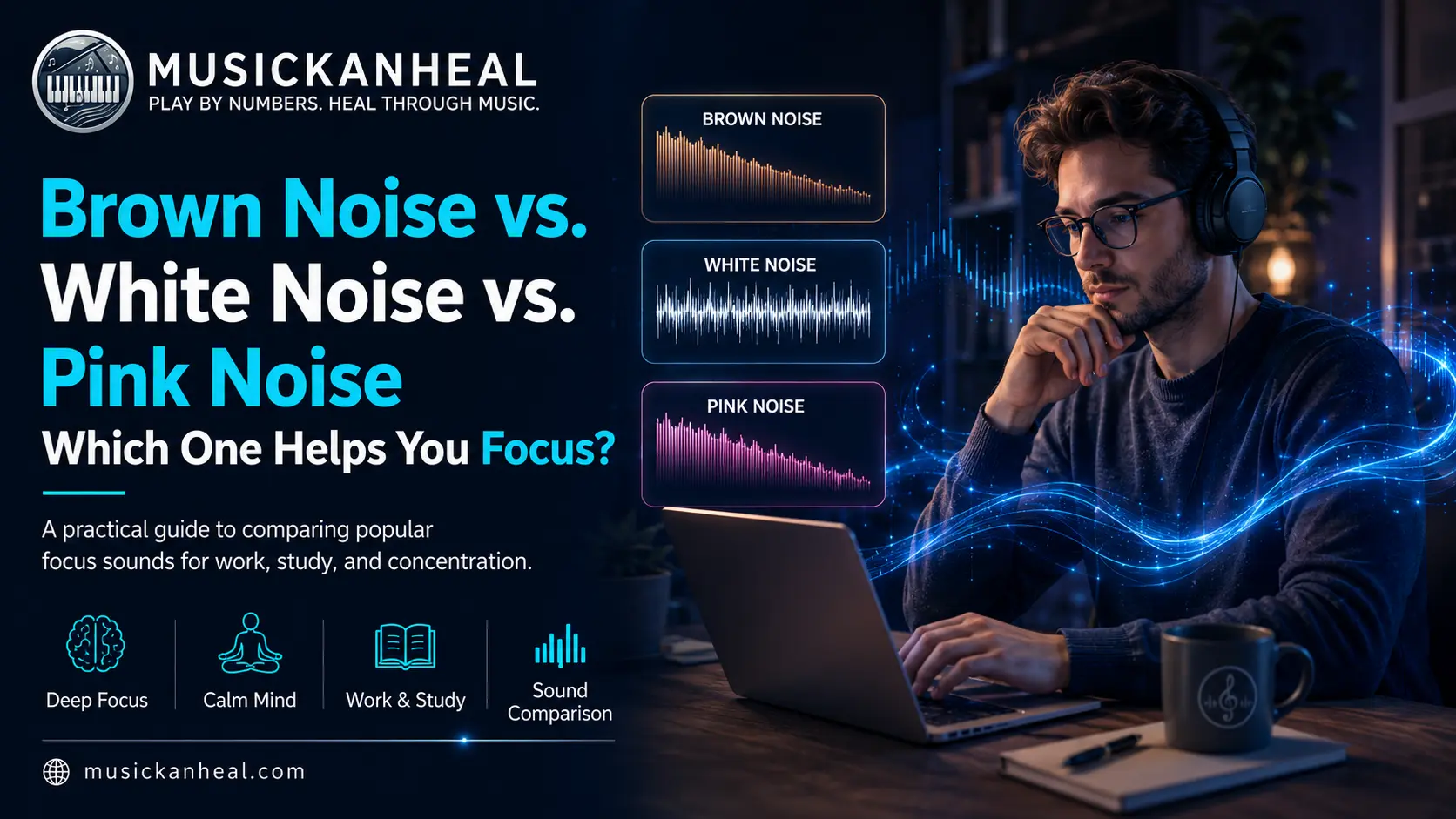
What’s the Difference Between White, Pink, and Brown Noise?
All three contain a full spread of audible frequencies; the difference is which frequencies are louder. White noise plays every frequency at equal intensity, which is why it sounds like TV static or a fan on high. It’s the harshest and most “hissy” of the three.
Pink noise reduces the higher frequencies, giving it more weight in the lows and mids. People usually describe it as steady rainfall or wind through trees, a rounder, less grating version of white noise.
Brown noise (also called red noise, after the botanist Robert Brown, nothing to do with the color) pushes further in that direction, cutting high frequencies even more and emphasizing the deep end. It sounds like a low rumble, a waterfall from a distance, or a plane cabin at cruising altitude.
None of these are musical tones or melodies. They’re all technically random signals, just shaped differently across the frequency spectrum, which is why people describe them with weather and nature comparisons instead of musical ones. A radio tuned to static is the clearest real-world example of white noise; a heavy air conditioner or box fan often leans closer to pink; a low, distant thunderstorm is closer to brown.
There are other, less common “colors” too, blue, violet, gray, and green, each shifting the emphasis to a different part of the spectrum, but white, pink, and brown are the three that show up in the actual attention and focus research and the three most people mean when they ask which one to use.
What the Research Actually Shows About Noise and Focus
The most rigorous evidence here is a 2024 systematic review and meta-analysis from Oregon Health & Science University, published in the Journal of the American Academy of Child & Adolescent Psychiatry. Researchers pooled 13 studies covering 335 participants and found that white and pink noise produced a small but statistically significant improvement in task performance for people with ADHD or elevated ADHD symptoms.
Here’s the detail almost no article covering this mentions: in participants without ADHD, the same white and pink noise produced a negative effect on performance.
“Which noise helps you focus” doesn’t have one answer; it depends on the brain doing the focusing.
And brown noise, the one with the viral moment, wasn’t in the review at all. The researchers searched the entire published literature and found zero studies on brown noise specifically that met their criteria for inclusion. Every claim you’ve seen about brown noise and ADHD is extrapolating from the white and pink noise research, not from actual data on brown noise itself.
Why Brown Noise Has Zero Studies Despite Going Viral
Brown noise’s popularity is a recent, internet-driven phenomenon, not something researchers have had years to catch up on and study properly. The #brownnoise tag has accumulated well over 100 million views, largely built on people’s real, first-person reactions to trying it.
That doesn’t mean brown noise does nothing. It means the specific claim “brown noise helps ADHD focus” is currently an assumption borrowed from white and pink noise research, not a finding that’s actually been tested. The deeper, bassier sound might work through the same general mechanism as the other two, or it might not, and right now nobody has run the study to know for sure.
Why It Only Seems to Work for ADHD Brains
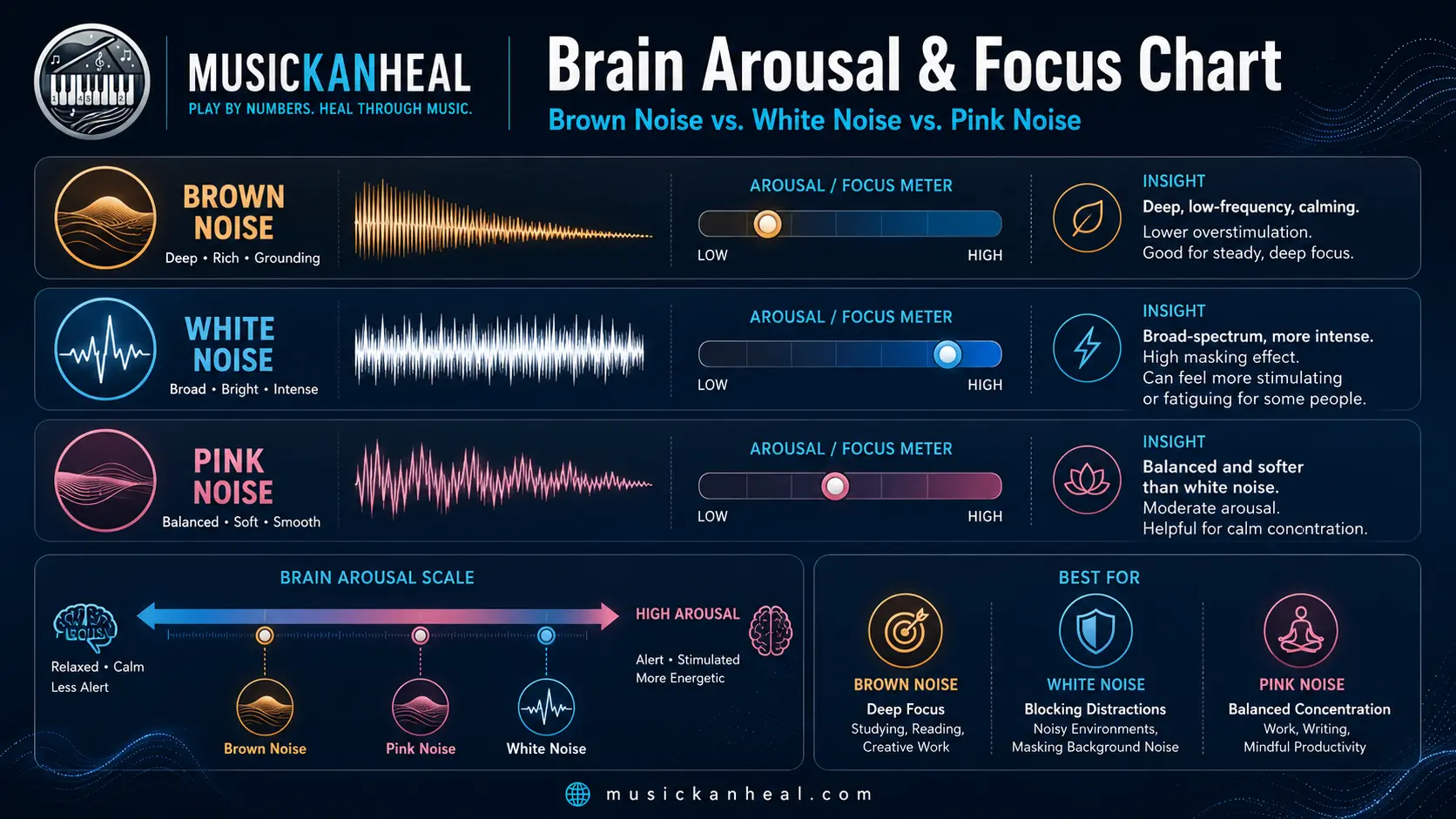
The leading explanation is called the Moderate Brain Arousal model, first proposed by researchers Sikström and Söderlund in 2007. It ties back to dopamine: ADHD is associated with lower baseline dopamine activity, which the model links to an understimulated, or “hypo-aroused,” brain state.
Through a mechanism called stochastic resonance, adding a moderate amount of random background noise can push an understimulated brain up toward a more optimal level of arousal, which is why people with ADHD showed measurable improvement in the meta-analysis. A brain that’s already at its optimal arousal level doesn’t need that push, which is why the same noise nudges non-ADHD performance in the other direction, toward overstimulation.
This is also why the effect is described as small in the research, not universal or dramatic. It’s a real, mechanistically explained shift in arousal level for a specific kind of brain, not a productivity hack that works the same way for everyone.
The same brain-arousal lens is worth applying to other frequency-based sound claims you’ve probably seen make bigger promises with less evidence: see how it holds up in Binaural Beats vs Solfeggio Frequencies and 528 Hz Frequency: 5 Claims Tested Against Real Science.
So Which Noise Actually Helps You Focus?
If you have ADHD or suspect you have significant attention difficulties, white or pink noise has the strongest evidence behind it specifically, not brown noise, even though brown noise is the one all over your “for you” page. Pink noise is generally the gentler starting point if white noise’s static feels too harsh.
If you don’t have ADHD, the meta-analysis suggests background noise is more likely to hurt your focus than help it, at least for the kind of task-based attention work the studies measured. That doesn’t mean you’ll never enjoy background sound; plenty of people work better with some ambient noise for reasons unrelated to attention, like blocking a noisy office, but the ADHD-specific attention benefit doesn’t transfer to you the same way.
If brown noise is what you already reach for and it works for you, nothing here says stop. It just means you’re running an experiment on yourself rather than following an established finding, which is a fair thing to know before recommending it to someone else as a proven fix.
How to Actually Use Background Noise for Focus
If any of this has you willing to test it on yourself rather than take a video’s word for it, here’s how to run that test without wasting two weeks second-guessing whether it’s working:
Match the Noise to Your Brain
If you have ADHD, start with white or pink noise, since that’s what the actual research covers, and treat brown noise as an untested variation worth trying, not a substitute with its own evidence.
Keep the Volume Moderate
The stochastic resonance mechanism depends on a moderate amount of noise; cranking the volume doesn’t mean more benefit, it more likely just adds strain.
Use It for the Specific Task
The studies measured noise during attention-demanding tasks, not as constant background throughout a workday, so there’s no evidence more exposure compounds the benefit.
Test It Honestly
If you don’t have ADHD, try a focused task with and without background noise and compare how you actually perform, not just how relaxed you feel, since the research found those can move in opposite directions.
Give It a Fair Trial
Feeling like “this one isn’t working” after 90 seconds isn’t a real test of whether a noise color helps your specific attention pattern.
Want a done-for-you option instead of assembling your own playlist? The Healing Music App is one at-home way to run this test without hunting down individual tracks yourself.
The Bottom Line
Brown noise doesn’t have the research it’s famous for, at least not yet. White and pink noise do, but the benefit is narrower than the internet’s framing suggests, a small, real effect specific to ADHD or elevated ADHD-like attention traits, not a universal focus button. If you’re neurotypical, the same noise that helps someone with ADHD concentrate may be quietly working against you.
None of this means background noise is a scam, and it doesn’t mean brown noise is doing nothing for the people who swear by it. It means the specific, evidence-backed claim that a certain kind of noise measurably improves focus currently applies to a narrower group and a narrower set of noise colors than the trend suggests. That’s a useful thing to know before you build a whole productivity routine around a sound because a video told you to.
Frequently Asked Questions About Brown Noise, White Noise, and Pink Noise
Does brown noise actually help you focus if you don’t have ADHD?
There’s no direct research on brown noise specifically for anyone. The closest available evidence, on white and pink noise, found a small negative effect on task performance for people without ADHD, so there’s reason for caution rather than assuming brown noise will help.
What does the research say about white noise vs pink noise for focus?
A 2024 meta-analysis of 13 studies found both white and pink noise produced a small, statistically significant improvement in task performance for people with ADHD or elevated ADHD symptoms, with no meaningful difference found between the two noise types specifically.
Why is there no research on brown noise specifically?
Brown noise’s popularity is largely a recent social media phenomenon, and researchers haven’t yet run studies isolating it the way they have for white and pink noise. The 2024 meta-analysis searched the full published literature and found zero qualifying brown noise studies to include.
Can background noise for focus actually make things worse?
Yes, for people without ADHD. The same 2024 meta-analysis found white and pink noise slightly reduced task performance in participants without ADHD or elevated attention symptoms, which is the opposite of the effect seen in the ADHD group.
What volume should I play background noise at for focus?
Keep it moderate rather than loud. The theoretical mechanism behind the benefit, stochastic resonance, depends on a moderate amount of added noise pushing an understimulated brain toward optimal arousal, not on maximum volume or intensity.
All rights are reserved. Copyright 2026 MusicKanHeal | musickanheal.com