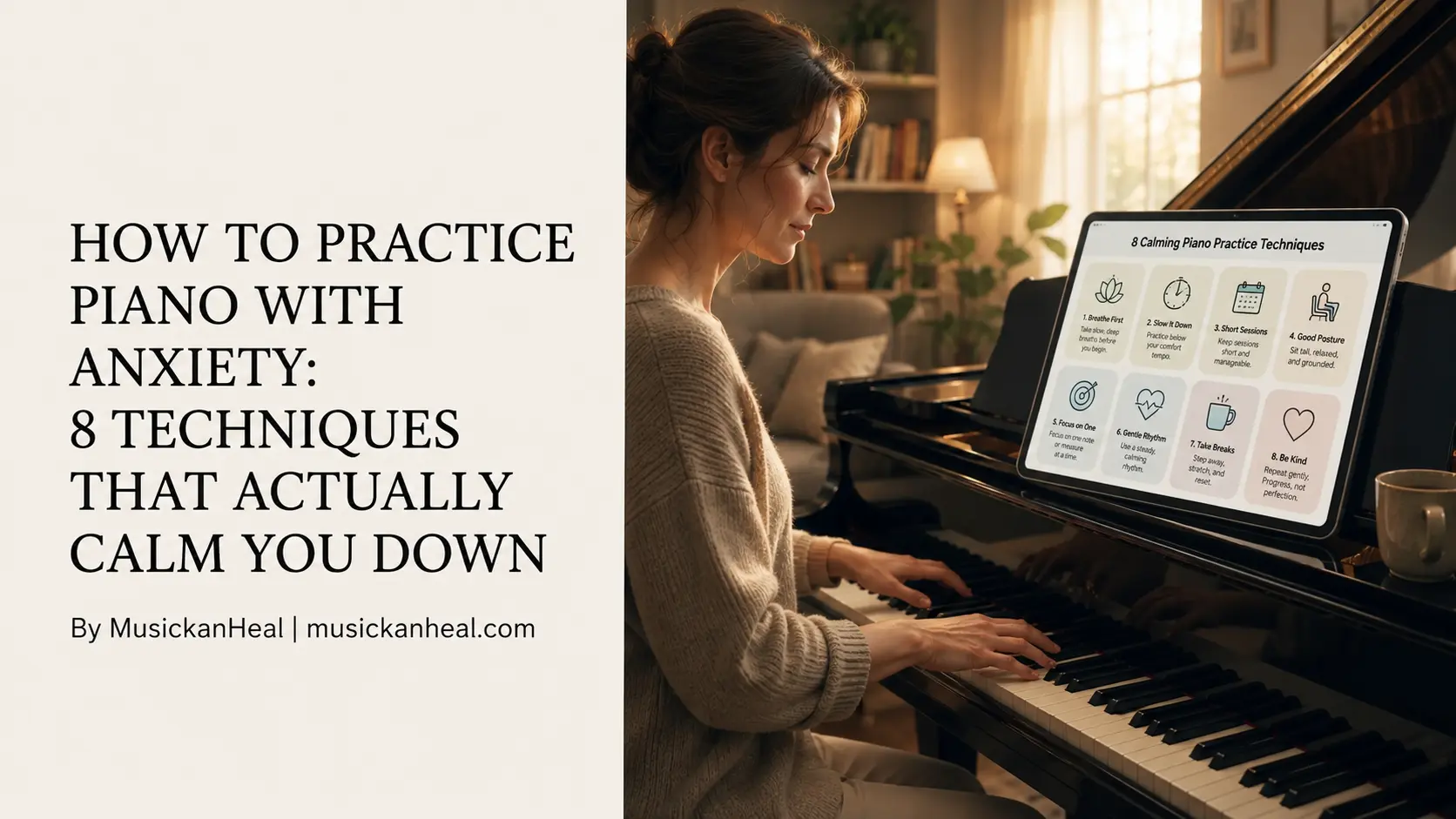
How to Practice Piano With Anxiety: 8 Techniques That Actually Calm You Down
If you have anxiety, sitting down to practice the piano can feel like walking into a room where you already know something’s about to go wrong.
The anticipation of making mistakes. The inner critic that starts before your hands are even on the keys. The frustration of not sounding the way you hear it in your head. For people managing anxiety, piano practice can quietly turn into another arena where the brain manufactures pressure out of something that should feel good.
Here’s what most piano guides get wrong: they treat anxiety as something that happens before a recital. But if you live with generalized anxiety, it follows you into the practice room too. The techniques for calming nerves before a public performance are different from what you need when it’s just you, alone at home, trying to get through 20 minutes without your brain dismantling the session.
This guide is specifically for that situation. These are techniques for how to practice piano with anxiety that make the session itself an active part of your mental health practice — not a source of additional pressure.
Why Piano Practice Feels Hard When You Have Anxiety
Anxiety thrives on unpredictability, perfectionism, and the fear of being evaluated. Piano practice — particularly early on — involves all three.
You don’t know what your hands will do. You make mistakes constantly. And even when no one is watching, anxiety creates an imaginary audience: an internal critic who evaluates every wrong note as if it means something about you.
Research on anxiety in piano learning found that 72% of piano students experience heightened anxiety tied to their practice, with symptoms ranging from hand tension to mental blankness. The research points to something important: this anxiety usually stems from the fear of judgment and disappointment rather than from the act of playing itself. The problem isn’t the piano. It’s the expectation structure the anxious brain brings to it.
Understanding that changes how you approach the fix. You’re not trying to become fearless. You’re trying to practice in a way that gives anxiety fewer hooks to grab.
8 Techniques for How to Practice Piano With Anxiety
Start With Breathing, Not Playing
Before your hands touch the keys, your nervous system needs a signal that this is not a threat. One minute of structured breathing accomplishes this physiologically — not metaphorically. The 4-4-6 pattern works well: inhale for 4 counts, hold for 4, exhale for 6. The extended exhale specifically activates the parasympathetic nervous system — your body’s “rest and digest” mode, the direct counter to the fight-or-flight response that anxiety triggers.
A 2025 study on mindfulness practices and music performance anxiety found that musicians who integrated brief pre-session breathing practices reported significantly lower anxiety and improved focus during performance. Make this non-negotiable. It takes 60 seconds. Do it before every session.
Set a Timer, Not a Goal
“I’ll practice until I can get through this piece” is an anxiety trap. There’s no defined endpoint. Progress is indefinite. The brain stays on alert because the session never has clear permission to end. Replace outcome goals with time limits. “I’m practicing for 20 minutes” is a contained, manageable commitment your nervous system can settle into. Anxiety intensifies when the brain doesn’t know when the threat ends — a timer removes that uncertainty entirely.
For most adults managing anxiety, 15 to 25 minutes is the productive session range. Short, consistent sessions build muscle memory and neural pathways faster than marathon sessions driven by frustration. This isn’t a concession to anxiety — it’s the more efficient approach regardless of your mental health.
Begin With Music You Already Know and Love
Starting cold on a difficult piece asks your nervous system to tolerate unpredictability from the very first moment. Open every session by playing something you already know — preferably something with personal meaning. This does two things: physically, it warms your hands and coordinates the hands-brain circuit. Psychologically, it reminds your brain that you can play — which is something anxiety works hard to make you forget.
Research on piano and stress reduction consistently shows the strongest neurochemical response — dopamine release, cortisol reduction, and the shift toward calm focus — occurs when the music has genuine emotional resonance for the player. The piece doesn’t need to be technically impressive. It needs to be yours.
Play Slower Than You Think You Need To
Anxiety pushes everything faster. This shows up as rushing, hand and shoulder tension, and the urge to get through a passage rather than inhabit it. When you slow down 30 to 40 percent below what feels necessary, mistakes stop feeling like failures and start feeling like information. You can actually hear what your hands are doing, and the inner critic quiets because there’s nothing urgent to catastrophize.
A study by Toyoshima et al. comparing piano practice against other creative activities found that piano reduced salivary stress markers more significantly than calligraphy or clay modeling — the mechanism was partly the rhythmic, controlled nature of the engagement, not speed or complexity. Set a metronome to 60–70% of your target tempo and keep it there.
Scan Your Body Before You Touch the Keys
Most people with anxiety carry physical tension before they even sit down — shoulders raised, jaw set, hands already gripping. When that tension transfers to the piano, it compromises technique and makes mistakes more likely, which feeds directly back into the anxiety loop. A 60-second body scan before playing interrupts this cycle. Start at the top of your head and work down: jaw, neck, shoulders, wrists, hands. Consciously release any tightness before you begin.
During the session, if tension returns — particularly in the wrists and forearms — stop. Set your hands in your lap, release, breathe, then continue. Physical tension during practice is both a signal that anxiety is climbing and a direct contributor to the technical errors that make anxiety worse. Catching it early is one of the most effective techniques that almost no piano guide mentions.
Remove the Audience — Even the Imaginary One
Anxiety during private piano practice is usually performance anxiety in disguise. The internal voice that mutters “that was sloppy” or “you’ve been on this for two weeks and still can’t get it” is functioning as a critical audience, even when you’re completely alone. Practice sessions are not performances. This distinction needs to be enforced deliberately because anxiety doesn’t make it naturally.
One practical method: close your eyes and play. It removes the visual feedback loop that keeps the critical brain engaged and forces a different kind of listening — less evaluative, more sensory. Ask “What does this feel like?” rather than “How does this sound to someone else?” That shift moves the session out of evaluation mode and into experience mode. Only one of those is useful for learning.
Reframe Mistakes as Information, Not Failure
When a mistake gets filed as failure, the emotional response — shame, frustration, deflation — interrupts the session and consumes the focus you need to keep playing. When you train your brain to file it as data, the same event produces curiosity instead of distress. Try replacing “I keep messing that up” with “that passage needs isolated work.” Then do the work: play just those two bars, slowly, five times. This converts anxiety from an emotional spiral into a problem-solving routine.
Keeping a brief practice journal — even two or three sentences noting what worked and what needs attention — gives you a written record of incremental progress. Anxiety compresses time and makes three weeks of improvement feel like standing still. Written evidence is one of the most effective counters to that distortion.
End Every Session Intentionally
Most anxious practice sessions end badly — you stop when frustration peaks, or when exhaustion wins the standoff. That means the last emotional state you associate with practicing is frustration or relief that it’s over. End every session deliberately on something you can play well. The emotional tone of how a session ends shapes how much internal resistance you feel to starting the next one.
Set the last two minutes of your timer aside. Use them to play something familiar all the way through without stopping. Then close the session. It’s a small adjustment with a compounding effect across weeks and months of practice.
Does Your Practice Environment Affect Anxiety?
More than most people expect.
Anxiety is sensitive to environmental cues. A cluttered, brightly lit, high-stimulus room keeps the nervous system slightly elevated before you’ve played a single note. A quieter, lower-stimulus space — even just your living room with notifications silenced and the lights turned down — signals safety to the brain.
You don’t need a dedicated practice room. You need a consistent context. Practicing at the same time, in the same place, with the same pre-session routine (breathing, body scan) conditions the brain to associate that context with calm engagement rather than evaluation. Over time, simply sitting at the piano becomes a nervous system cue for downregulation rather than pressure.
If guided healing audio is part of your mental wellness routine, a few minutes of that before active practice can serve the same priming function — moving your baseline state toward calm before you begin playing.
How Long Should You Practice Piano When Anxiety Is High?
On hard days, less is more — but less does not mean zero.
Ten minutes of deliberate, present practice on a high-anxiety day is worth more than 45 minutes of self-critical repetition on a good one. The goal on difficult days is to maintain the habit and the positive nervous system association between piano and calm. Technical progress is secondary. Showing up is the task.
The mental health benefits of learning piano accumulate through consistent engagement over time, not through session length. Short, regular practice is where the neurological and psychological benefits compound.
On days when even 10 minutes feels out of reach, consider shifting to the listening or exploratory side of practice. The Nashville Number System approach — learning by feel and by ear, rather than through notation-heavy drilling — makes sessions more accessible on difficult days without losing momentum entirely.
Frequently Asked Questions About Practicing Piano With Anxiety
Is it normal to feel anxious when practicing piano?
Yes, and it’s more common than most people admit. Anxiety during private practice is usually a combination of perfectionism, fear of slow progress, and the habit of self-evaluation rather than self-observation. Recognizing this is useful because it removes the additional anxiety about feeling anxious — which is where many people get stuck in a loop.
How to practice piano with anxiety without getting frustrated?
Structure reduces frustration more effectively than willpower. Set a time limit, begin with familiar music, play slowly, and end intentionally. When frustration rises mid-session, it’s almost always a signal to slow down — not push through. Frustration during practice means your brain has shifted from learning mode to evaluation mode, and slow practice, body scanning, and closed-eye listening are all ways to shift back.
How long should I practice piano if I have anxiety?
Fifteen to twenty-five minutes is a sustainable target for most people managing anxiety. Short, consistent sessions are neurologically superior to infrequent long ones for both skill development and building a calm association with the piano. If you’re in flow and want to continue, do. But never set a session target that feels overwhelming before you start — lowering the entry threshold is one of the most important decisions you can make for long-term consistency.
Can practicing piano make anxiety worse?
It can — but only if the practice environment reinforces anxiety patterns rather than interrupting them. Practicing without structure, setting impossible standards, or ending sessions in frustration all risk strengthening the association between piano and stress. Applied consistently, the techniques in this article prevent that outcome. Piano practice should function as anxiety management, not as another arena where anxiety wins.
What type of music should I practice when I have anxiety?
Music with personal meaning produces the strongest response. Neurochemical benefits — dopamine release, cortisol reduction, and the calming attentional shift — are amplified when the music matters to the person playing it, regardless of genre or difficulty. Start with music you love and have an emotional connection to. Technical progress and expanded repertoire can develop alongside that, rather than as a prerequisite to it.
All rights are reserved. Copyright 2026 MusicKanHeal | musickanheal.com