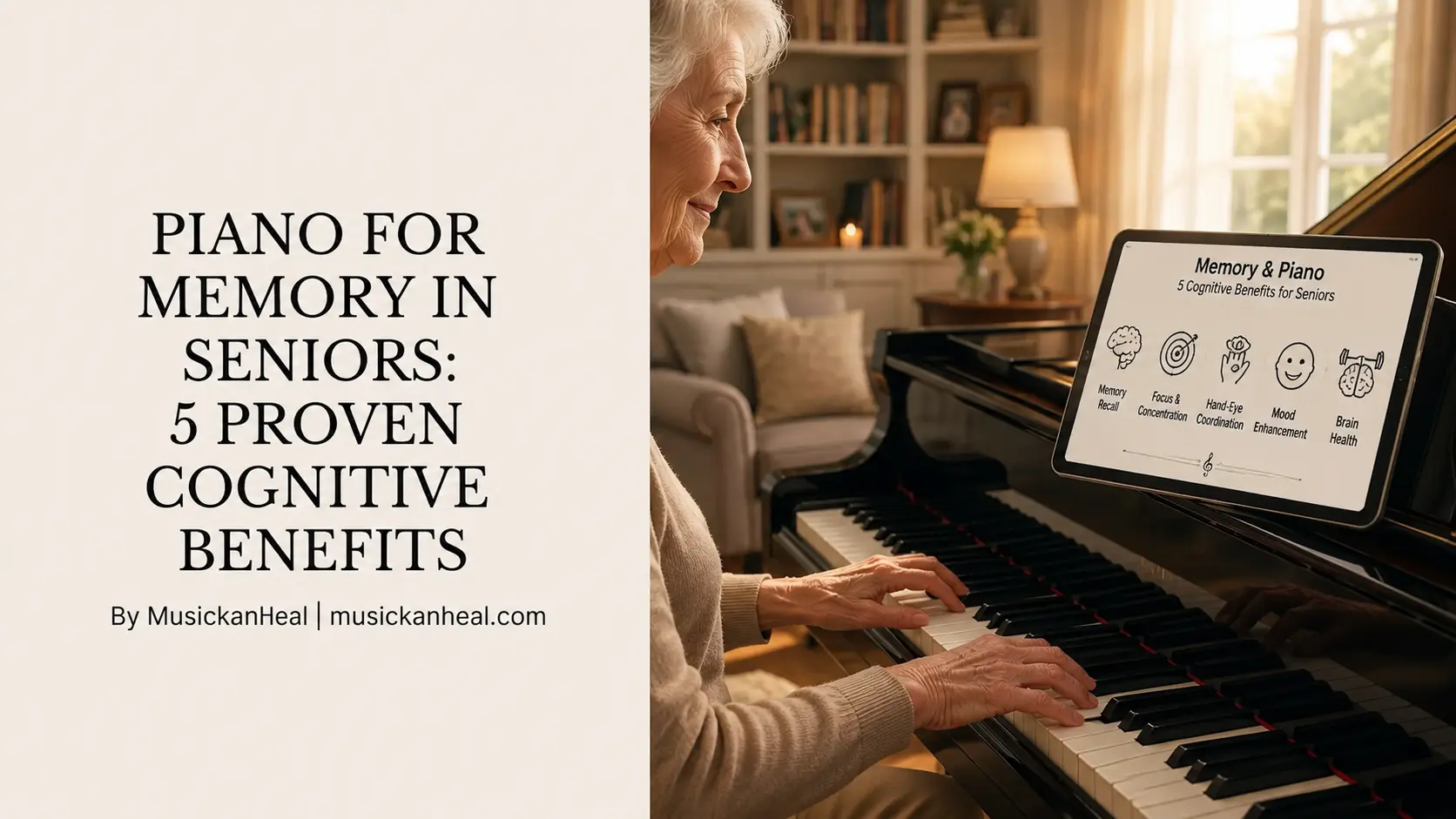
Piano for Memory in Seniors: 5 Proven Cognitive Benefits

If you’ve started researching ways to help a parent stay sharp, you’ve probably run into headlines claiming piano keeps the brain young. It’s fair to be skeptical—there’s no shortage of “secret to a sharp mind” content online, and most of it cites one small study and calls it proven.
Piano for memory in seniors actually has more research behind it than most brain-health claims you’ll find, including randomized controlled trials, a twin study that controls for genetics, and findings that replicate across multiple universities. None of it means piano cures dementia. It does mean there’s a real, evidence-based case for suggesting it to a parent, along with a few things worth knowing before you do.
Piano for Memory in Seniors: What Does the Research Actually Show?
Short answer: yes, with caveats. Multiple studies on older adults who took up piano, most starting with zero musical background, found measurable gains in working memory, processing speed, and executive function after as little as six months of lessons.
The caveat is that “improves memory” doesn’t mean what marketing copy makes it sound like. Researchers aren’t claiming piano reverses memory loss. The clearer finding is that piano training appears to slow age-related decline in specific brain regions tied to memory, and that benefit shows up faster than most people expect.
One of the more rigorous studies, a population-based twin study, found that twins who played a musical instrument were notably less likely to develop dementia or cognitive impairment than their genetically identical sibling who didn’t, according to the peer-reviewed study published in PMC. That detail matters because using twins controls for genetics, which removes the obvious “smart people are more likely to take up piano anyway” objection.
A separate study out of Geneva and Hannover tracked older adults over six months and found that those taking piano lessons showed slower degeneration in the fornix, a brain structure tied to memory, compared to a group that only listened to and studied music. The piano group also held onto more gray matter in regions linked to processing sound, according to reporting on the study from Classic FM.
Why Piano, Specifically—Five Things the Studies Found
Piano isn’t unique in being good for the brain. Reading, learning a language, and even certain video games show some cognitive benefit too. But piano keeps showing up in research as having an outsized effect, likely because it demands so much at once: interpreting patterns, translating that into two-handed finger movement, listening for errors, and adjusting in real time.
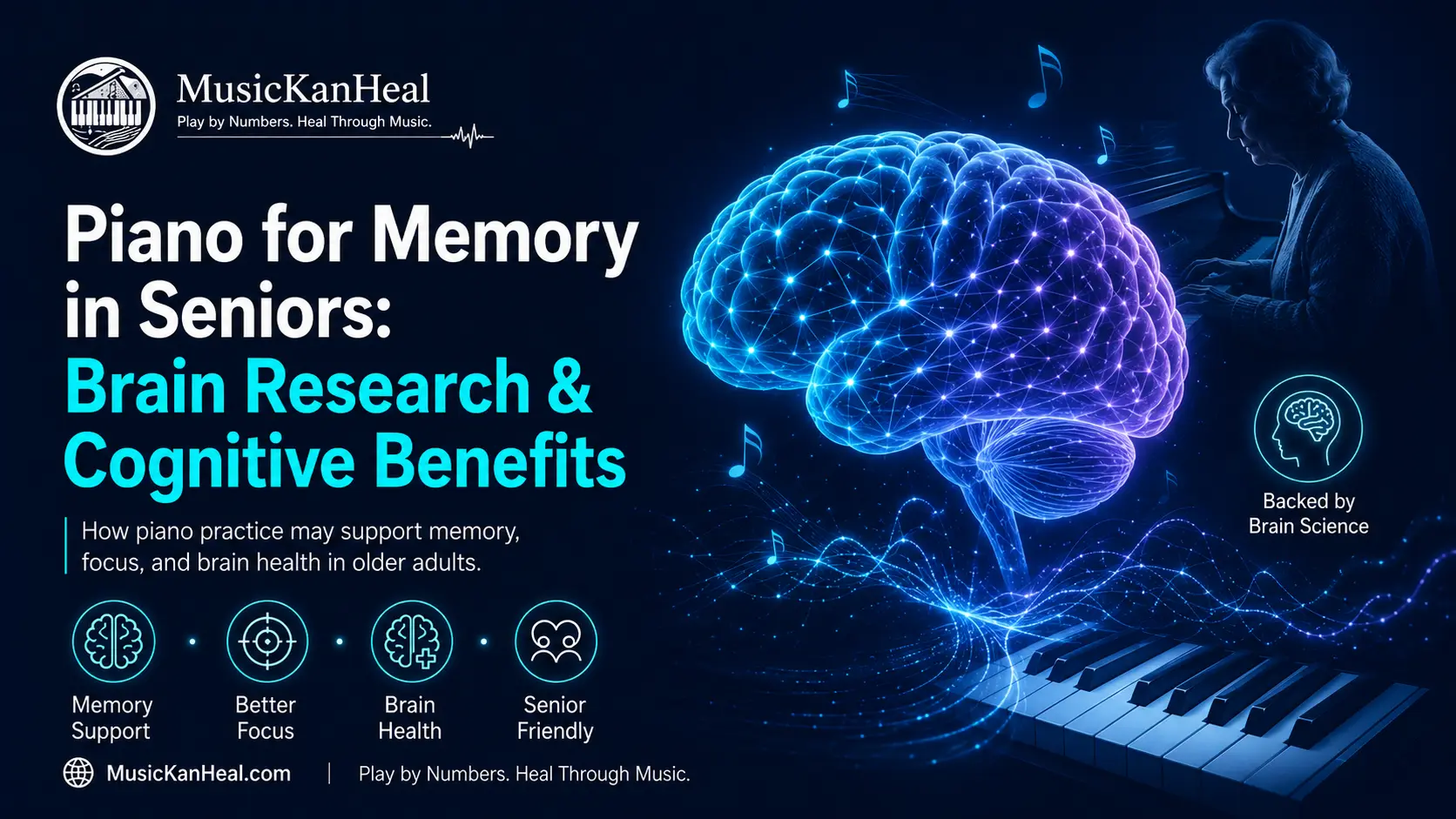
Here’s what the research specifically points to:
Working memory gains within six months
Randomized trials on adults aged 60 to 85 with no musical background showed measurable improvement in working memory and processing speed after roughly six months of weekly lessons.
Slower decline, not just stable test scores
The fornix study above found actual structural preservation, not just better performance on memory tests, but measurably less degeneration in memory-related brain tissue.
Lower long-term dementia risk among instrument players
Found in long-term population studies, though this kind of finding is correlational and doesn’t prove piano alone causes the reduction.
Better gains than passive listening
Studies that directly compared playing piano to simply listening to music found the active-playing group consistently outperformed the listening group on memory and attention tasks.
A specific edge in cognitive flexibility
A study comparing piano training to computer-based brain training found piano had a unique advantage in cognitive flexibility, the ability to switch between tasks, something most generic “brain games” don’t reliably improve, according to reporting from Being Patient and a summary of brain-health research on instrument learning from AARP.
If you want the deeper neuroscience on why playing, not just listening, makes the difference, we break down the mechanism in more detail here.
Is It Too Late for Your Parent to Start?
This is usually the real question underneath “Does piano help memory?” not whether the research is real, but whether it still applies to someone in their 70s or 80s who’s never touched a piano.
The honest answer is that age has surprisingly little to do with it. Every major study on this topic specifically recruited older adults with no musical background, not lifelong musicians. The benefit comes from learning something new and demanding, not from decades of practice.
Researchers at the University of South Florida studied adults aged 60 to 85 with no musical background and found measurable improvements in memory, verbal fluency, and processing speed after six months of individual piano instruction, according to reporting in National Geographic.
The studies also didn’t require any prior interest in music. Participants were everyday older adults, not people who’d always wanted to play piano. Motivation to stick with it mattered more than natural talent, which is good news, since most parents being signed up for this by their adult kids weren’t planning to become musicians anyway.
What “starting” actually looks like in week one is usually underwhelming, and that’s normal. Most beginners spend the first week or two just learning to find notes without looking, well before anything resembling a full song. The cognitive engagement behind piano for memory in seniors starts on day one, even though visible musical progress takes longer.
Prevention vs. Intervention: Does Piano Help If Memory Loss Has Already Started?
Most articles on this topic lump everyone together, but there’s a real difference between a parent who’s sharp and you’re being proactive and a parent who’s already showing signs of memory loss or has a diagnosis like mild cognitive impairment.
For the first group, prevention, the research above applies directly. For the second, the picture is more limited but still meaningfully positive.
A study following adults aged 60 to 85 with mild cognitive impairment, not just healthy seniors, found that those assigned to six months of piano lessons showed improvements in memory, attention, and processing speed compared to a control group, according to coverage from Riverside Music Studios summarizing research published in Frontiers in Psychology. That’s a meaningfully different finding from prevention studies: it suggests piano may help even after some decline has started, not just delay it from beginning in the first place.
What it isn’t: a treatment for diagnosed dementia, and no legitimate study claims it reverses existing damage. If a parent has a dementia diagnosis, piano is worth discussing with their doctor or care team as a complementary activity, not a substitute for medical care.
What About Arthritis or Limited Hand Mobility?
This is the most common practical objection, and it’s a fair one. A lot of seniors in the age range these studies cover also deal with arthritis, reduced grip strength, or general hand stiffness.
The reassuring part is that gentle, regular use of the hands is generally considered helpful for arthritic joints rather than harmful, with short sessions being the key word. Most teaching approaches for older beginners recommend 15- to 20-minute practice sessions rather than long ones, which also happens to match what the research studies actually used.
If pain is a real barrier, an occupational therapist or the parent’s doctor can advise on whether piano specifically makes sense, especially for more advanced arthritis. For mild to moderate stiffness, short sessions with breaks tend to be manageable, and some people find the regular hand movement helps rather than hurts. This isn’t medical advice, just a starting point for that conversation.
How to Help Your Parent Actually Start Playing
Once you’ve decided it’s worth trying, the next obstacle is usually logistics, not motivation. Traditional piano lessons assume the student will learn to read sheet music, which is its own steep learning curve and a common reason older beginners quit in the first month.
A few things make the early weeks more likely to stick:
- Start with short, frequent sessions—15 to 20 minutes, several times a week, rather than one long weekly lesson.
- Skip traditional notation if it’s a barrier. Number-based or chord-based systems let beginners play real songs in the first sitting instead of spending months on note-reading.
- Pick songs they already know. Familiar melodies from their generation are easier to learn and more motivating than method-book exercises.
- Track progress loosely, not with grades or tests. The cognitive benefit comes from sustained engagement, not performance level.
If you’re comparing structured options, our beginner’s guide to learning piano for stress relief and mental health walks through a realistic 90-day starting plan, and this comparison of piano learning apps break down which tools work best for adult beginners who’d rather not deal with sheet music.
It’s also worth preparing for resistance, because it’s common. Some parents will say they’re “too old,” “not musical,” or “don’t have time for that.” None of those objections hold up against what the research actually measured, but pointing to a study rarely changes someone’s mind on its own. What tends to work better is framing it as something to try for a few weeks with no pressure to be good at it, rather than presenting it as a project they have to commit to.
On cost, this doesn’t have to mean a piano teacher and a baby grand piano. A basic 61-key keyboard is enough to start, and app-based or number-based learning systems are typically far cheaper than weekly private lessons, which matters if a parent is testing this out rather than committing to it long-term.
There’s also a secondary benefit worth mentioning. The same University of Bath trial widely cited for cognitive gains also found reduced depression and anxiety scores in beginner pianists after just a few weeks, a finding we cover in more depth here, which matters if isolation or low mood is part of what you’re trying to address alongside memory.
Frequently Asked Questions About Piano for Memory in Seniors
How long does it take to see memory benefits from playing piano?
Most controlled studies measured results at the six-month mark, with some improvements in mood and attention showing up after just a few weeks. Structural brain changes, like slower decline in memory-related regions, take longer to show up than behavioral improvements like better focus or working memory.
Is playing piano better for the brain than just listening to music?
Yes, based on the available research. Studies that directly compared the two found that actively playing produced measurably better results on memory and attention tasks than listening alone, though listening still has its own mood and relaxation benefits.
Can piano help if a parent already has dementia, or only prevent it?
Research on adults with mild cognitive impairment found real improvements after lessons, suggesting piano isn’t only useful before decline starts. It is not a treatment for diagnosed dementia, and any plan involving a parent with a dementia diagnosis should involve their doctor.
Do seniors need to learn sheet music to get the memory benefits?
No. The cognitive demand comes from coordinating hands, ears, and attention while learning something new, not specifically from reading notation. Number-based or chord-based systems that skip traditional sheet music still engage the same brain functions the studies measured.
Is piano for memory in seniors actually backed by real studies, or is this overstated online?
It’s genuinely backed by peer-reviewed research, including randomized controlled trials and a twin study that controls for genetics, which is more rigorous than most “brain health” claims circulating online. The honest caveat is that no study shows piano reverses existing memory loss or prevents dementia outright. The evidence supports slower decline and measurable cognitive gains, not a cure.
The Bottom Line
Piano for memory in seniors isn’t hype. It’s one of the more researched, replicated interventions in the cognitive-aging space, with results that show up faster than most people expect and apply to complete beginners regardless of age within the 60 to 85 range these studies have covered.
All rights are reserved. Copyright 2026 MusicKanHeal | musickanheal.com