Piano Lessons for Anxiety and Depression: 11-Week Proof
In 2022, researchers at the University of Bath handed 31 adults with no musical experience a simple schedule: one hour of piano lessons, once a week, for 11 weeks.
No medication. No therapy sessions. No major lifestyle overhaul.
By the end of those 11 weeks, the group taking piano lessons for anxiety and depression showed measurably reduced scores across all three categories — depression, stress, and anxiety. The groups that only listened to music or used the time to read and study showed no such change.
That result, published in Nature Scientific Reports, is not a wellness blog’s opinion. It is a randomized controlled trial. The distinction matters, and this article unpacks exactly why it happened — and how you can replicate those 11 weeks starting today.
The 11-Week Study That Redefined What Piano Lessons Can Do
The study was straightforward. University of Bath researchers assigned 31 adults into three groups: music training (weekly piano lessons), music listening (they heard the same pieces the piano group played), and a passive control group (reading and homework).
Every participant was a complete beginner. No prior musical experience was required or allowed.
Within a few weeks — not months — the piano group reported improvements the other two groups did not. Their ability to process sensory information improved. Their mood scores shifted. By week 11, the depression, stress, and anxiety reductions were statistically significant compared to where they started.
Here is the detail that gets overlooked in every article that summarizes this study: the music-listening group heard the exact same pieces as the piano group and still showed no mental health improvement. Passive listening did not move the needle. Playing did.
This is not an argument against listening to calming music — that has its own value. It is a direct challenge to the assumption that the mental health benefits of music come from the music itself. They come, at least in part, from the act of learning to create it.
Why Piano Practice Reduces Anxiety: The Brain Science
Piano practice affects anxiety and depression through several overlapping biological pathways, not just one.
Dopamine and Serotonin Release
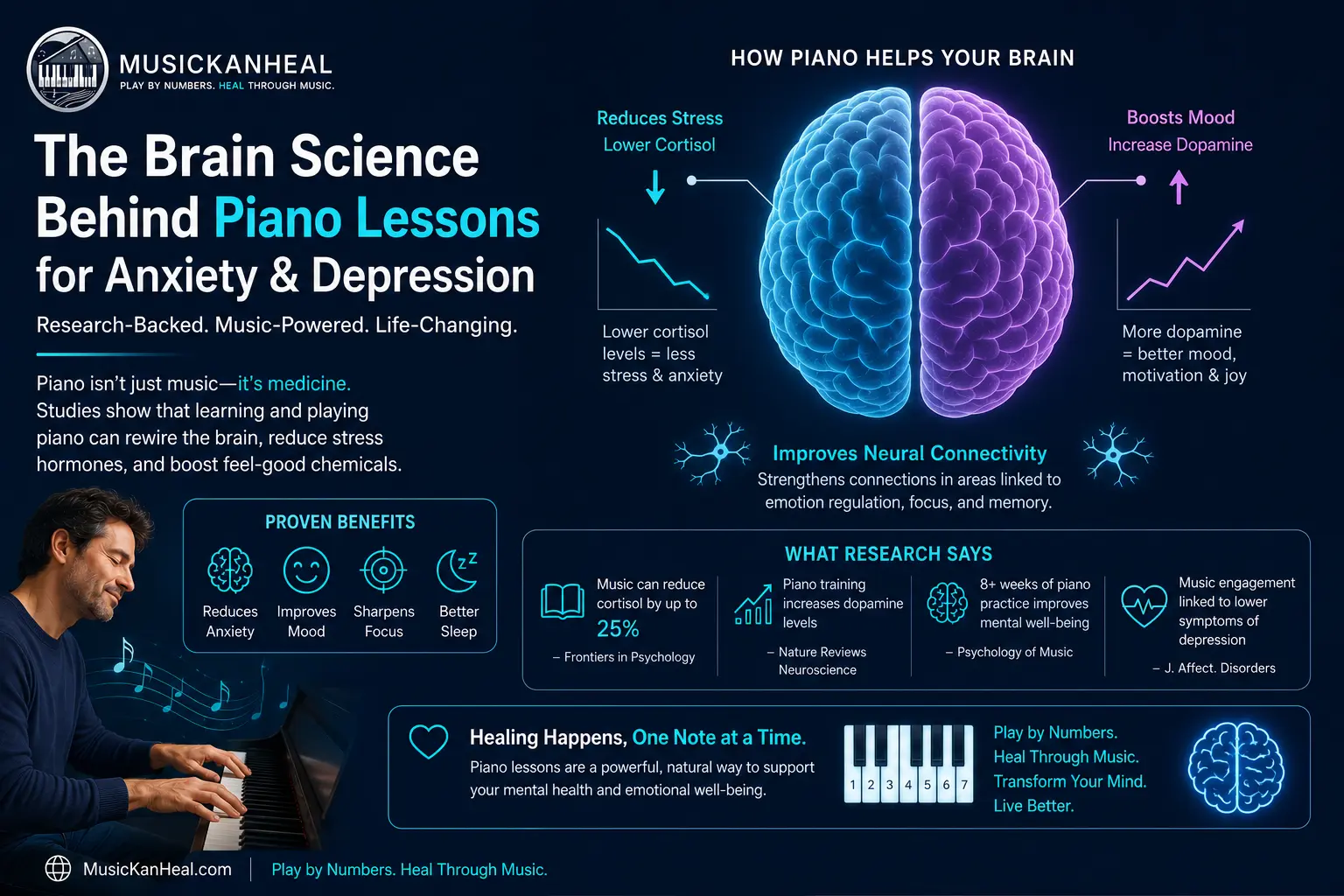
When you play music — even imperfectly — your brain’s reward system activates and releases dopamine and serotonin. These are the same neurochemicals that antidepressants are designed to increase. Playing a simple chord progression for ten minutes triggers this response. It does not require skill or polish.
Cortisol Reduction
Cortisol is your primary stress hormone. Studies consistently show that piano playing lowers cortisol levels more effectively than comparable activities like calligraphy or drawing. A study comparing creative activities found piano playing produced the sharpest drop in both cortisol levels and State-Trait Anxiety Inventory scores among all activities tested.
Forced Presence
Piano practice demands your full attention. Both hands do different things simultaneously. You are reading, listening to yourself, and adjusting in real time. Your mind physically cannot ruminate on the thing that is stressing you while doing this. That is not a metaphor — it is how cognitive attention works. For people whose anxiety is driven by looping thoughts, this enforced focus functions as active meditation.
Corpus Callosum Development
Regular piano practice strengthens the corpus callosum, the bundle of nerve fibers connecting the brain’s two hemispheres. A stronger corpus callosum improves emotional regulation and problem-solving — both of which degrade under chronic anxiety and depression.
None of this requires you to become a skilled pianist. The neurological benefits begin in the early weeks of learning, which is exactly what the Bath study confirmed.
Piano Lessons for Anxiety and Depression: What the Research Beyond Bath Shows
The Bath study is the most-cited, but it is not alone.
A 2025 study published in PubMed examined the impact of piano lessons on elderly adults over six months. The Taylor Anxiety Scale score dropped by 19 points — more than half its original value. The Beck Depression Inventory score dropped by 21.5 points, roughly a twofold reduction. Well-being, activity, and mood all improved significantly.
A separate analysis reviewed 51 studies involving 3,276 adults and found music therapy produced a medium reduction in anxiety with a statistically significant effect size. The 2025 analysis also confirmed that music-based practices complement medication and talk therapy rather than replacing them — they work together, not in competition.
What the research consistently shows is this: passive listening helps mood in the moment. Active playing — learning, practicing, improving — builds structural change over time. The mental health benefits of piano lessons are cumulative, not immediate. That is important context before you sit down for week one expecting to feel transformed after a single session.
Do You Need a Teacher, or Will a Piano App Work?
The Bath study used one-to-one human instruction. Participants had a teacher in the room, correcting technique and guiding progression.
That matters, but it does not mean an app is useless.
A teacher provides two things an app cannot: technique correction in real time and accountability. Bad hand posture, excessive tension, and inefficient fingering develop silently in self-taught learners, and they compound over months. A teacher catches these in week two before they become habits.
An app provides accessibility, flexibility, and cost. For someone who cannot commit to fixed lesson times or cannot afford regular instruction, a structured app still delivers practice — and any consistent piano practice, according to the research, produces benefits.
If you are using MusicKanHeal, the Nashville Number System removes the sheet music barrier entirely — letting you focus on playing rather than decoding notation, which reduces the frustration that causes most adults to quit in the first four weeks.
How to Start Piano Lessons for Anxiety and Depression Today
The Bath study used a simple, low-friction structure. Here is what those participants actually did each week:
- First 20 minutes: Finger exercises and technique warm-up
- Next 40 minutes: Learning one piece at a time, moving to the next only after accurate grasp of the current one
The pieces used were Grade 1 ABRSM level — meaning genuinely beginner. Simple melodies. Both hands eventually, but not immediately.
What the structure tells you is that one hour a week is enough to produce measurable results in 11 weeks. That is 11 hours total across the entire experiment. You are not being asked to rebuild your life around practice.
A few practical steps to start:
- Get a keyboard. A 61-key model under $100 is sufficient for the first several months. You do not need a weighted instrument or a full 88 keys to begin.
- Choose one method and commit. The biggest cause of failure in adult beginners is switching approaches after two weeks. Pick a teacher, app, or structured course and stay with it past week four.
- Use headphones for daily sessions. This reduces self-consciousness and helps you hear yourself more accurately, which accelerates feedback loops.
- Set a timer. Twenty minutes of focused practice beats sixty minutes of half-distracted playing every time.
MusicKanHeal’s approach to building piano skills through the Nashville Number System is specifically designed for adult beginners who have no musical background — and pairs the skill-building side with guided healing audio for days when anxiety makes active practice feel like too much. Both pathways are there depending on where you are mentally on a given day.
How Long Before Piano Practice Helps with Anxiety and Depression?
Based on the Bath study, the piano group reported mood improvements within the first few weeks — not at week 11. Week 11 is when the cumulative effect became statistically significant against baseline. The shift in how participants felt day-to-day started earlier.
A reasonable expectation for most adult beginners:
- Weeks 1–2: Practice requires active concentration — this itself interrupts anxious thought patterns, even before any real skill develops
- Weeks 3–5: The dopamine loop from small wins (playing a recognizable phrase correctly) begins reinforcing the habit
- Weeks 6–11: Cumulative effects on mood, stress tolerance, and self-efficacy become noticeable
What you should not expect is immediate relief in session one. This is not a medication. It is a practice that builds mental health benefits the same way physical exercise builds cardiovascular fitness — through consistent repetition over weeks, not through a single intense session.
Frequently Asked Questions About Piano Lessons for Anxiety and Depression
Can piano lessons for anxiety and depression work if I have no musical experience at all?
Yes — that is specifically who the Bath study recruited. Every participant was a complete beginner with zero prior musical training. The study was designed to test whether musical experience was required to see mental health benefits. It is not. The neurological effects from learning and practicing begin regardless of starting skill level.
How many minutes of piano practice per day actually helps with anxiety?
The Bath study used one hour per week — roughly 8 to 10 minutes per day. That is the minimum threshold where structural benefits were observed. More is better, but consistency matters more than duration. Daily 15-minute sessions consistently outperform occasional 90-minute marathon practice sessions for both skill development and mood regulation.
Is listening to piano music as effective as playing it for depression?
No, and the Bath study makes this distinction clearly. The music-listening group heard the same pieces as the piano group and showed no significant improvement in depression or anxiety scores. The mental health benefits appear to come from the active engagement of learning and playing — not from the music itself as a passive stimulus.
Can piano lessons for anxiety and depression replace medication or therapy?
The research shows piano practice as a complement, not a replacement. The 2025 meta-analysis across 51 studies found music therapy enhances outcomes when combined with other treatments. If you are currently on medication or in therapy, adding piano practice is additive — it does not compete with other interventions. If you are dealing with clinical depression or an anxiety disorder, speak with a health professional before making decisions about treatment changes.
Do I need a real piano, or will any keyboard work for the mental health benefits?
Any keyboard works. The Bath study participants used standard instruments, not premium weighted pianos. What matters is having enough keys to practice the pieces you are learning and consistent access to practice. A $60 beginner keyboard achieves the same neurological engagement as a $2,000 instrument when you are at the beginner stage. The brain does not care about the instrument’s price.
Conclusion
The evidence is clear. Piano lessons for anxiety and depression are not a wellness trend — they are a studied, measurable intervention with a published randomized controlled trial behind them.
One hour a week. Eleven weeks. That is what it took for beginners with no musical experience to show significant reductions in depression, stress, and anxiety in a controlled research setting.
The hardest part is not the practice itself. It is overcoming the catch-22 that anxiety and depression create: both conditions make starting new things feel impossible. The solution the research points to is a low barrier to entry — short sessions, simple pieces, and no prior experience required.
Eleven weeks is not long. Start this week, and it ends before most people finish deciding whether to begin.
All rights are reserved. Copyright 2026 MusicKanHeal | musickanheal.com