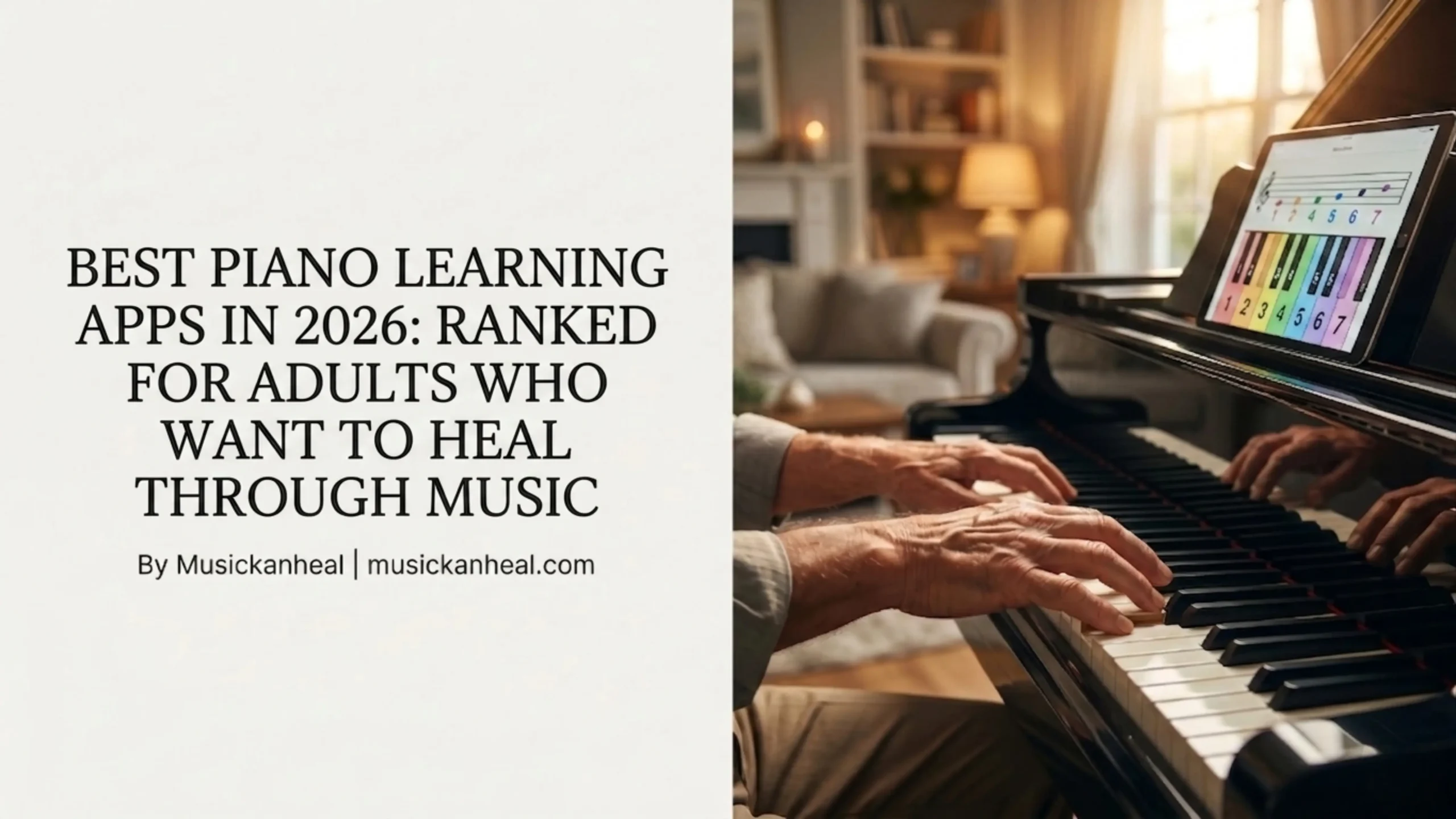
Best Piano Learning Apps in 2026: Ranked for Adults Who Want to Heal Through Music
The best piano learning apps in 2026 are not just teaching tools — if you want to reduce anxiety, rebuild focus, or use music as a genuine mental health practice, what the app teaches matters less than how it makes you feel while you’re doing it.
Most “best piano app” rankings compare note-detection accuracy and song libraries. This one doesn’t. This ranking puts the healing outcome first — because that’s what the research says actually keeps adults playing long enough to get the benefits.
Why the Healing Angle Is Not Optional
A March 2025 study published in the Journal of Nervous and Mental Disease followed 30 adults aged 60 to 70 through six months of twice-weekly piano lessons. The Taylor Anxiety Scale dropped by 19 points by the end. The Beck Depression Inventory dropped by 21.5 points. Those are not marginal improvements.
A study published in Frontiers in Psychology found that piano practice can directly treat depression in elderly adults, specifically by releasing serotonin and dopamine — the same neurochemicals responsible for the emotional lift you get from music you love, now triggered by the act of making it yourself.
According to Yamaha’s published research on music and well-being, piano players who practice regularly experience lower blood pressure, reduced cortisol levels, and measurably less anxiety than their non-playing peers. In one study published in the International Journal of Music Education, college students who played piano showed far larger drops in cortisol than groups who made sculpture, wrote calligraphy, or sat in silence.
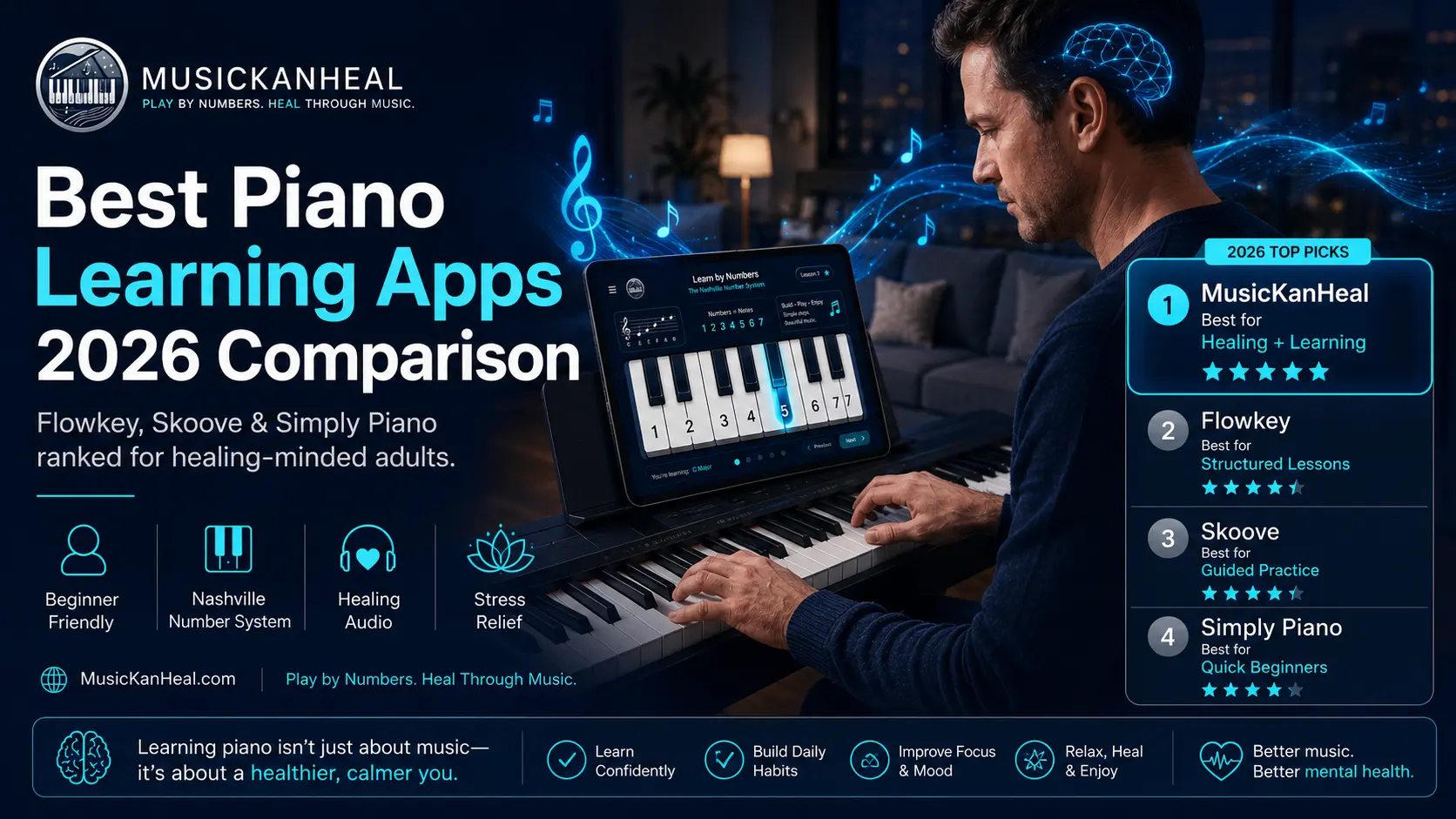
MusicKanHeal — Best for Healing Through Active Playing
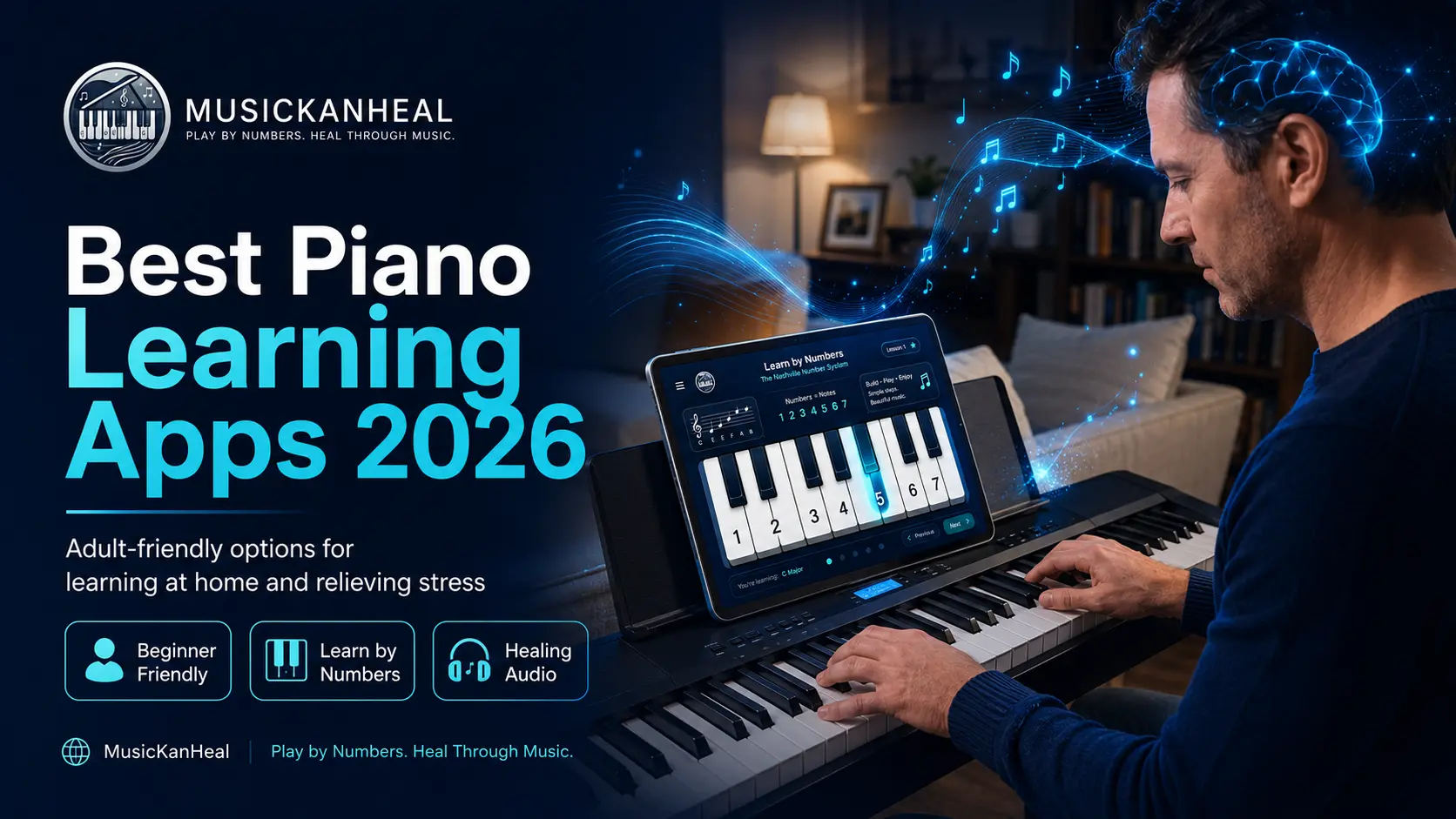
Best for: Adults who want the mental health benefits of piano practice without years of sheet music theory.MusicKanHeal occupies a category none of the mainstream apps compete in directly. While every other app on this list teaches piano through falling notes or sheet music, MusicKanHeal uses the Nashville Number System — a professional chord-numbering method used by session musicians since the 1950s — to let beginners play real, emotionally resonant songs within the first session.
That distinction matters for the healing outcome. The anxiety-reduction research doesn’t require you to read music. It requires active engagement: both hands on the keyboard, musical intention, and emotional connection to the piece. The Nashville Number System gets you there faster than any notation-based approach because it removes the most common reason adults quit — the frustration of decoding sheet music before they’ve played a single full song.
MusicKanHeal is also the only app on this list built with a dedicated healing mode. The platform pairs piano learning with guided music therapy audio — specifically designed for stress relief, anxiety management, and sleep. On days when active practice feels like too much, that mode gives you access to the same neurological benefit through receptive listening.
Founder Keith A. Norris built MusicKanHeal around the belief that music should be a mental health tool first and a skill-builder second. That philosophy is directly aligned with what the research actually shows about why piano practice helps.
Simply Piano (JoyTunes) — Best for Fast Early Wins
Best for: Complete beginners who want to play recognizable songs within a week.Simply Piano is the most downloaded piano learning app in the world for a reason. The onboarding is smooth, the gamification keeps streaks going, and you’ll be playing a simplified version of a pop song you recognize within your first three sessions. For adult beginners with no prior experience, those early wins matter enormously — early success is one of the strongest predictors of whether someone continues practicing.
The dopamine hit from playing your first full song — even a simplified one — is real. The brain releases serotonin and dopamine during piano playing, and that reward signal is strongest when you complete something recognizable. Simply Piano is optimized to trigger that signal early.
The limitation is depth. The scrolling-note interface builds reflexes, not musical understanding. Adults who want to eventually understand what they’re playing will outgrow Simply Piano within six to twelve months. It’s also designed with younger learners in mind, which shows in the interface and content choices. For healing purposes, it works well as an entry point — the gamification creates a daily practice habit, and daily practice is exactly what the clinical research is built on.
Flowkey — Best for Adults Who Want to Play Real Songs Now
Best for: Adult learners with some musical background who want a large, elegant song library.Flowkey consistently appears at the top of every credible best piano learning apps 2026 roundup, and it earns that placement. The interface is cleaner and more adult-oriented than Simply Piano. The song library runs to thousands of tracks. It supports both MIDI input and microphone-based listening, giving you real-time feedback without needing any hardware beyond your phone.
Flowkey carries an endorsement from Yamaha — the world’s largest piano brand — and it shows in the quality of the experience. The lessons are video-based and elegant, treating you like someone who wants to learn a craft rather than beat a level.
The healing angle here is real but indirect. Flowkey’s strength is song selection. Playing music you love — actually love, not beginner exercises — is one of the primary drivers of the emotional benefits research documents. A study in the Journal of Nervous and Mental Disease found that personal musical meaning amplifies the mental health response. Flowkey gives you more access to meaningful music than any other app on this list. The weakness: less structure than Skoove, and limited fingering guidance on advanced pieces.
Skoove — Best Structured Curriculum for Anxious Adult Beginners
Best for: Adults who want proper fundamentals and find unstructured learning stressful.This is a detail most app reviews miss: for adults with anxiety, an unstructured learning environment can make anxiety worse. Skoove’s strength is that it builds a genuinely scaffolded curriculum — lesson to lesson, skill to skill — so you always know exactly where you are and what comes next. For adults who experience anxiety partly because things feel out of control, that structure has a therapeutic value of its own.
After a significant 2024 revamp, Skoove now has the strongest sheet-music-first curriculum of any app at its price point ($12.49/month — the most affordable premium option on this list). Real teacher support is available through Skoove Duo, which adds live instructor sessions at extra cost. Having a teacher correct technique errors once a month is a meaningful differentiator — apps alone cannot catch bad habits forming in your wrists and posture.
The downside: Skoove is less fun than Simply Piano. It won’t feel like a game. Adults who need external motivation through gamification will find it harder to maintain daily habits. For the healing outcome, Skoove is the best choice for an adult serious about long-term practice — because long-term practice is what produces structural brain changes. The Journal of Nervous and Mental Disease study that found 19-point drops in clinical anxiety ran for six months. Skoove is built for that commitment.
Piano Marvel — Best for Adults Who Want to Measure Progress
Best for: Goal-oriented adults and those learning alongside a teacher.Piano Marvel is trusted by music teachers and schools worldwide. Its SASR (Standard Assessment of Sight Reading) system grades your accuracy in real time at a claimed 99% two-note polyphony recognition via MIDI — the most precise feedback engine on this list. If you own a MIDI keyboard and want to know exactly how accurate your playing actually is, Piano Marvel is the only app built for that level of accountability.
The healing connection here is cognitive. According to the National Endowment for the Arts Research Lab at Florida State University, a 16-week program of piano training significantly increased verbal fluency in older adults — more than computer-based cognitive training programs. Piano Marvel’s structured, graded lessons mirror that kind of intensive training most closely.
Pricing is competitive at $110–$130/year. There’s also a meaningful free tier — 150+ songs, 200+ exercises, and 25 guided lessons — enough to evaluate whether the teaching approach works for you before committing.
Yousician — Best for Multi-Instrument Households
Best for: Families or adults who want to explore multiple instruments under one subscription.Five instruments under one subscription is Yousician’s main differentiator. Piano isn’t its flagship instrument — guitar and ukulele content is deeper — but the gamified structure is genuinely effective at building practice habits. Its polyphonic audio engine grades accuracy and timing via microphone and awards stars on weekly leaderboards.
The healing angle is primarily motivational. Consistent daily practice — even 15 minutes — is the variable the research documents again and again. Yousician is the best app for making that consistency feel like something you want to do rather than something you should do.
For pure piano healing purposes, it comes last among the paid options. The depth isn’t there for serious progress, and serious progress is what produces the structural brain changes that matter over months and years. But if the alternative is not playing at all, Yousician’s gamification is a legitimate on-ramp.
Hoffman Academy — Best Free Option for Self-Motivated Beginners
Best for: Adults who want real lessons at zero cost and don’t need gamification to stay motivated.Hoffman Academy offers genuine piano education for free. The lessons are structured, friendly, and build real musical understanding rather than just song-playing reflexes. For an adult who is internally motivated and doesn’t need streaks or leaderboards to practice daily, it’s the most underrated option on this list.
The teaching is foundational in a way most apps aren’t. You’ll understand what you’re playing, not just how to move your hands through it. That understanding has its own therapeutic value: when music feels comprehensible rather than mysterious, the anxiety of “am I doing this right?” decreases substantially.
Limitation: no real-time MIDI feedback, limited interactive elements, and it can feel constraining for adults past the beginner stage who need adaptive lesson pacing.
The One Thing Most Piano Apps Get Wrong for Adults
Every app on this list was built to teach piano. Very few were built around why adults actually want to play.
Adults who pick up piano in their 30s, 40s, or 50s are not trying to become concert pianists. Research consistently shows that adult learners are driven by emotional goals: stress management, mental clarity, a sense of accomplishment, and connection to music they love. When an app spends the first month drilling scales and note identification before the learner plays a single song that means something to them, it optimizes for the wrong outcome.
That’s the gap MusicKanHeal fills. The Nashville Number System gets adults playing emotionally connected music fast enough that the brain’s reward system activates before frustration sets in. For a complete review of how piano learning genuinely affects the brain, the MusicKanHeal piano skills deep-dive breaks down the neuroscience behind what consistent practice actually produces.
Frequently Asked Questions About the Best Piano Learning Apps 2026
Which is the best piano learning app in 2026 for adults with anxiety?
MusicKanHeal and Skoove are the strongest options for adults managing anxiety. MusicKanHeal removes the learning barrier of sheet music entirely and adds dedicated music therapy audio for days when active practice is too demanding. Skoove’s structured curriculum reduces the cognitive overwhelm that makes unstructured practice stressful. A 2025 study in the Journal of Nervous and Mental Disease found that six months of piano lessons cut clinical anxiety scores by more than half — but only when the learner stuck with the practice. The app that keeps you playing consistently is the right one.
Are the best piano learning apps in 2026 worth it if I don’t own a keyboard?
Yes, with limits. MusicKanHeal, Simply Piano, and Yousician all work using your phone or tablet screen as a practice surface. You won’t build proper hand technique or finger strength without a physical keyboard, but you can learn the theory, chord structures, and musical intuition — all of which produce real cognitive and emotional benefits. When you’re ready, a basic digital keyboard costs under $100 and immediately unlocks the full benefit of any app. For a fuller breakdown, the piano app for free guide covers how to start without any equipment.
Does playing piano on an app have the same healing benefits as a real piano?
The healing benefits — reduced anxiety, lower cortisol, improved mood — appear to be linked to the act of active musical engagement, not the quality of the instrument. The University of Bath randomized controlled study that found reduced depression and anxiety after 11 weeks used beginners on basic instruments. What matters is that you’re actively playing music you’re emotionally connected to, consistently. App-based learning that produces that engagement does produce those benefits.
Is the Nashville Number System better than sheet music for adult beginners?
For adults whose primary goal is to play music they love and experience the mental health benefits of piano practice, the Nashville Number System is faster and less frustrating than traditional sheet music. Sheet music reading is a separate skill that takes months to develop and adds a cognitive burden that can derail beginners before they experience any reward. The Nashville Number System lets most beginners play full chord progressions in their first session. Professional session musicians have used it for decades for exactly this reason — it prioritizes playing over decoding.
What do the best piano learning apps in 2026 have in common?
The ones that keep adults playing share three things: early success (you play something meaningful quickly), real-time feedback (you know immediately whether you’re accurate), and emotional connection (the music means something to you). Apps that delay all three — drilling theory first and requiring perfect technique before songs — lose adult learners within weeks. The research on piano and mental health is built on consistent practice over months. The best app is the one that makes consistent practice feel worth it.
All rights are reserved. Copyright 2026 MusicKanHeal | musickanheal.com