The Complete Beginner’s Guide to Learning Piano for Stress Relief and Mental Health
Learn piano for beginners is one of the most research-supported things an anxious adult can do — and you can feel the difference within weeks, not years. A study published in the International Journal of Music Education found that 30 minutes of piano practice reduced cortisol — the body’s primary stress hormone — more effectively than clay molding, calligraphy, or sitting in silence.
This guide covers everything a complete beginner needs: what to buy, how to practice, how much time it actually takes, and how to structure your first 90 days so that playing piano becomes a genuine mental health practice — not just a hobby that sits in the corner collecting guilt.
Why Learning Piano Does More Than Teach You Music
Before the practical advice, the research context matters — because it changes what your goal actually is.
Most beginner piano guides are written by musicians. Their implicit goal is technical competence: reading notation, playing scales correctly, advancing through grade levels. That’s a legitimate goal. It’s also the reason most adults quit within six months. Technical competence is a slow-building reward, and adult learners don’t have the patience of a ten-year-old whose only alternative is homework.
Kumiko Toyoshima and colleagues (published in the International Journal of Music Education) ran a controlled study comparing the stress effects of piano playing, clay molding, calligraphy, and silence. Piano produced the largest drop in cortisol of all four conditions. This wasn’t a group of concert pianists. These were people who had played for varying amounts of time, engaged for 30 minutes. The physiological stress response happened within a single session.
A separate 2013 clinical trial from Florida State University, published in the Journal of Music Therapy, found that 30 minutes of piano playing reduced cortisol by 17%. A 2020 University of Melbourne study found that amateur pianists experienced 28% drops in anxiety and physiological stress after a single focused session — and those results improved with repetition.
The longer-term picture is equally specific. The University of Bath’s randomized controlled study, published in Nature Scientific Reports, took 31 adults with no prior musical experience and had them practice one hour per week for 11 weeks. By the end, participants reported significantly lower depression, stress, and anxiety scores than both a music-listening group and a control group. The key word is “beginners.” This wasn’t about reaching a high skill level. It was about consistent, engaged practice from a starting point of zero.
According to Steinway & Sons’ published research on music and mental health, people who actively make music — as opposed to just listening — experience measurably less anxiety, loneliness, and depression. The distinction between making and listening is one most guides miss entirely.
If you want to understand the neuroscience behind why all of this happens at the brain level, the full breakdown is in what 2026 research shows about piano and brain healing. For this guide, the practical point is simple: you don’t need to be good at piano to get the mental health benefits. You need to be doing it.
What You Actually Need to Start (It’s Less Than You Think)
The most common reason adults delay starting is the assumption that they need a full piano, a teacher, and a clear block of free time. None of those are required.
Instrument
You need a keyboard with at least 61 keys. For beginners, a 61-key digital keyboard in the $100–$200 range is completely sufficient for the first year of practice. Weighted or semi-weighted keys are preferable — they teach your fingers proper pressure and feel closer to an acoustic piano — but even an unweighted keyboard works for learning chords, melody, and the musical concepts that matter for the stress-reduction outcomes.
- You do not need 88 keys to start.
- You do not need an acoustic piano. Both are unnecessary costs and logistical complications that beginners use as reasons to delay indefinitely.
- A basic keyboard with a sustain pedal input — most have one — is a working setup.
- Headphone output matters. If you live in an apartment, have family members who sleep at different hours, or practice late at night, a keyboard with a headphone jack removes every environmental barrier to sitting down. This detail has more impact on long-term consistency than any feature comparison between instruments.
Time
Twenty minutes a day, five or six days a week. That’s the research protocol. It’s enough. The University of Bath study used one hour per week total — roughly 10 minutes a day if spread across seven days. The FSU cortisol study ran 30-minute sessions. You do not need 90-minute practice blocks to get mental health benefits. You need consistency.
What kills most adult beginners is not lack of talent — it’s the expectation that practice sessions need to be long. A 20-minute practice is not a compromise. It’s a sustainable format that fits a real adult schedule and still produces the outcomes the studies document.
Learning Method
You have three realistic options: a piano app (the most accessible and best for independent adults), online video courses (good for structured curriculum), or a private teacher (best feedback, highest cost). For the purposes of this guide — learning piano for beginners specifically for stress relief and mental health — an app-based approach is the lowest-barrier entry point that still works. The full comparison of 2026 piano learning apps covers the field in detail if you want to evaluate your options.
Sheet Music vs. The Number System: Why the Method You Choose Affects Your Mental Health Outcomes
This is the decision most beginner guides avoid because it challenges the traditional teaching assumption.
Learning to read sheet music is a valuable skill. It is also a six-to-twelve-month project before it becomes fluent, and during that period, most adult beginners are doing more decoding than actual music-making. The emotional engagement that drives the mental health outcomes — the dopamine release, the cortisol reduction, the sense of creative expression — requires you to be playing music that means something to you. That’s very hard to achieve while you’re still sounding out individual notes from a page.
The Nashville Number System offers a different path. Instead of naming specific notes in a specific key, it assigns numbers 1 through 7 to the chord positions in any key. A song written in the number system can be transposed instantly. A beginner who learns the 1-4-5 chord pattern — the foundation of gospel, blues, country, and popular music — can play hundreds of songs in any key from their first week of practice.
This matters for mental health outcomes because of what happens neurologically when you play music that sounds like actual music rather than halting exercises. The brain’s reward circuitry responds to musical completion — finishing a recognizable phrase, landing a chord resolution. That response is what produces serotonin and dopamine during playing. You can’t get it from exercises that don’t produce music. You can get it from a simple three-chord gospel progression on your first week.
The Nashville Number System method used by MusicKanHeal is designed around this principle — getting adult beginners to emotional musical engagement as fast as possible, specifically because that engagement is where the healing happens.
Your First 30 Days: What to Actually Practice
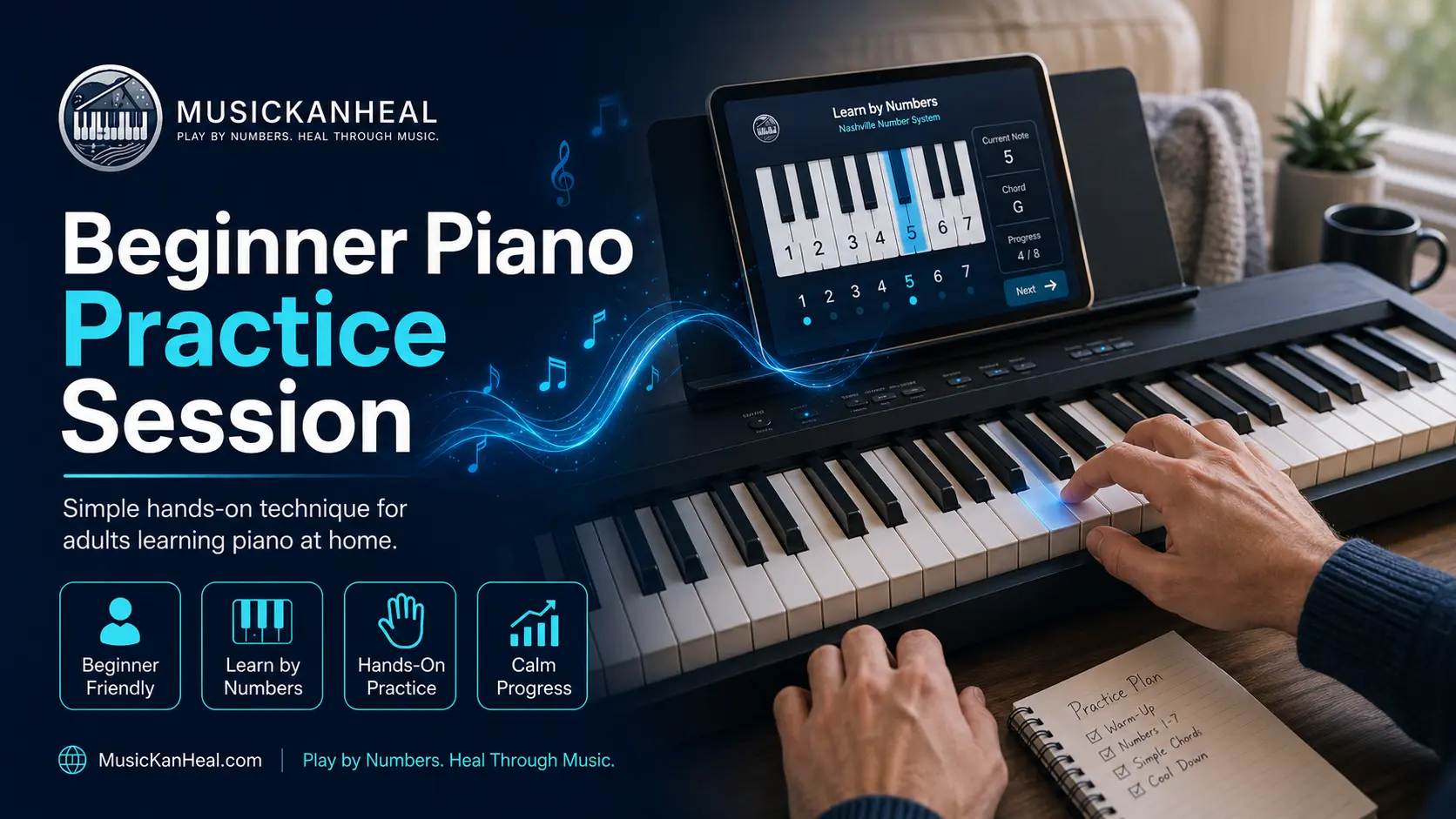
The first month has one job: build the neural habit of sitting down and playing without dread.
That sounds soft, but it’s the variable that determines everything. A 2025 study by the European Piano Education Association found that piano students who documented their progress weekly showed 43% higher self-esteem and 28% lower anxiety compared to those who didn’t track. The act of noting “I played today, and I can play this chord now” produces a measurable psychological effect independent of how well you played.
Weeks 1–2
- Learn where your hands sit on the keyboard. Fingers should be slightly curved, wrists relaxed. Tension in the wrists is where beginners generate frustration and physical discomfort. Five minutes of deliberate hand placement before playing pays off for months.
- Learn your first three chords in one key. If you’re using the Nashville Number System, those are your 1, 4, and 5 chords. In the key of C, those are C major, F major, and G major. You can play those three chords in a 1-4-5 progression, and it will sound like music you recognize.
- Practice moving between those three chords until the movement feels automatic. That’s it. Two weeks on three chords.
Why three chords and not more: the goal isn’t to cover more material. It’s to reach the point where your hands move without your brain consciously directing every finger. When movement becomes partially automatic, your mind can shift from “What note comes next?” to “How does this sound?” — and that shift is where emotional engagement begins.
Weeks 3–4
- Add a simple melody with your right hand over the chord pattern in your left.
- Try playing one song — a simplified version — with both hands, slowly.
- A normal beginner pace for this is slower than the recorded version of any song. That’s fine. The brain’s reward system responds to musical completion regardless of tempo.
Practice Session Structure for Weeks 1–4 (20 Minutes Total)
| Time | Activity | Purpose |
|---|---|---|
| 0–5 min | Warm up. Move through your chords slowly, no pressure. | Cortisol begins dropping during the first minutes of musical engagement. Don’t rush past this. |
| 5–15 min | Focused work on one specific thing — a chord transition, a melody line, a two-hand coordination point. | Focused attention is what produces the multisensory training effect the research documents. |
| 15–20 min | Free play. Put down the structure and play anything you know, whatever feels good. | This is where the session becomes emotionally owned — the neurological payoff of the structured work before it. |
The free play segment is not optional. It’s the part of the session that most closely mimics the emotional release the cortisol research documents. A practice session that ends in rigid drills doesn’t produce the same neurological outcome as one that ends in unstructured musical expression.
Days 31–60: The Habit Window (When Your Brain Starts Changing)
The University of Bath study found that mood and cognitive changes were measurable by weeks 5 and 6 of piano practice. That’s where you are entering this phase — at the point where the research says something is happening.
The first month was about building the habit and learning the physical fundamentals. This month, the work shifts toward musical understanding.
What to Add
- A second song. If month one was one piece at a slow tempo, month two should be the same piece at a moderate tempo plus a second piece. The sense of expanding repertoire is one of the strongest psychological motivators adult learners report.
- A second key. If your first month was in C, spend 10 minutes a week exploring the same chord patterns in G. The Nashville Number System makes this genuinely fast — the patterns are identical, just starting on different notes.
- Five minutes of free improvisation added to every session. You don’t need to know theory to improvise. Press notes that sound right to you. This is where creative ownership of the instrument begins.
What the Research Says Is Happening Right Now
According to the November 2025 review published in Brain Sciences (Noda & Noda, Department of Psychiatry, International University of Health and Welfare, Tokyo), active musical experiences produce long-term structural connectivity changes in the brain — but only when the practice is emotionally engaged, not mechanical. The distinction matters for how you practice. Running through the same piece on autopilot is not the same thing as playing it with intention.
Dr. Karin Petrini of the University of Bath noted that piano practice “couples visual with auditory cues and results in a multisensory training” — meaning the brain benefits compound precisely because the activity is demanding in multiple dimensions simultaneously. This is why passive listening produces real but smaller effects compared to active playing.
The brain changes the research documents include reduced gray matter loss in auditory regions, stronger neural connections between the motor cortex and prefrontal cortex, and improved working memory. None of those require professional-level playing. They require consistent, engaged practice. For the full neuroscience breakdown, the piano brain healing research guide covers the imaging studies in detail.
What to Expect Emotionally
Some days in this window feel flat. You’ll sit down, play through something you know, and feel nothing in particular. That’s normal, and that’s not failure. The Journal of Nervous and Mental Disease study that found dramatic reductions in anxiety ran for six months. Progress in the mental health outcomes is not linear. The research protocol is consistency, not peak experiences.
Days 61–90: When Playing Becomes a Practice
By month three, most adult beginners who have stuck to a consistent schedule can play two or three pieces they genuinely like, move between chord positions without consciously thinking, and produce something that sounds like music to outside ears.
That shift — from exercises to music — is when the full mental health picture becomes available.
What Changes
The emotional release that piano produces intensifies as your musical vocabulary grows. Playing a song you’ve known for years but playing it yourself — not listening to someone else play it — activates the brain’s reward system differently than listening does. The dopamine response is stronger when you are the agent. That’s the neurological basis for why Steinway’s research shows musicians consistently report less anxiety than listeners, not just less anxiety than non-music-involved people.
What to Add
- One song that is difficult. Slightly beyond your current ability, requiring you to slow down and problem-solve. This is the “cognitive reserve” practice — the kind that produces the neuroplastic changes the long-term studies document. Comfortable repetition builds habits; challenging material builds brain architecture.
- On days when you don’t want to practice actively, use the healing audio mode instead of skipping entirely. MusicKanHeal’s dedicated healing music and therapy audio is built for exactly this function — maintaining the mental health engagement with music on days when active practice feels like too much.
- Track one metric weekly. It doesn’t have to be sophisticated. “This week I could play the bridge section without stopping.” The 2025 European Piano Education Association finding — 43% higher self-esteem in those who tracked progress — suggests the act of recording momentum is itself therapeutic, independent of how impressive the progress is.
How to Structure Every Practice Session for Maximum Stress Relief
The session structure matters more than most beginners realize. A practice session designed for skill development and a practice session designed for stress relief are not identical, and conflating them produces worse outcomes on both dimensions.
The 20-Minute Stress-Relief Session
| Time | Activity | Purpose |
|---|---|---|
| 0–3 min | Slow, comfortable chord movement. No pressure, no goal. | Cortisol begins dropping during the first minutes of musical engagement. Don’t rush past this. |
| 3–14 min | Focused practice on one specific target — a transition, a phrase, a new chord position. One thing only. | Focused attention is what produces the multisensory training effect the research documents. |
| 14–20 min | Free play. Anything you want, whatever feels right. No evaluation. | This is where the session becomes emotionally owned. It’s the neurological payoff of the structured work before it. |
The Mistake Most Beginners Make with Practice Structure
Treating the entire session as focused work. This produces skill improvement at the cost of emotional experience, and it’s why many technically improving beginners paradoxically feel worse about their practice. The goal for learning piano for beginners with a mental health focus is not to maximize skill growth per minute — it’s to make the session an experience worth having.
Two Rules That Apply to Every Session
- End on something you can play well, not something you’re struggling with. The emotional residue of a practice session — how you feel when you close the keyboard cover — is what determines whether you come back tomorrow.
- No evaluation during free play. The 2025 study in Frontiers in Psychology on anxiety and practice behaviors found that anxious musicians who practiced with excessive self-monitoring showed worse outcomes than those who allowed themselves to play without judgment. You are not auditioning. You are healing.
The 4 Beginner Mistakes That Undermine the Mental Health Benefits
These are the patterns that derail adult beginners specifically — not because they’re unique to adults, but because adults are more likely to apply a productivity mindset to a process that specifically doesn’t respond to one.
1. Practicing Too Long
Sessions over 45 minutes produce diminishing mental health returns and increasing physical tension for beginners. The cortisol reduction the Toyoshima study documented happened in 30 minutes. More time doesn’t compound linearly. If you have more time and want to use it, rest for 20 minutes between sessions rather than practicing continuously.
2. Social Media Comparison
A 2024 survey cited across multiple piano education platforms found that 65% of adult learners felt inadequate after watching video content of more advanced players online. This is a specific, documented pattern with a specific outcome: increased anxiety associated with practice rather than decreased anxiety. If social media piano content makes you feel behind, it is not motivating you — it is working against the reason you picked up the instrument.
3. Treating Practice Like Homework
The stress-reduction outcomes disappear when practice becomes an obligation rather than a choice. If you sit down because you “have to,” the emotional state you bring to the session is already counterproductive. On days when it genuinely feels like a task, do the free play segment only — five minutes, no structure, just music — and call it done. That preserves the habit without forcing the work.
4. Picking the Wrong Learning Method for Your Actual Goal
If your goal is stress relief and emotional engagement with music, a learning method that spends the first two months on music theory notation before you play a recognizable note is not aligned with that goal. The method should get you playing emotionally connected music as fast as possible. For a detailed comparison of which apps and approaches do that best, the MusicKanHeal piano skills overview breaks this down specifically for adult beginners.
Your 90-Day Piano Healing Plan
| Phase | Weeks | Daily Practice | Goals | Mental Health Milestone |
|---|---|---|---|---|
| Foundation | 1–4 | 20 min | 3 chords in one key, first simple song | Cortisol begins dropping within single sessions |
| Habit Building | 5–8 | 20–25 min | Second song, second key, 5 min improvisation | Research shows mood improvements emerge around week 5–6 |
| Expansion | 9–12 | 25–30 min | Third song, slightly challenging material, tracking progress | Full emotional engagement; 28% anxiety reduction in session studies |
Month 1 focus: Get your hands comfortable on the keys. Learn three chords. Play one song all the way through by week four, even slowly. Consistency matters more than any other variable.
Month 2 focus: Build on what you have. Expand your repertoire to two songs. Add a key. Begin improvising freely for five minutes at the end of every session. Notice — just notice, without judgment — how you feel before and after you play.
Month 3 focus: Push slightly into difficulty. Add one piece that requires problem-solving. Track your progress weekly in any format. The research on the six-month outcomes from the Journal of Nervous and Mental Disease — a 19-point anxiety scale drop and 21.5-point depression scale drop — comes from people who reached this phase and kept going.
The 90-day plan is not the endpoint. It’s the point at which playing piano stops being a beginner’s project and becomes a practice — something you’ll maintain not because you committed to it three months ago, but because it has become a working part of how you manage your own mental state.
The Bottom Line
Learning piano for beginners is not primarily about music. It’s about what happens to your nervous system when you engage consistently with an instrument you’re emotionally connected to.
The cortisol drops in 30 minutes. The mood improvements show up within weeks. The structural brain changes take months, but they are happening from your first session, quietly, building the kind of cognitive resilience that protects against decline and depression long-term.
You don’t need talent. You need a keyboard, 20 minutes a day, and a method that gets you playing music that actually means something to you fast enough that your brain’s reward system does the rest.
Frequently Asked Questions About Learning Piano for Beginners
Is it too late to learn piano for beginners who are 40, 50, or 60?
No — and the research on adults and piano is unusually encouraging on this point. Multiple studies, including the Journal of Nervous and Mental Disease 2025 paper, studied adults aged 60–70 specifically and found dramatic improvements in anxiety and depression from piano lessons at that age. Adult learners have advantages children don’t: stronger motivation, clearer goals, and a better ability to understand what they’re practicing and why. The neuroplasticity research confirms that the brain retains the ability to form new connections and adapt to piano practice throughout adulthood.
How long does it take to learn piano for beginners who want real results?
The stress-relief benefits begin within your first session. Within weeks 5–6 of consistent practice, the University of Bath research found measurable mood and cognitive improvements. To play a recognizable song with both hands, most adult beginners reach that milestone within 2–4 months of 20-minute daily practice. Long-term outcomes — preserved gray matter, stronger memory, lower dementia risk — are documented in studies running six months to years. There is no single answer because the question conflates multiple goals. For mental health, the timeline is weeks.
Do I need to learn to read sheet music to get the mental health benefits from piano?
No. The anxiety, cortisol, and depression reduction outcomes documented in research are not tied to reading notation. They are tied to active, emotionally engaged musical practice. The Nashville Number System allows complete beginners to play real chord-based music from their first session without reading a single note. For adults whose primary goal is mental health and stress relief rather than formal music education, sheet music reading is an optional extension — not a prerequisite.
How much does it cost to start learning piano for beginners?
A usable beginner setup costs $100–$200. That covers a 61-key digital keyboard with weighted keys and a sustain pedal input. MusicKanHeal is free to download. Several of the strongest learning apps — including Hoffman Academy — have genuinely useful free tiers. The total cost to begin a 90-day healing piano practice is the price of a keyboard and optionally a $10–15/month app subscription. Compare that to virtually any other evidence-backed anxiety intervention.
What is the single most important thing for a beginner to get right in the first month?
Ending every practice session on something you can already play well — not the thing you’re struggling with. The emotional residue of a session — the feeling you associate with sitting at the piano — is the most powerful predictor of whether you come back tomorrow. A beginner who ends every session with a chord progression that sounds good to them will show up consistently. A beginner who ends every session feeling defeated will find reasons not to. Skill acquisition follows consistent practice; consistent practice follows positive association.
All rights are reserved. Copyright 2026 MusicKanHeal | musickanheal.com