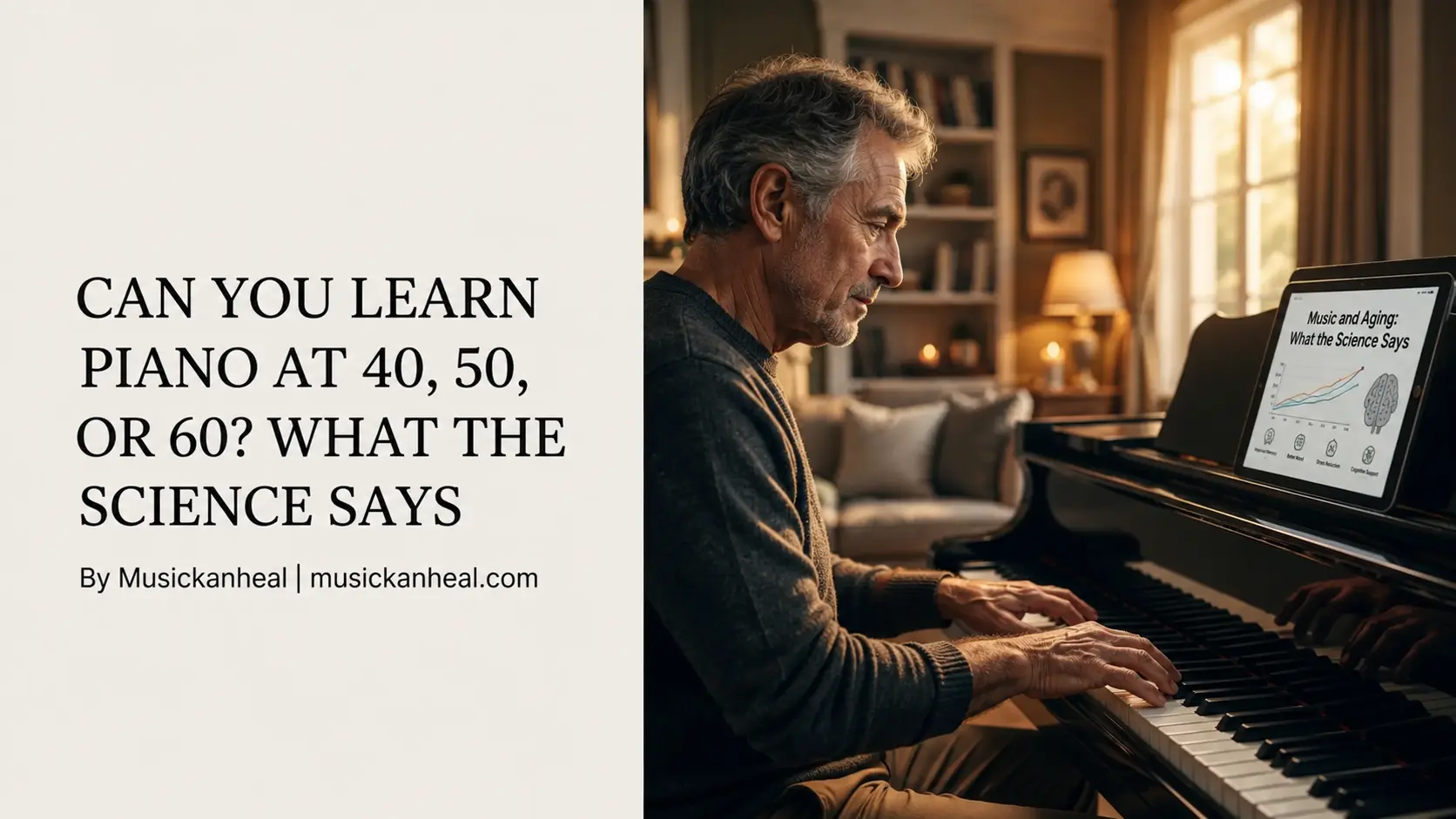
Can You Learn Piano at 40, 50, or 60? What the Science Says
You probably didn’t search “learn piano at 40” because you doubted yourself in the abstract. Something specific triggered the question—a friend’s recital, an unused piano sitting in your living room, or a video of someone twice your age playing a piece you assumed was out of reach.
The old voice kicks in: Isn’t this a kid’s game?
It isn’t. Several of the strongest claims about adult learning aren’t motivational filler—they come from randomized controlled trials. People who learn piano at 40, 50, and 60 build real, measurable skill, and the research behind that is more specific than most articles bother to mention.
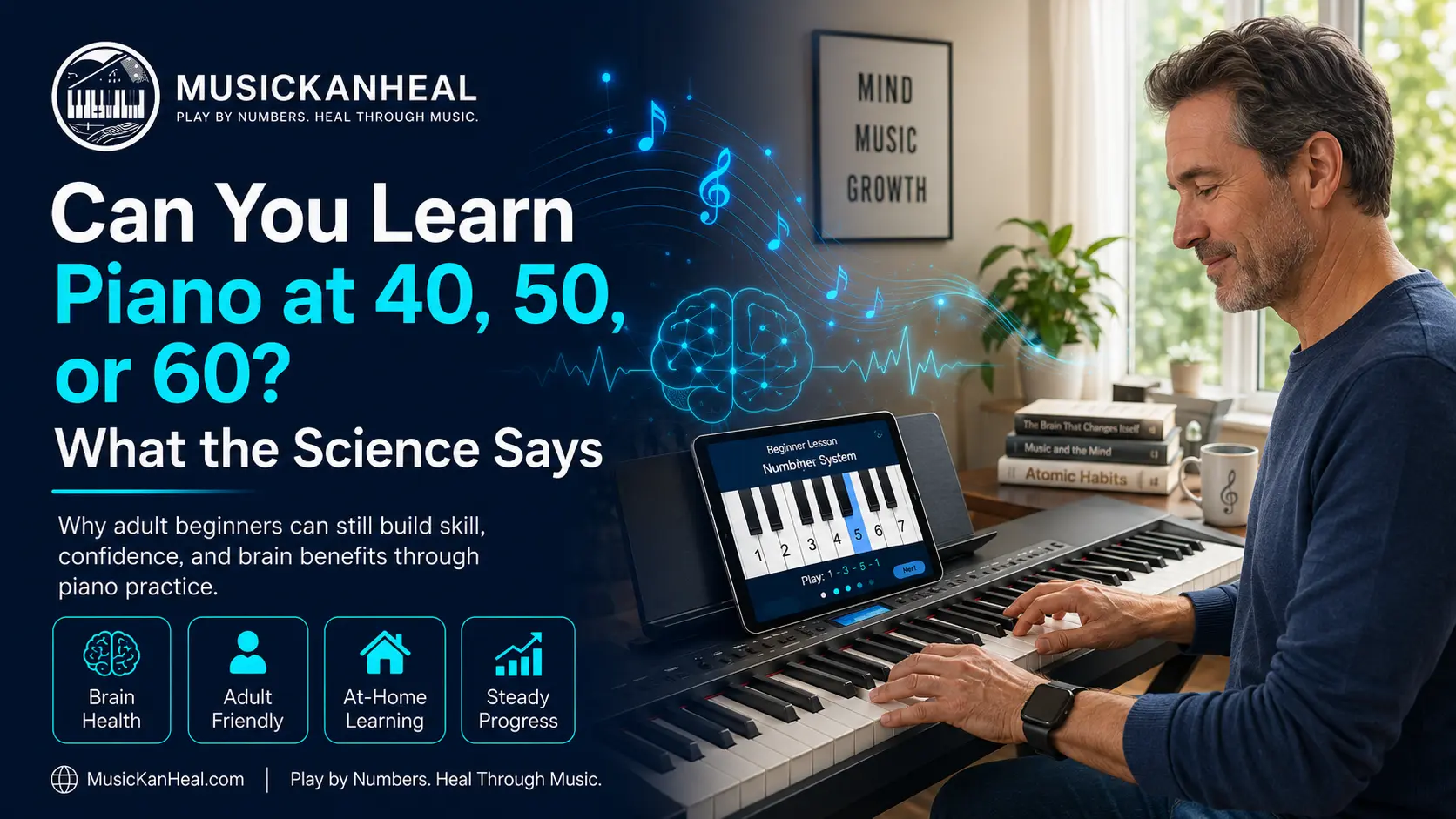
This article breaks the question apart by decade, because “can adults learn piano” isn’t the same question at 42 as it is at 67. We’ll cover what actually changes with age, what doesn’t, what a realistic timeline looks like and how to start without the years-long detour through traditional notation.
Learn Piano at 40? Here’s What the Science Actually Says
Search “is it too late to learn piano,” and you’ll find the same uncredited line copy-pasted across dozens of blogs: “Studies show adult brains can still learn.” Almost none of them name a study. That’s worth being suspicious of. Vague appeals to “science” are a red flag in any health or cognition claim, including this one.
Here’s what’s actually published. Researcher Jennifer Bugos and colleagues ran a randomized controlled trial on adults aged 60 to 80, comparing a piano training group against a no-training control group. The piano group showed measurable gains in executive function and self-efficacy, along with reduced cortisol levels, compared to people who never trained. An earlier Bugos study from 2007 found that six months of individualized piano instruction improved working memory and processing speed in older adults, with the gains holding up on follow-up testing.
A separate trial at the University of Bath looked at a different question: mood, not just cognition. Researchers split 31 adults into a piano-training group, a music-listening group, and a control group that simply did quiet homework. After 11 weekly piano lessons, the training group showed reduced depression, anxiety, and stress scores compared to where they started—a change the other two groups didn’t show.
None of this makes piano a substitute for medical care. It means the “it’s too late” belief isn’t supported by the people who actually study adult brains. If you want to learn piano at 40 purely for the joy of it, that’s reason enough. If you needed the research’s permission first, you have it now.
Learn Piano at 40 vs. 50 vs. 60: What Actually Changes
Most articles lump every adult learner into one bucket. That’s lazy, and it doesn’t match what teachers who specialize in adult students actually report.
- Starting at 40: Your hands are near peak dexterity for your lifetime, and decades of pattern recognition from work and life transfer directly into reading chord shapes and rhythms. The real obstacle isn’t ability. It’s time—careers and kids eat up the hours a teenager would spend practicing.
- Starting at 50: Some early stiffness in fingers and wrists is common, and bench height and posture start to matter more than they did at 30. This decade also tends to bring the steepest jump in patience and follow-through, and those traits predict piano progress better than age does.
- Starting at 60 and beyond: Joint stiffness and slower fine-motor recovery are real, and pretending otherwise helps no one. What also tends to show up: more free time, steadier emotional regulation, and — per the research above — a brain that responds particularly well to structured, multisensory training.
The pattern across all three decades is consistent. Physical limitations are manageable with small adjustments, but motivation and consistency predict success far more than age does. Whether someone learns piano at 40 or at 65, the same two habits decide the outcome: showing up and not quitting in month two.
The Real Obstacles — and What to Do About Them
Three things derail adult beginners more often than age does.
- Time scarcity. Adults rarely fail at piano because they’re too old. They fail because they copy a child’s lesson structure — one long weekly session plus homework — onto a schedule with no slack in it.
- Perfectionism. Adults compare week-one playing to a professional’s recording, then quit out of embarrassment. Kids skip this trap because they haven’t learned self-consciousness yet.
- Notation overload. Traditional sheet music takes years to read fluently. For someone starting at 45 or 55, that multi-year on-ramp before playing a recognizable song is often where motivation quietly dies.
That last obstacle has a real workaround. Methods that replace staff notation with a simpler system let beginners play actual songs within days instead of years. The Nashville Number System assigns the numbers 1 through 7 to scale notes instead of requiring fluent sheet reading, and The MKH Method is built specifically around it, with adult beginners listed as one of its core use cases.
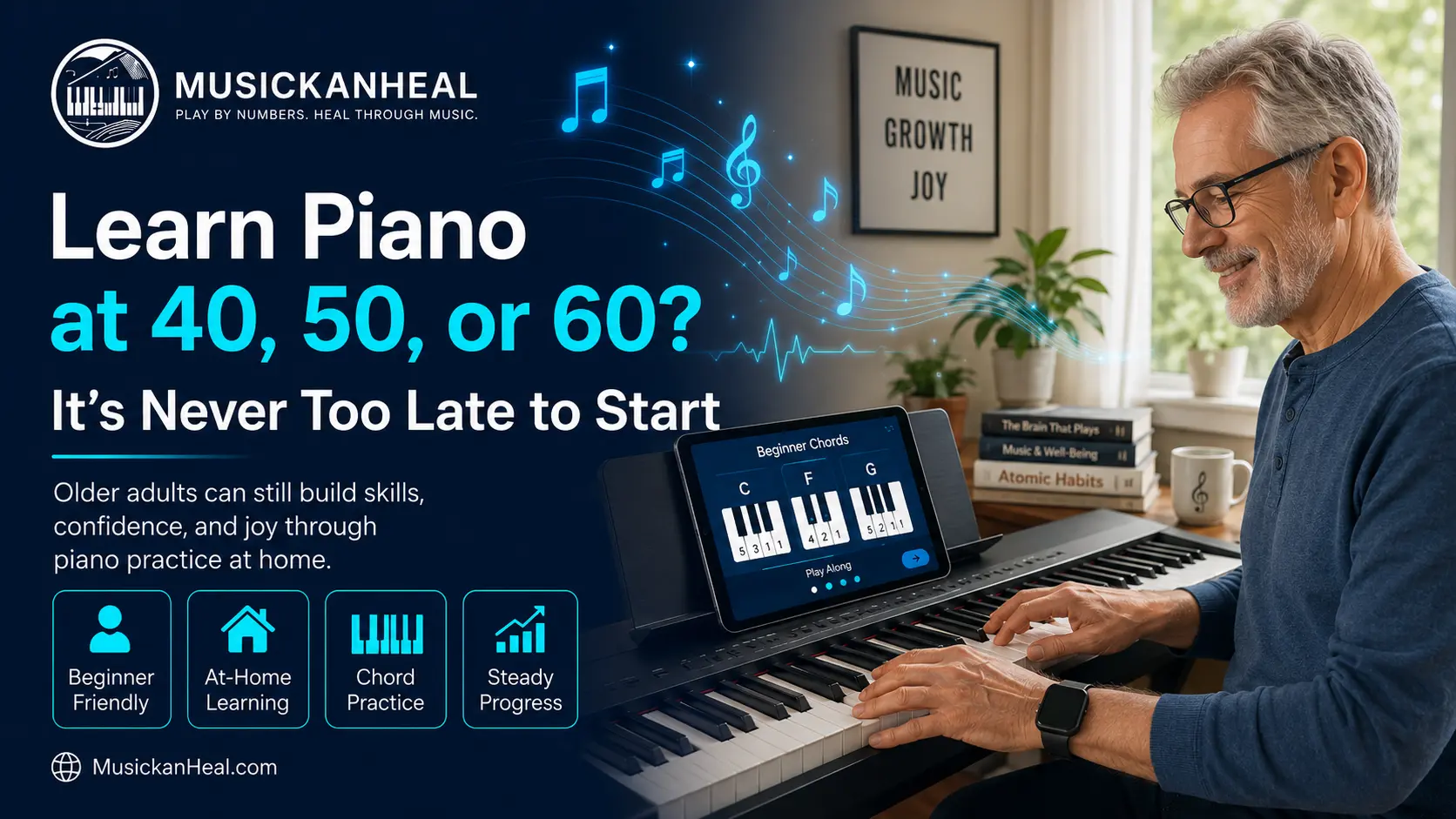
What Keyboard or Piano Should You Buy as an Adult Beginner?
You don’t need an acoustic piano to start, and spending heavily up front is a common reason adults abandon the hobby before it sticks.
- Get 88 weighted keys. Anything fewer limits the songs you can play later; weighted keys teach proper finger pressure from day one.
- Buy headphones, not a soundproof room. A keyboard with a headphone jack lets you practice at 11pm without negotiating with a household.
- Skip the bundle upsells. Stands, pedals, and stools matter eventually, not in week one. A flat surface and a chair will get you through the first month.
- Test the action in person if you can. Some keyboards feel mushy under the fingers; if you’re transitioning from an acoustic piano you played decades ago, that difference is noticeable.
A mid-range digital keyboard is the right call for almost every adult starting from zero. You can always upgrade once you know you’ll stick with it.
How Long Does It Take an Adult to Learn Piano?
Realistic timelines, based on what teachers who specialize in adult students consistently report:
- Weeks 1–4: Basic hand position, a handful of chords, simple one-handed melodies.
- Months 2–6: Two-handed coordination, a few recognizable songs, growing comfort reading chord charts.
- Year 1: Genuinely enjoyable playing of real music — not concert-level, but unmistakably music.
- Years 2–3: Noticeable fluency, faster pickup of new songs, real technical confidence.
These numbers hold up reasonably consistently whether someone starts at 25 or 65, with one important caveat: total practice time matters more than calendar time. Twenty focused minutes a day outpaces two distracted hours once a week, at any age.
A Practice Routine That Fits an Adult Schedule
Forget the conservatory model built for someone with no job and no children. A sustainable adult practice session looks closer to this:
- 2 minutes: hand and wrist warm-up
- 5 minutes: a scale or chord pattern in one key
- 10 minutes: working on the current song
- 3 minutes: playing something you already know, purely for enjoyment
That last step gets skipped constantly, and it shouldn’t be. Pure enjoyment is what carries people past the awkward beginner phase.
If stress relief matters as much as skill-building, pairing short practice with guided listening on low-motivation days keeps the habit alive without forcing it. MusicKanHeal’s healing audio is built around exactly that two-track approach: play when you feel like it and listen when you don’t.
Frequently Asked Questions About Learning Piano at 40, 50, or 60
Is it too late to learn piano at 60?
No. Research on adults aged 60 to 80 has shown measurable cognitive and emotional benefits from structured piano training, including improved executive function and reduced stress markers. Joint stiffness is real but manageable with proper warm-ups and pacing—it changes the routine, not whether you can learn.
How long does it take to learn piano if you start at 40?
Most adult beginners play simple, recognizable songs within the first one to six months and reach comfortable, enjoyable fluency around the one-year mark with consistent practice. Total practice time matters more than calendar time, so 20 focused minutes daily beats occasional long sessions.
Can arthritis or stiff joints stop an adult from learning piano?
Mild arthritis or stiffness typically slows progress rather than blocking it. Shorter sessions, proper warm-ups, and attention to bench height and posture go a long way toward managing it. Anyone with significant joint pain should check with a doctor or physical therapist first, since small technique adjustments can prevent strain.
Do adults need a teacher, or can they self-teach piano?
Either approach can work. A teacher speeds up technique correction and adds accountability, while simplified, self-directed methods that skip traditional notation let motivated adults make fast progress without a weekly commitment. The right choice depends more on your schedule and learning style than your age.
Does learning piano really reduce anxiety and improve memory in older adults?
A randomized controlled trial at the University of Bath found that adults who took piano lessons for 11 weeks showed reduced depression, anxiety, and stress scores, along with improved multisensory processing, compared to a control group. Separate trials led by researcher Jennifer Bugos found similar memory and processing-speed benefits in adults aged 60 to 80.
Conclusion
The honest answer to “Can you learn piano at 40, 50, or 60?” is yes, and not as a feel-good platitude. It’s something randomized controlled trials have actually measured. What changes with age is the shape of the obstacle, not whether it can be overcome. A 45-year-old fights time. A 65-year-old fights joint stiffness. Neither one fights a closed door.
All rights are reserved. Copyright 2026 MusicKanHeal | musickanheal.com