Binaural Beats vs Solfeggio Frequencies
Here’s the honest answer most wellness articles won’t give you: they’re not on the same playing field.
One has been tested in randomized controlled trials involving over a thousand patients. It has systematic reviews published in peer-reviewed journals. Researchers have measured its effects on brain waves with EEG equipment, tracked anxiety scores before and after, and watched it shorten the time it takes people to reach deep sleep.
The other is more about how it makes you feel—which isn’t worthless, but it isn’t clinical evidence either.
If you’ve been staring at YouTube videos promising that 528 Hz will “repair your DNA” or that 396 Hz will “liberate guilt,” you’ve earned a straight answer about what the research actually says on binaural beats vs solfeggio frequencies. This article gives you that so you can make a decision that actually helps your sleep and anxiety rather than just your YouTube recommendations algorithm.
And yes, one of them wins. We’ll tell you which one—and why.
What Are Binaural Beats and How Do They Actually Work?
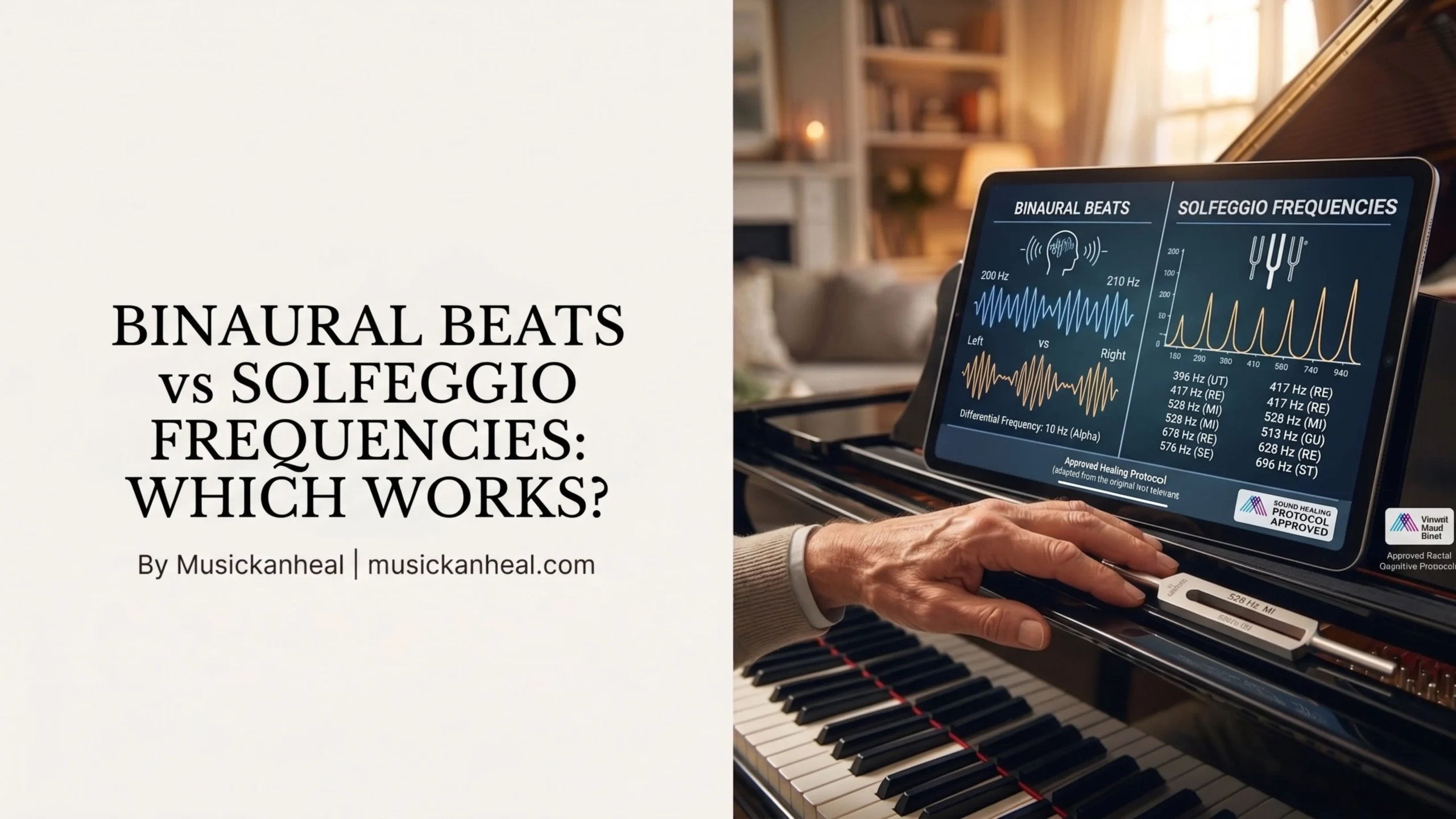
Binaural beats were first described in 1839 by physicist Heinrich Wilhelm Dove. The mechanism is specific: when you play two slightly different tones in each ear simultaneously — say, 200 Hz in the left ear and 210 Hz in the right — your brain doesn’t hear two tones. It perceives one pulsing beat at the difference between them, in this case 10 Hz. That 10 Hz beat doesn’t exist in the audio. Your brain generates it.
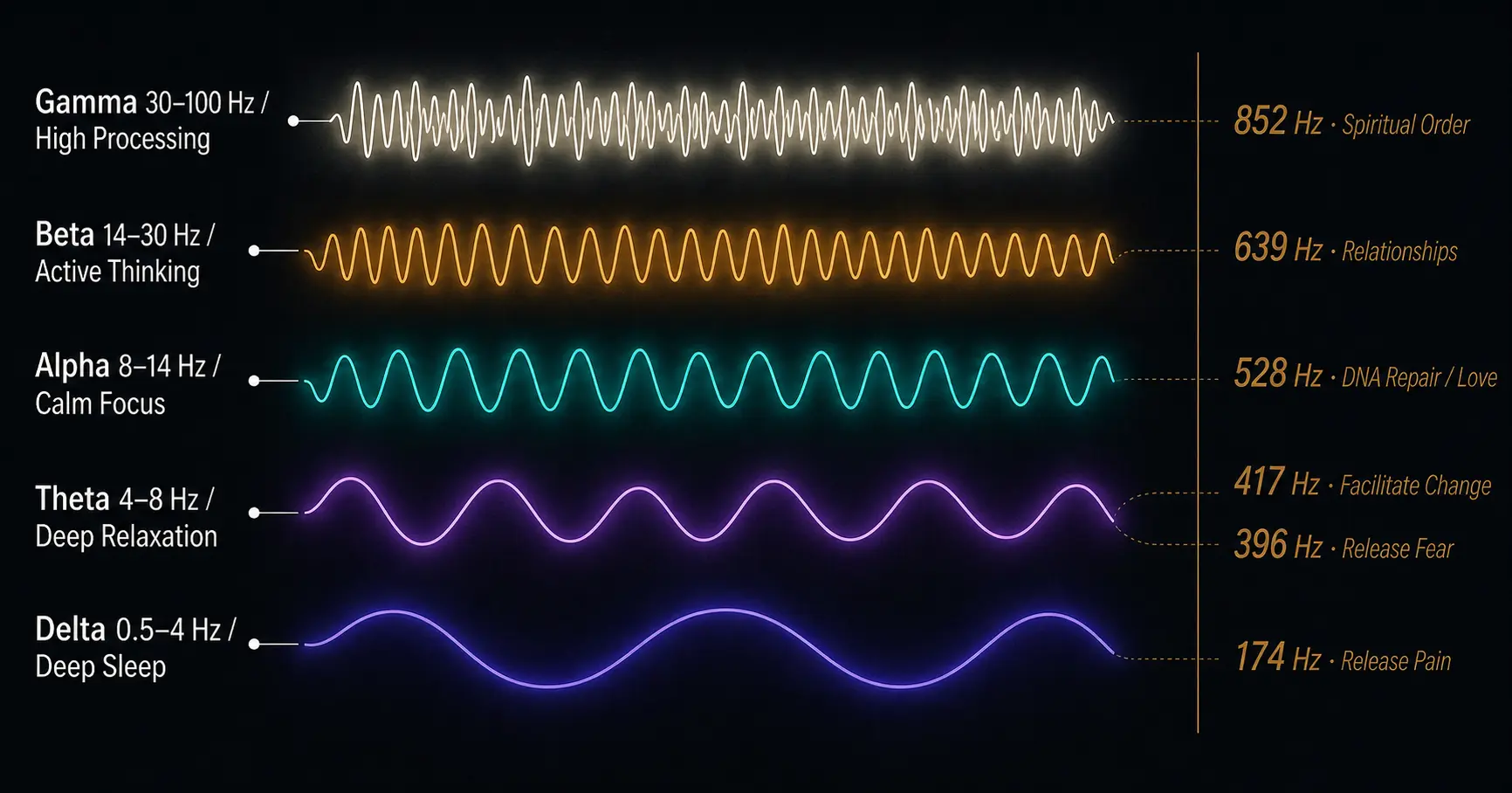
This matters because 10 Hz falls in the alpha brainwave range, the state associated with relaxed alertness. By adjusting the frequency difference, you can theoretically guide your brain toward different states:
- Delta (0.5–4 Hz): Deep sleep, physical restoration
- Theta (4–8 Hz): Drowsy relaxation, the edge of sleep, meditation
- Alpha (8–14 Hz): Calm focus, anxiety reduction
- Beta (14–30 Hz): Alert, active thinking
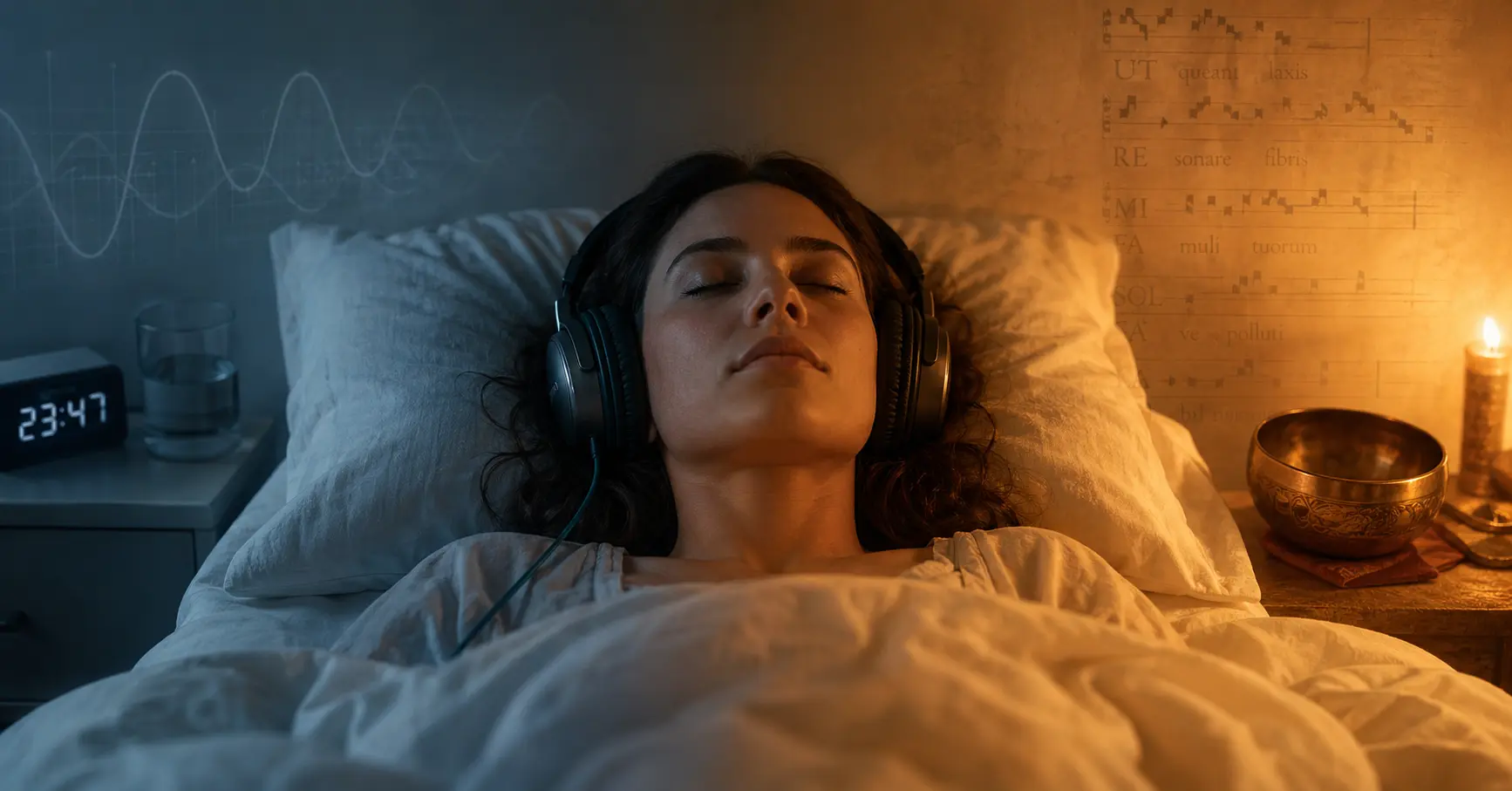
The key requirement: binaural beats only work through stereo headphones. Each ear needs to receive its separate frequency independently. Playing them through speakers defeats the whole mechanism because both ears hear both tones.
This is a real, neurologically-grounded phenomenon. The question isn’t whether the mechanism exists — it does. The question is how effective it is, and under what conditions.
What Are Solfeggio Frequencies? (And Where They Really Came From)
The popular claim is that solfeggio frequencies are ancient — rooted in Gregorian chants, dating back to Biblical times, used by medieval monks. That origin story is wrong, and it’s worth knowing why.
The modern solfeggio frequency system was actually developed by Dr. Joseph Puleo and Leonard Horowitz in the 1990s. The specific frequencies — 396 Hz, 417 Hz, 528 Hz, 639 Hz, 741 Hz, 852 Hz — were derived by applying numerological manipulation to Bible verse numbers. There is no historical documentation connecting these specific Hz values to Gregorian chants or any pre-20th century musical tradition. Musicologist and sound healing researcher sources, including a detailed fact-check by Science Feedback, confirm this directly.
That doesn’t mean the music sounds bad or that listening to it is useless. It means the spiritual origin story is not accurate.
Each solfeggio frequency is paired with a claimed benefit:
- 396 Hz: Releases guilt and fear
- 417 Hz: Facilitates change
- 528 Hz: “DNA repair” and transformation (the most popular)
- 639 Hz: Connecting relationships
- 741 Hz: Removes toxins and emotional blockages
- 852 Hz: Spiritual alignment
These are not medical claims supported by clinical trials. They are wellness marketing claims — some with small supporting studies, most with none.
Solfeggio frequencies are typically played as single tones layered under ambient music or nature sounds. Unlike binaural beats, they don’t require headphones and work the same whether you’re using earbuds, speakers, or anything else.
Does Research Actually Support Binaural Beats for Sleep and Anxiety?
Yes—with important nuance on what works and what doesn’t.
A 2024 study published in Scientific Reports found that binaural beats at 0.25 Hz significantly shortened the time it took participants to reach N2 and N3 sleep stages — the deep, restorative sleep stages — compared to a sham (silent) condition. This wasn’t a self-report survey. It measured actual physiological sleep stages.
A 2025 meta-analysis covering 15 randomized controlled trials across more than 1,000 surgical patients found that binaural beat audio significantly reduced perioperative anxiety, postoperative pain, systolic blood pressure, and heart rate — and outperformed non-binaural “placebo” music in direct comparisons.
A systematic review of binaural beats for non-clinical stress management, published in Applied Sciences in 2024, searched across six major databases and identified consistent effects on anxiety reduction across multiple study designs.
A 2025 insomnia pilot using customized binaural beat tracks found that 70% of adults with moderate-to-severe chronic insomnia met treatment-response criteria after four weeks.
The picture isn’t perfectly clean — some studies have methodological weaknesses, effect sizes vary, and individual responses differ significantly. But the body of evidence is real. Binaural beats are not placebo. For sleep and anxiety specifically, the delta and theta frequency ranges (0.5–8 Hz) have the strongest support.
One thing the research is consistent about: the specific frequency combination, carrier tone, and exposure duration all matter. A generic “binaural beats for sleep” playlist may or may not use the right parameters. This is worth checking before you assume any binaural audio will work.
Is There Real Science Behind Solfeggio Frequencies — or Is It Vibes?
This is the part most wellness sites dodge. Let’s not.
The honest summary: the science is thin, the claimed mechanisms are implausible, and the benefits people experience are most likely coming from the music itself rather than the specific Hz value.
Here’s what the evidence actually shows:
- The small supporting studies: A 2018 Japanese study found that music tuned to 528 Hz reduced cortisol levels compared to music at 440 Hz. A 2019 study on 15 males found that 432 Hz music had a calming effect based on brainwave activity. These are real studies, but they are small, and neither was a double-blind RCT.
- The implausibility problem: The claim that a specific audio frequency at 528 Hz “repairs DNA” or “removes toxins” has no biological mechanism. DNA repair is a cellular process that happens at the molecular level. Sound waves are pressure waves in air. The idea that one causes the other has no basis in biochemistry. Science Feedback reviewed this claim specifically and rated it unsupported.
- What’s probably actually happening: When you lie down, put on ambient music, close your eyes, and relax for 20 minutes, you will likely feel calmer. That effect is real — but it’s attributable to the relaxation practice, the ambient music quality, and the mental intention you brought to it. The specific Hz value is almost certainly not the active ingredient.
This doesn’t mean solfeggio frequency music is worthless. It can serve as a meditation anchor, a sleep ritual, or a spiritual practice. Those are legitimate uses. But if you’re comparing binaural beats vs solfeggio frequencies for measurable anxiety relief or clinically improved sleep, the evidence gap is wide.
Binaural Beats vs Solfeggio Frequencies: The Honest Verdict
For sleep: Binaural beats win on evidence. Delta-range binaural beats (0.5–4 Hz) have been measured in controlled studies shortening time to deep sleep and improving sleep efficiency. Start with theta (4–8 Hz) during your wind-down period and shift to delta as you fall asleep.
For anxiety: Binaural beats win on evidence. Alpha-range beats (8–14 Hz) have demonstrated consistent anxiety reduction across multiple study designs. The 2025 surgical meta-analysis alone—1,000+ patients, anxiety measured against controls — is more evidence than the entire solfeggio research base combined.
For spiritual practice, meditation anchoring, or general relaxation: Solfeggio frequencies are a valid personal choice. If 528 Hz ambient music helps you feel grounded before bed, use it. You’re not being deceived by physics—you’re using music as a ritual tool, which is a real thing with real psychological value.
The key difference to remember: Binaural beats work by directly influencing brain electrical activity through an auditory illusion. Solfeggio frequencies work (to the extent they work) the same way all relaxing music works — through association, intention, and the physiological effects of calm-inducing sound. Both can be part of your routine through the healing therapy features on MusicKanHeal, which is built around the idea that music engagement—in whatever form reaches you—has measurable mental health value.
How to Use Each One Effectively
Once you’ve decided which to try—or both—the details of how matter more than most guides admit.
Using binaural beats effectively:
- Stereo headphones are non-negotiable. Standard earbuds work. Over-ear headphones are ideal. If you’re using speakers, you’re not getting binaural beats — you’re getting regular music.
- Choose the right frequency for your goal. For falling asleep: start with theta (6–8 Hz) for 15–20 minutes, then switch to delta (1–3 Hz) as you’re close to sleep. For daytime anxiety: alpha range (8–12 Hz) for 20–30 minutes. Most quality binaural beat apps specify the frequency — if they don’t, that’s a flag.
- Volume should be low. You don’t need loud audio. The beat effect works at low volume, and high volume will keep you awake.
- Give it at least 10–15 minutes. Short exposures are unlikely to produce measurable brainwave shift. Most studies that showed results used 20–30 minute sessions.
Using solfeggio frequencies intentionally:
- No headphones required. Works fine on a speaker, which makes it easier to use during sleep without discomfort.
- Set an intention. The psychological research on ritual and healing suggests that the mental frame you bring to a practice shapes its outcomes. If you treat 528 Hz music as a meaningful signal that relaxation begins now, your nervous system will eventually treat it that way too.
- Combine with breathwork or body scans. The frequency itself may not be doing the work, but combined with slow breathing, the music becomes a useful anchor for a genuine calming practice.
- Don’t use it as a substitute for clinical care. If you’re dealing with clinical anxiety or a diagnosed sleep disorder, both of these tools are adjuncts — not treatments. Learning to make music actively is one of the most evidence-backed mental health interventions available, as covered in our piece on how MusicKanHeal enhances both your piano skills and mental well-being.
The Bottom Line
The binaural beats vs solfeggio frequencies question has a clear answer if you follow the research: binaural beats have earned clinical credibility across hundreds of controlled trials; solfeggio frequencies have not.
That doesn’t mean solfeggio music is worthless. It means its value comes from the same place all meaningful music comes from — rhythm, mood, association, ritual, and the simple act of giving your nervous system permission to slow down.
And in either case, remember that actively engaging with music—playing it, not just consuming it—remains one of the most evidence-backed paths to long-term mental health. That’s the angle the Mount Sinai research made clear, and it’s what tools like MusicKanHeal are built around.
Frequently Asked Questions
Do binaural beats vs solfeggio frequencies both require headphones to work?
Only binaural beats require headphones — the mechanism depends on each ear receiving a different frequency independently. Solfeggio frequencies are standard audio and work through any speaker or earbuds. If you’re using binaural beats through a stereo speaker, you’re not getting the binaural effect at all.
Can binaural beats actually help with anxiety, or is it just placebo?
The evidence says it’s not purely placebo. A 2025 meta-analysis of 15 RCTs covering more than 1,000 patients found significant reductions in anxiety using binaural beat audio compared to controls. Alpha-range binaural beats (8–14 Hz) in particular show consistent anxiety-reducing effects across multiple study designs. That said, individual responses vary, and no single tool works for everyone.
What is the best binaural beat frequency for sleep?
Delta frequencies (0.5–4 Hz) have the strongest evidence for deep sleep. A 2024 Scientific Reports study specifically showed that 0.25 Hz binaural beats shortened the time to reach slow-wave sleep. Practically, most sleep experts recommend starting with theta (4–8 Hz) as you wind down — to ease the transition from wakefulness — then switching to delta audio as you get close to sleeping.
Is 528 Hz scientifically proven to repair DNA or reduce anxiety?
The DNA repair claim has no scientific support and is biologically implausible — it was derived from numerological manipulation of Bible verse numbers in the 1990s, not from ancient Gregorian tradition or any clinical evidence. There are two small studies (a 2018 Japanese study and a 2019 study) suggesting 528 Hz music may reduce cortisol — but these used tiny samples and weren’t double-blind RCTs. 528 Hz music can still be relaxing and useful as a meditation aid. Just not because of DNA repair.
Can you use binaural beats vs solfeggio frequencies together at the same time?
Technically yes — some audio tracks layer solfeggio-tuned ambient music under binaural beat tones, and anecdotally people find this useful. The binaural beat mechanism (which needs headphones) would still work regardless of the underlying music’s tuning. Whether stacking both provides any added benefit over binaural beats alone has not been studied. Keep it simple: use whichever creates a consistent pre-sleep or anxiety-reduction ritual you’ll actually stick to.
All rights are reserved. Copyright 2026 MusicKanHeal | musickanheal.com