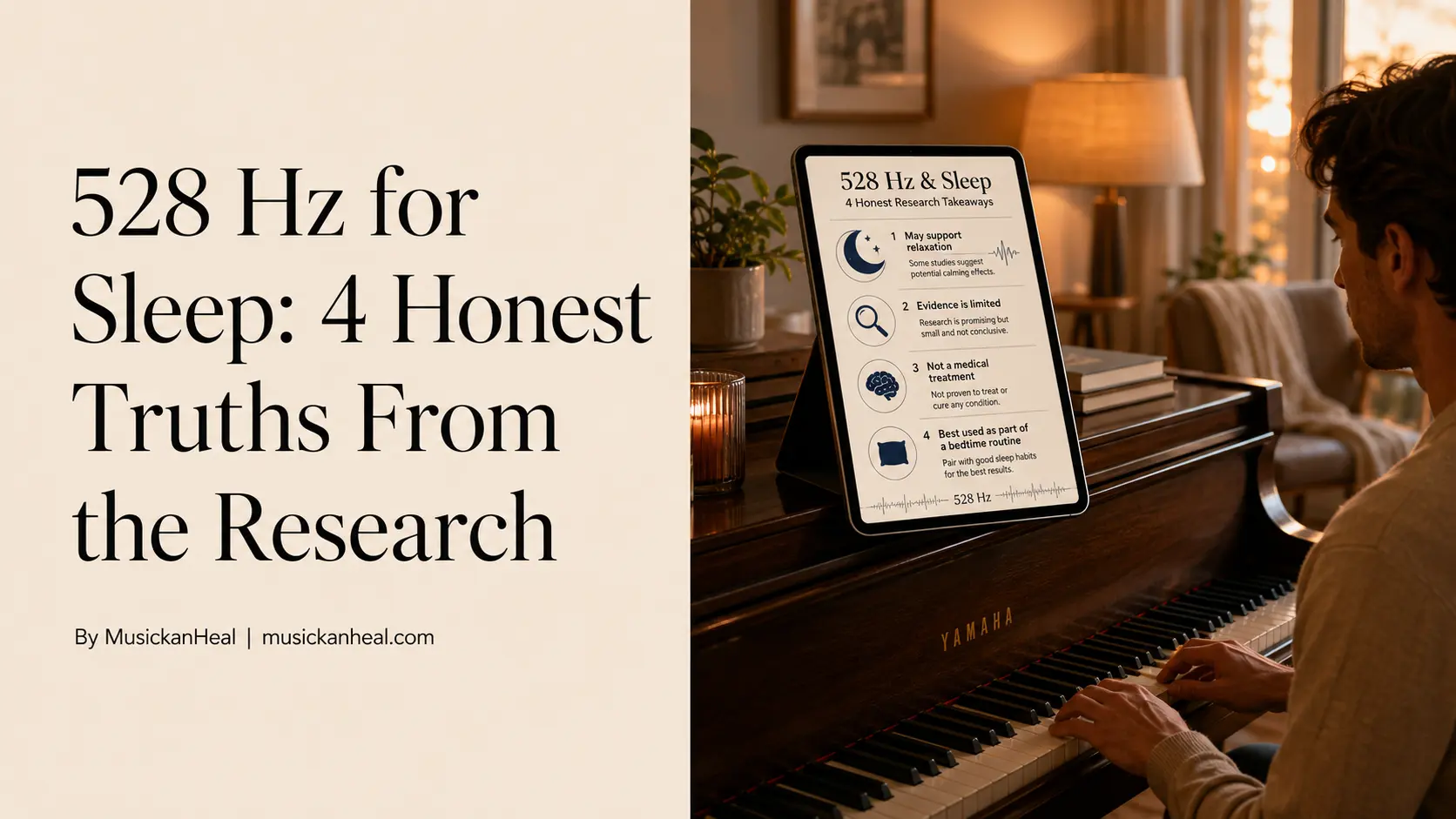
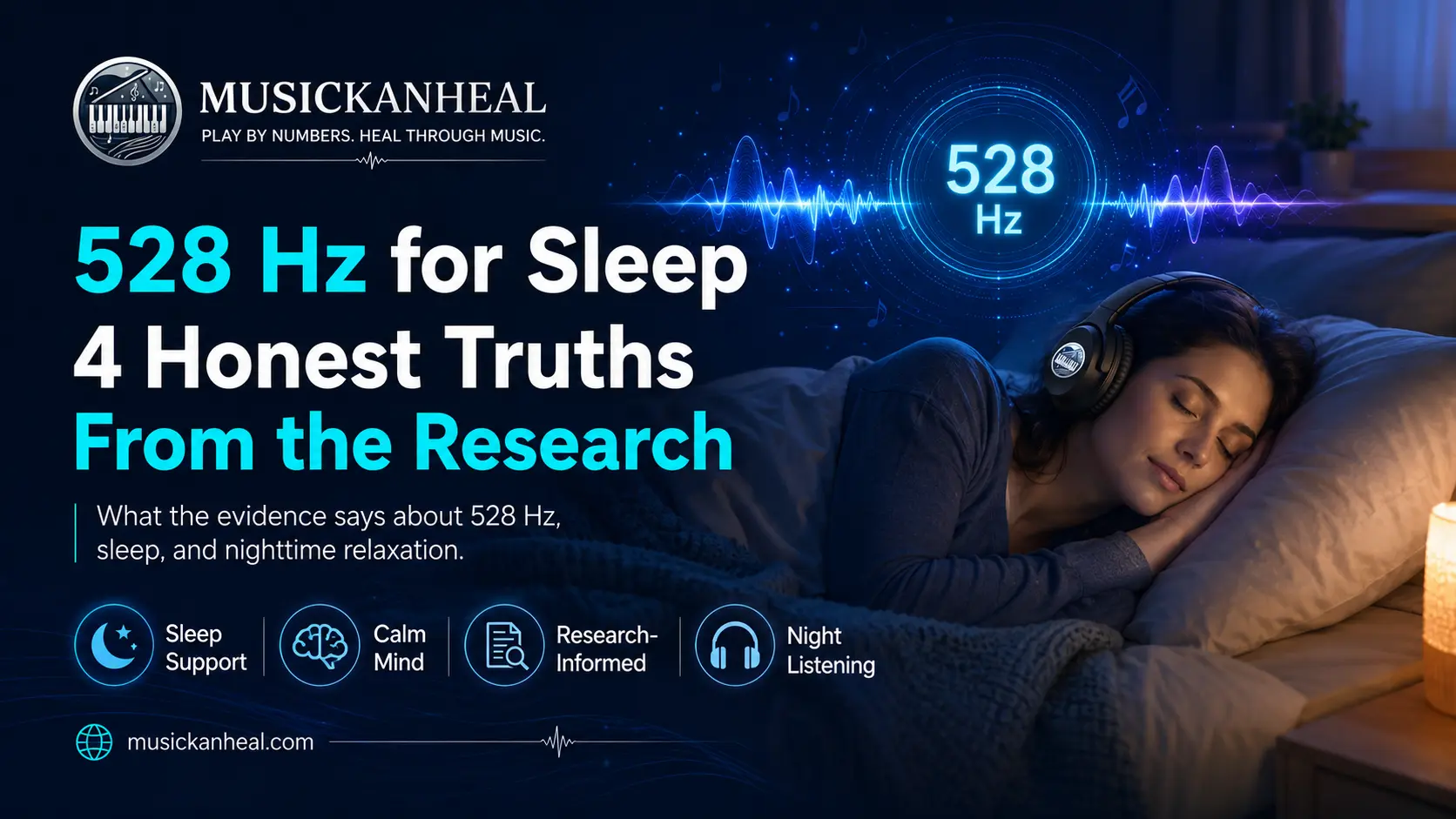
528 Hz for Sleep: 4 Honest Truths From the Research
If you’ve searched “528 Hz for sleep” at 1 a.m. hoping for a straight answer, you’ve probably landed on ten different tabs telling you ten different things. One site swears by it. Another calls it new-age noise. A third sells you an eight-hour YouTube video and calls that proof.
The honest version sits between those extremes, and it’s more useful than either. There is real research on how 528 Hz affects stress hormones. There is no research showing it beats other calming sounds for actually getting you to sleep. Both of those facts matter, and most articles online only give you one of them.
This piece separates what’s been measured from what’s been marketed and gives you a way to use 528 Hz for sleep tonight without either overselling it or writing it off.
Does 528 Hz Actually Help You Sleep? The Short Answer
Yes, for some people, in the same way a lot of calming sounds help some people. No, not because 528 Hz has a special property other frequencies lack. The frequency isn’t magic, but the practice of winding down with slow, predictable, low-volume sound is genuinely useful for sleep, and 528 Hz happens to be a popular vehicle for that practice.
That distinction is the whole article, and it’s worth sitting with before you keep reading: the calming effect is real, but it’s coming from the sound’s general qualities more than the number 528 itself.
Part of why this gets confusing is sheer volume. Search interest in 528 Hz has climbed for years, and the content answering it splits hard into two camps: total believers and total dismissers. Neither camp is describing the actual research very accurately, which is the gap this article is trying to close.
What the 528 Hz Sleep Studies Actually Measured
The most cited piece of research behind every 528 Hz sleep claim is a small 2018 study, in which researchers measured salivary cortisol and oxytocin in nine adults after five minutes of listening to music tuned to 528 Hz versus the same music at standard 440 Hz tuning. Cortisol dropped and oxytocin rose after the 528 Hz session, with no significant change after the 440 Hz session. Tension and anxiety scores also improved compared to the 440 Hz condition.
That’s a real, measurable effect on stress hormones. It is not a sleep study. Nobody in that research went to bed, and nobody measured sleep onset, sleep duration, or sleep quality. Every claim online about 528 Hz helping you fall asleep faster is extrapolating from a five-minute stress-hormone measurement taken during the day, not from anyone’s actual night of sleep. (Source: the 2018 Akimoto study)
The sample size is worth remembering too. Nine people is enough to justify follow-up research. It is not enough to justify the sweeping claims built on top of it across thousands of wellness blogs and YouTube video descriptions.
If you want the fuller picture on where the DNA-repair and miracle-tone claims around 528 Hz actually came from and what the evidence does and doesn’t support, this breakdown of 528 Hz claims tested against real science covers that ground in detail.
Why “Brainwave Entrainment” Doesn’t Work the Way Most 528 Hz Content Claims
A lot of sleep-focused 528 Hz content leans on the word entrainment: the idea that your brainwaves sync up to an external sound. That’s a real phenomenon in sleep science, but it doesn’t apply to 528 Hz the way it’s usually described.
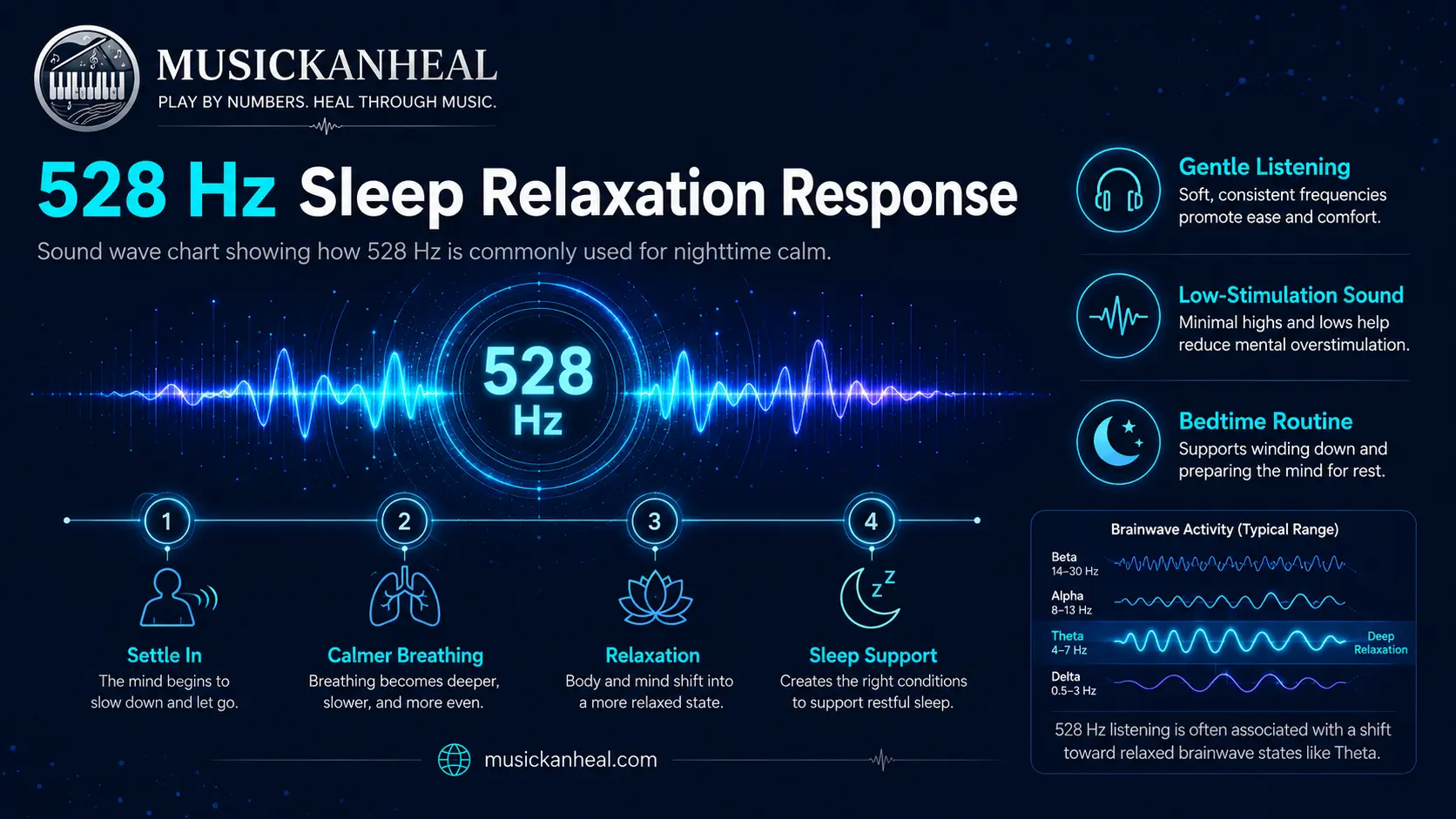
Sleep-relevant brainwave states sit at frequencies far below what you can hear. Delta waves, associated with deep sleep, run at roughly 0.5 to 4 Hz. Theta waves, linked to lighter sleep stages, run at 4 to 8 Hz. A pure 528 Hz tone is somewhere between 66 and over 1,000 times higher than those ranges, which means it cannot directly entrain them the way the term implies.
Binaural beats work through a different, more defensible mechanism. Play two slightly different tones, one in each ear, say 200 Hz and 208 Hz, and the brain perceives a third, phantom beat at the difference between them, in this case 8 Hz, which does sit inside a genuinely sleep-relevant range. Research protocols studying overnight binaural beat audio for sleep entrainment have measured real changes in brainwave activity using this exact mechanism. That’s an actual entrainment pathway with a plausible physical basis. A single 528 Hz tone playing through both ears isn’t using it, no matter how the marketing copy describes it.
None of this means 528 Hz audio is useless for sleep. It means the word “entrainment” is being borrowed from a different technique and applied somewhere it doesn’t technically fit. This comparison of binaural beats versus solfeggio frequencies breaks the distinction down further if you’re deciding between the two.
What’s Actually Proven to Help You Sleep, With or Without a Specific Hz Number
Strip away the frequency-specific claims, and the evidence for sound-based sleep support gets a lot stronger, just less exciting to write headlines about.
Slow, predictable music, generally anything without sudden volume changes, complex melodic shifts, or lyrics, reliably lowers heart rate and reduces pre-sleep cortisol. A tempo around 60 beats per minute is consistently associated with a calming physiological effect, regardless of the tuning frequency running underneath it.
Pink noise, a specific blend of frequencies weighted toward the lower end of the audible range, has real research support for improving slow-wave sleep stability. That effect works mostly through masking disruptive environmental sounds rather than through any deeper mechanism tied to a specific number.
There’s also a simpler physiological story underneath all of this: slow, predictable sound nudges the nervous system out of a sympathetic, alert state and into a parasympathetic, rest-oriented one. Heart rate drops, breathing slows, and cortisol follows. That shift happens with a metronome, a fan, or a cello playing at the right tempo, not exclusively with any specific Hz number.
Put simply: what’s doing most of the work in a calming 528 Hz track is its tempo, predictability, and volume, not the number printed in the video title. If a 528 Hz recording happens to have those qualities, and most ambient tracks in this genre do, it will probably help you the same way any well-made ambient track would.
How to Use 528 Hz for Sleep Without Wasting Your Night
Keep the Volume Under 70 Decibels
Roughly conversational volume is the ceiling. Louder audio risks disrupting sleep rather than supporting it, and can cause hearing strain over the course of a full night.
Time It: 15–30 Minutes Before Bed, or All Night
Give it 15 to 30 minutes before you actually expect to fall asleep, or let it play through the night at low volume. Both approaches have supporting evidence for general calming audio, and there’s no research pinning down one timing as better than the other specifically for 528 Hz.
Skip Sudden Swells and Spoken Affirmations
Tracks with sudden swells, key changes, or spoken affirmations layered underneath the tone keep your brain actively evaluating content, which works against the goal of winding down.
Headphones or Speaker — Pick What Keeps You Asleep
Use headphones if you’re a light sleeper who wakes to a partner’s movement or household noise. Use a speaker at low volume if headphones feel uncomfortable overnight. Neither option is objectively better for the frequency itself.
Consistency Beats the Exact Number
A sound your brain has learned to associate with sleep becomes part of the mechanism over time, which means the habit itself matters more than the exact Hz number you started with.
If you want a starting point that’s already built for this instead of hunting through hours-long YouTube uploads, MusicKanHeal’s healing audio library has guided tracks designed specifically for winding down before bed, which is a more reliable starting point than the algorithm.
When 528 Hz Isn’t Enough: Signs You Need More Than a Playlist
Sound is a reasonable, low-risk tool for the occasional restless night. It is not a treatment for a diagnosed sleep disorder, and that difference matters more than most 528 Hz content admits.
Chronic insomnia has a specific clinical definition: trouble falling or staying asleep at least three nights a week, for three months or longer, with a noticeable impact on daytime functioning. If that describes your sleep, a playlist isn’t the right first move, no matter how well-produced it is.
Cognitive behavioral therapy for insomnia, usually shortened to CBT-I, has the strongest evidence base of any insomnia treatment available, medication included. It’s worth pursuing with a doctor or sleep specialist rather than layering more ambient tracks onto a problem that needs a different kind of intervention entirely.
Using 528 Hz on an otherwise normal night when you just want to wind down faster is a reasonable, evidence-adjacent choice. Using it instead of addressing a genuine, ongoing sleep disorder mostly delays the thing that would actually fix it.
The Bottom Line
528 Hz for sleep isn’t a myth, and it isn’t a miracle. The stress-hormone research behind it is real, small, and specific to a five-minute daytime measurement, not a night of actual sleep. The entrainment story most content repeats is borrowed from a different technique that doesn’t technically apply to a single audible tone. And the qualities actually driving the calming effect — slow tempo, predictability, low volume, consistency — belong to good ambient sound in general, not to the number 528 specifically.
Frequently Asked Questions About 528 Hz for Sleep
Is 528 Hz for sleep safe to play all night?
Yes, for most people, as long as the volume stays low, under about 70 decibels, similar to normal conversation. There’s no evidence that all-night exposure to 528 Hz causes harm beyond the general risk of any audio played at high volume for hours, which is auditory fatigue, not anything specific to the frequency itself. If you share a bed, headphones or a low-volume speaker both work fine.
How long should you listen to 528 Hz for sleep before it works?
The one human study behind most of the claims measured effects after just five minutes, though that study looked at stress hormones, not sleep onset. In practice, 15 to 30 minutes before bed is a reasonable starting point, and letting it play through the night is fine too. There’s no research pinning down an ideal duration specifically for sleep outcomes, so consistency matters more than hitting an exact number.
What’s the difference between 528 Hz and binaural beats for sleep?
528 Hz is a single audible tone, generally too high in frequency to directly correspond to any sleep-related brainwave state. Binaural beats use two slightly different tones to create a perceived low-frequency beat that can sit within actual sleep-relevant ranges, which gives binaural beats a more direct, if still preliminary, entrainment mechanism. Neither is dramatically better studied than the other for sleep specifically, but the underlying science behind each claim is different.
Can 528 Hz replace treatment for chronic insomnia?
No. Chronic insomnia, trouble sleeping at least three nights a week for three months or more with daytime impact, responds best to cognitive behavioral therapy for insomnia (CBT-I), which has stronger evidence than any sound-based approach. Ambient audio like 528 Hz can be a reasonable addition alongside treatment, not a substitute for it.
Does 528 Hz work better than other calming music for sleep?
There’s no research showing it outperforms other slow, predictable, low-volume music for sleep specifically. The qualities that make ambient audio calming, tempo, consistency, absence of sudden changes, appear to matter more than the exact tuning frequency underneath them, so the best choice is usually whichever track you’ll actually listen to consistently.
All rights are reserved. Copyright 2026 MusicKanHeal | musickanheal.com