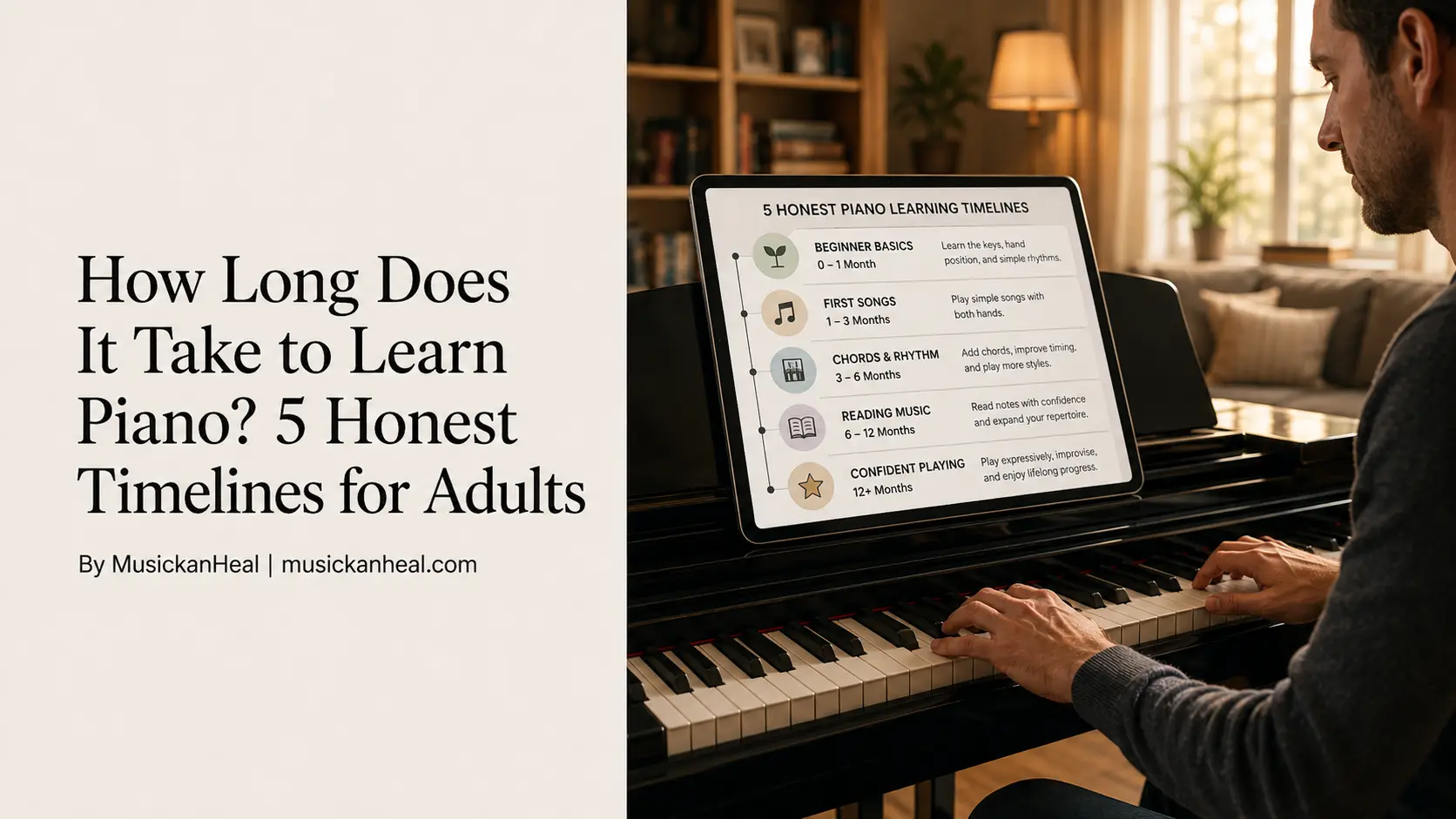
How Long Does It Take to Learn Piano? 5 Honest Timelines for Adults
If you have typed “how long does it take to learn piano” into Google at 11 p.m. after watching someone play a song you love, you already know the problem with most answers: they contradict each other. One site says three months. Another says fifteen years. A YouTube ad promises you will be fluent in six weeks if you just buy the course.
None of them are lying, exactly. They are just answering a different question than the one you asked. “How long does it take to learn piano?” only makes sense once you decide what “learn piano” means to you and once you’re honest about how much time you’ll actually put in, not the amount you plan to put in during week one before life gets in the way.
This guide breaks the timeline into five real, achievable stages, tells you what actually changes your speed, and skips the vague “it depends” answer that leaves you no closer to a plan. By the end, you’ll know roughly how long it takes to learn piano at the level you’re actually aiming for — not the level a marketing headline is aiming for.
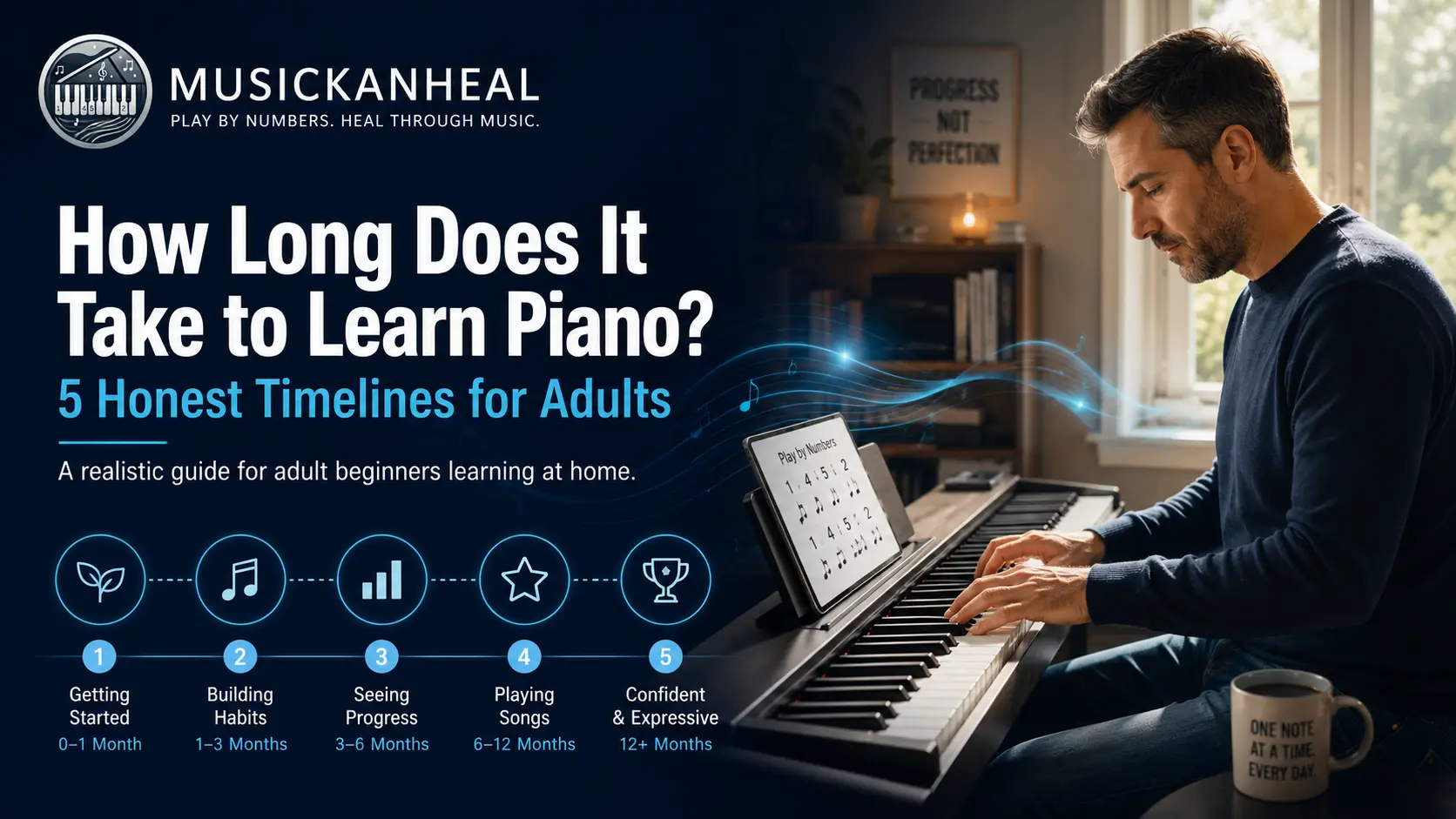
Stage 1: Your First Song (2 to 4 Weeks)
This is the milestone most beginners actually care about, even if they ask the question a different way. Can I sit down and play something recognizable without stopping every four seconds?
With 15 to 20 minutes of daily practice, most complete beginners can play a simple one-hand melody within two to three weeks. Add the left hand and basic chords, and a full, slow, two-hand arrangement of something like “Für Elise” (the opening bars) or a simple pop song is realistic within a month.
The catch: this stage moves fast because expectations are low. You’re not reading full sheet music yet. You’re pattern-matching finger positions to sound. That’s a legitimate skill, but it’s the easiest part of the whole journey, and it’s why the “learn piano in 30 days” ads aren’t technically lying — they’re just showing you stage one and calling it the whole trip.
Stage 2: Feeling Like an Actual Piano Player (3 to 6 Months)
Somewhere around month three or four, something shifts. You stop consciously thinking about where your fingers go for common chords. You can play a handful of songs from memory. A friend hears you and says, “Wait, you play piano?” — and for the first time, you don’t feel like you’re overselling it when you say yes.
This is also where most quitting happens. The early wins slow down, and piano starts asking for real, boring repetition: scales, hand independence, and reading two staves at once if you’re going the traditional route. Research on more than 1,000 pianists found that intermediate players most commonly reached that level after one to three years of consistent practice, but the jump from “beginner” to “comfortable novice” — the stage most people actually mean when they ask this question — happens much sooner, typically in the three-to-six-month range with regular practice.
What “regular” means matters more than people want to admit. Fifteen to twenty minutes daily beats ninety minutes once a week, every time, because muscle memory needs frequency more than duration.
Stage 3: Intermediate Playing (1 to 3 Years)
By this point you can pick up a moderately difficult song and work through it independently. You understand chord relationships well enough to fake your way through a song you’ve never practiced. If you started with the goal of accompanying yourself while singing, or playing worship music, or handling most pop songs by ear, this is usually where you land — and for a lot of adult learners, it’s also where the goal was met and further “advancement” stops mattering.
A 2026 survey of pianists found that 41% of intermediate players had been at it for one to three years and 34% for four to ten years — a wide range that mostly comes down to practice consistency, not talent.
Stage 4: What Actually Determines Your Timeline (Hint: Not Talent)
Every “how long to learn piano” article eventually gets to this list, because it’s the honest answer hiding underneath all the stage-by-stage numbers. Four things move your timeline more than anything else:
- Practice frequency, not session length. Five 20-minute sessions a week outperform one two-hour session, because your brain consolidates finger patterns during the gaps between sessions, not during the session itself.
- Whether you get feedback. Practicing a mistake for a month teaches your hands the mistake. A teacher, an app with note detection, or even recording yourself and comparing it to the original catches this early.
- What you’re learning to play. Chord-based playing (following a number or letter chart) gets you playing real songs faster than note-by-note sheet music reading because you’re not decoding a new symbol system while also building finger coordination.
- Whether you quit during the slow months. This is the biggest one and the least discussed. Most timeline estimates assume you don’t stop. The people who ask “how long does it take” and never touch a keyboard again get excluded from every survey and every statistic, which quietly makes every published timeline a little optimistic.
Stage 5: How Long Does It Take an Adult to Learn Piano Specifically?
Adults ask this question more anxiously than kids do, usually because of one assumption: that starting later means moving slower. The research doesn’t back that up. One piano teacher’s analysis found that “average” adult beginners make steady progress practicing 20 to 60 minutes most days, and adults typically bring better focus, clearer goals, and more self-discipline to practice than younger learners — the things that actually predict speed more than age does.
Where adults do lose time is the traditional path: private lessons built around method books originally designed for eight-year-olds, which spend months on songs adults have zero emotional interest in playing. That mismatch causes more adult dropouts than any lack of ability. If you’re mapping out a realistic path as an adult beginner, our 90-day plan for adult piano learners lays out a week-by-week structure built around that reality instead of around a curriculum written for children. And if age itself is the worry — not time, but whether 40, 50, or 60 is “too late” — the science on that question is worth reading on its own; we cover it in Can You Learn Piano at 40, 50, or 60?
Why the Learning Method Changes the Timeline More Than People Expect
Two adults can practice the exact same number of hours and land on wildly different timelines, and the difference usually isn’t discipline — it’s whether the method they’re using gets them playing real music early or makes them wait months for that payoff.
Apps have become the default starting point for a lot of adult beginners, and they genuinely compress the early timeline — but not all of them compress it the same way, and the honest tradeoffs are worth knowing before you pick one. Our breakdown of what app-based piano learning can and can’t do covers this in more detail, including where apps speed things up and where they eventually hit a ceiling.
The number-based approach — reading chord numbers instead of a full musical staff — is one of the more direct shortcuts to the “playing real songs” milestone, because it removes an entire layer of decoding (staff notation) while you’re still building basic finger coordination. If you want to see how that specific method compresses the early stages, the Nashville Number System is worth a look before you commit to a learning path.
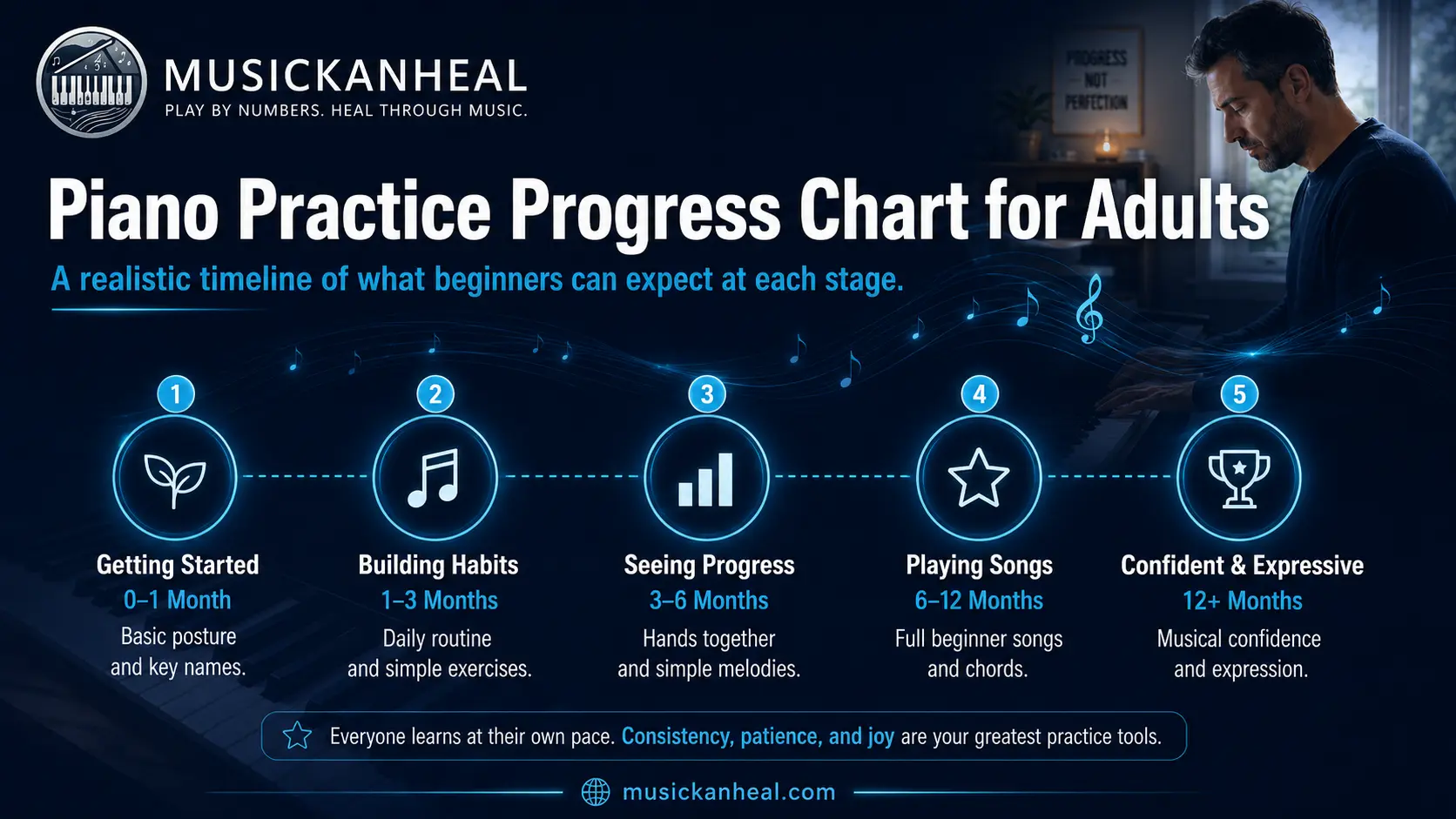
How Long It Takes to Learn Piano for a Specific Song
A lot of people asking how long it takes to learn piano aren’t thinking about the instrument in the abstract — they have one song in mind. The timeline for that shifts a lot depending on difficulty.
A simple pop song with basic block chords is realistic within your first month, even at a beginner level, especially using a chord-chart approach instead of full sheet music. Something like the opening of “Für Elise” — slow, one hand at a time — is also a first-month target for most beginners, though the full piece, up to tempo, with both hands, is closer to a three-to-six-month project.
Anything by Chopin, or a full classical piece with independent left- and right-hand parts moving at speed, is an intermediate-to-advanced target. That’s not a discouraging answer — it’s just accurate, and knowing it upfront saves you from picking a first song that guarantees frustration in week two.
The practical takeaway: if your motivation is “I want to learn piano well enough to play this one song,” pick a version of it that matches your current stage. A simplified arrangement you can actually finish beats the full sheet-music version you abandon halfway through.
A Realistic Practice Plan by Timeline Goal
If you want a rough framework instead of a single number, here’s how practice time maps to outcome for most adult beginners:
| Goal | Daily Practice | Timeframe |
|---|---|---|
| Play one recognizable song | 15–20 minutes | 2–4 weeks |
| Feel comfortable, not just capable | 20–30 minutes | 3–6 months |
| Handle new songs independently | 30+ minutes | 1–2 years |
| Reach a level others would call “good” | 45–60 minutes, ideally with feedback (teacher, app, or recording yourself) | 2–5 years |
None of these numbers assume natural talent. They assume consistency, which is the one variable you actually control.
Frequently Asked Questions About How Long It Takes to Learn Piano
How long does it take to learn piano as a complete beginner?
Most complete beginners can play a simple song within two to four weeks of daily 15-to-20-minute practice, and feel genuinely comfortable with basic playing within three to six months. Full musical fluency takes years, but “comfortable beginner” is a much closer, much more realistic target.
Is it possible to learn piano in 3 months?
You can reach a solid beginner level in three months with consistent daily practice — playing several songs, understanding basic chords, and reading simple notation. You won’t be intermediate yet, but three months is enough time to know whether piano is something you’ll stick with long-term.
How long does it take to learn piano as an adult with no musical background?
The timeline is nearly identical to younger beginners, sometimes faster, because adults typically bring more focus and self-discipline to practice sessions. The real variable is time available for daily practice, not age or lack of prior experience.
What slows down piano learning the most?
Inconsistent practice is the single biggest factor, followed closely by practicing without feedback, which lets mistakes turn into habits. Learning material that doesn’t match your actual goals — classical method books when you want to play pop songs, for example — is the third major drag on progress.
Can you learn piano faster with an app instead of a teacher?
Apps can speed up the early stages significantly because they give instant feedback and let you play recognizable songs sooner. They tend to plateau in teaching deeper technique and musical understanding, which is where a teacher or a structured method still has an edge past the six-month mark.
The Bottom Line
“How long does it take to learn piano” doesn’t have a single honest number, but it does have an honest structure: a few weeks to play something, a few months to feel like a player, a couple of years to feel genuinely capable, and a lifetime if you want to keep going. The version of that timeline you experience depends far more on consistency and method than on natural ability. Pick a practice rhythm you can actually sustain on a Tuesday in month four, not just on day one, and the timeline mostly takes care of itself.
All rights are reserved. Copyright 2026 MusicKanHeal | musickanheal.com