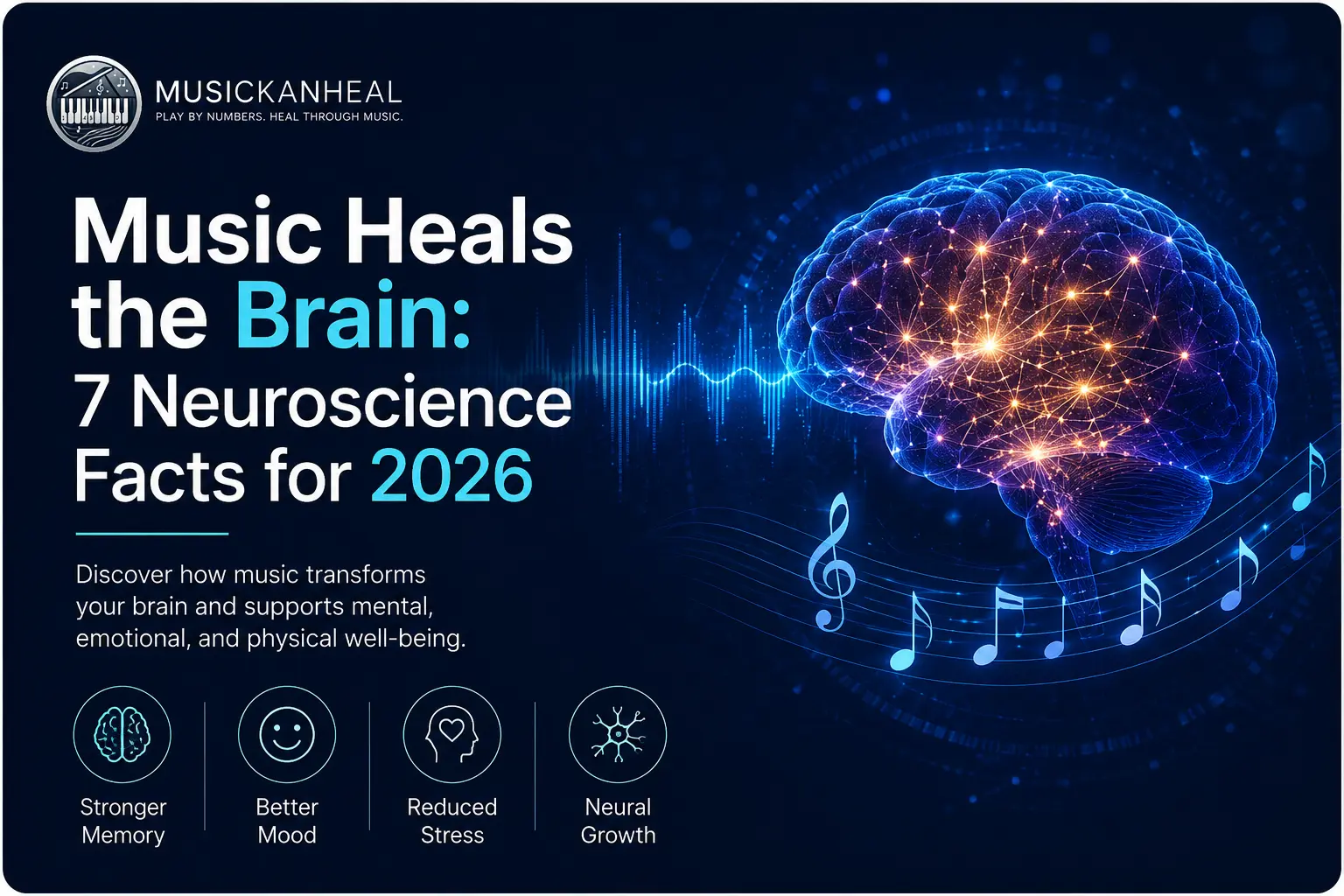
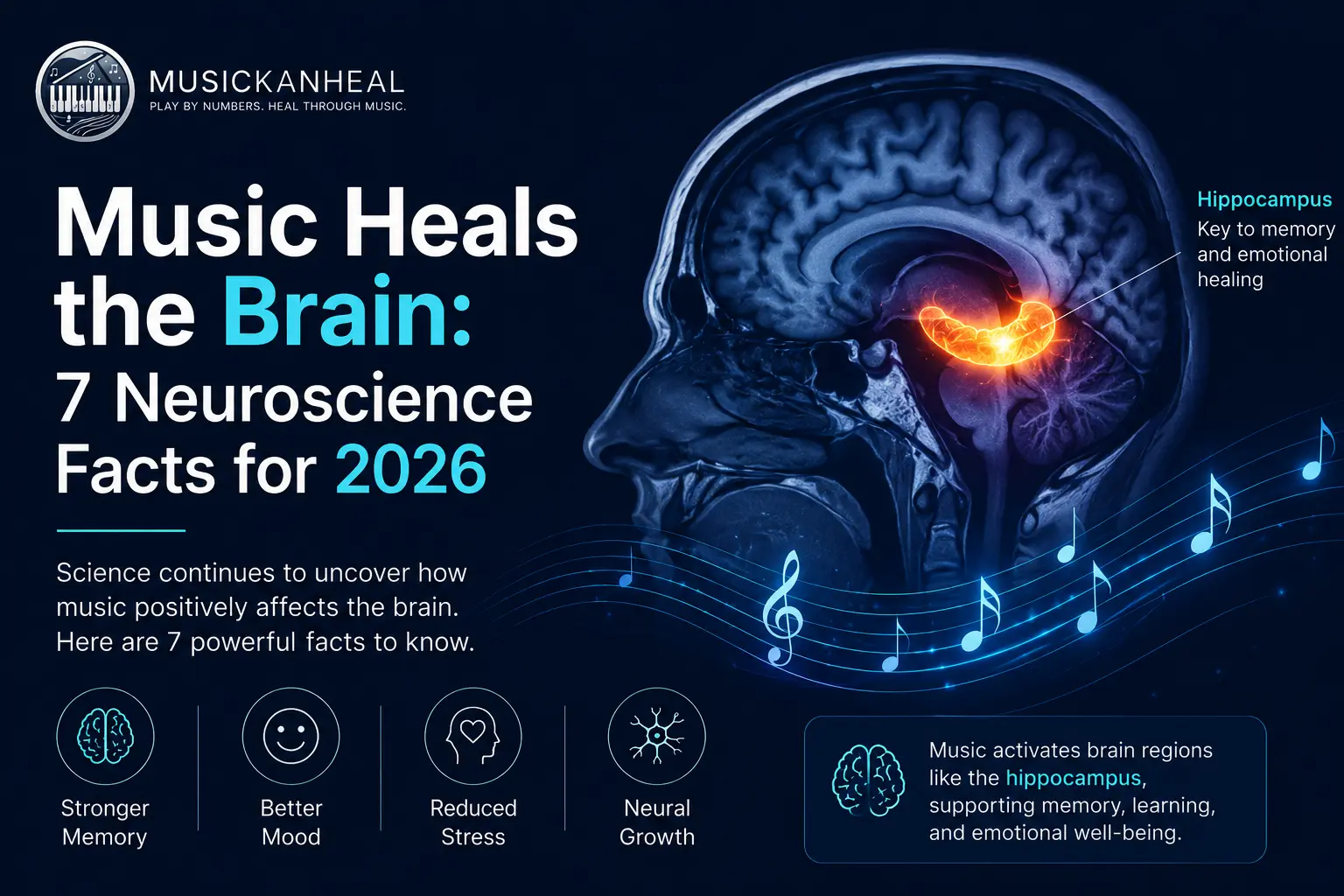
Music Heals the Brain: 7 Neuroscience Facts for 2026
The claim that music heals the brain has been floating around wellness circles for decades. What’s changed is the quality of evidence behind it.
In 2026, the evidence that music heals the brain is no longer limited to small observational studies or anecdotes about feeling calm after a playlist. We have neuroimaging data, randomized controlled trials, and a clearer map of the specific brain regions that music activates, repairs, and rewires. Science has moved from “music is good for you” to something far more specific — and far more interesting.
This article covers what that research actually says, what it means in practical terms, and why the distinction between listening to music and actively making it matters more than most people realize.
Does Music Actually Heal the Brain? (What the Science Shows)
The honest answer is yes — with important nuance about what “heal” means and under what conditions it applies.
Music heals the brain in measurable ways across several dimensions: it modulates stress hormones, activates dopamine pathways, supports neuroplastic change, and, in clinical settings, has been shown to help restore lost function in stroke and Parkinson’s patients. Those aren’t soft wellness claims. They’re outcomes documented in peer-reviewed research.
The nuance is this: music doesn’t function like a drug with a fixed dose and a predictable outcome. Its effects depend on the type of music, whether you’re listening or playing, your personal relationship with what you’re hearing, and the specific brain function in question. A playlist that drops cortisol for one person can raise it in another. Context is everything.
What the research does confirm consistently is that music heals the brain in ways that few other stimuli can match — because few other stimuli engage as much of the brain at once.
Why Music Activates the Entire Brain at Once
Most activities engage specific brain regions. Reading activates your language centers. Exercise fires up your motor cortex. Doing math works your prefrontal cortex.
This is exactly why the claim that music heals the brain has so much traction in neuroscience — it isn’t engaging one system; it’s engaging all of them. According to neuroscientist Kristin Scaplen of Bryant University, the entire brain activates when you listen to music — a statement that sounds like marketing copy but is backed by functional MRI research. Your auditory cortex processes the sound. Your motor cortex responds to rhythm. Your limbic system handles emotion. Your hippocampus encodes memory. Your prefrontal cortex is managing prediction, expectation, and attention — all at the same time.
This full-brain engagement is part of why music heals the brain in such a wide range of applications. When stroke damages one neural pathway, music can sometimes reroute function through intact ones. When dementia degrades language centers, musical memory pathways — which are stored differently — can survive. Music has so many entry points into the brain that it’s difficult to shut them all down at once.
For a deeper look at how specific sound frequencies interact with these brain systems, our breakdown of binaural beats vs. solfeggio frequencies covers the differences in practical detail.
How Does Music Heal the Brain Through Neuroplasticity?
Neuroplasticity is the brain’s ability to form new neural connections and reorganize existing ones. It’s the mechanism behind learning, recovery from injury, and adaptation to new challenges. And music is one of the most effective neuroplasticity triggers researchers have found.
When you engage with music repeatedly — whether listening attentively or playing an instrument — the brain physically changes in response. The corpus callosum, which connects the brain’s two hemispheres, is measurably thicker in trained musicians. The auditory cortex develops greater processing capacity. Motor areas used for playing become denser and more precise.
A 2026 paper in Nature Reviews Neuroscience led by UConn’s Edward Large introduced neural resonance theory, which describes how the brain’s own oscillating rhythms synchronize with musical rhythms — essentially, music entrains the brain to move in patterns that support healthier neural coordination. Large’s research is the reason Oscillo Biosciences, which he co-founded, is currently applying music and light therapy to slow cognitive decline in Alzheimer’s patients.
Neuroplasticity doesn’t stop at childhood. It continues throughout life, which means that music heals the brain not just for young learners but for adults and older adults who engage with it consistently. The research on adult musicians is particularly clear on this point — the brain keeps adapting as long as the engagement continues.
Can Music Therapy Help with Anxiety, Stress, and Depression?
This is where the research on how music heals the brain is most immediately useful for most people — not because clinical brain rehab isn’t important, but because anxiety, stress, and low mood are what the majority of people are actually dealing with on a daily basis.
Research from Johns Hopkins Medicine confirms that listening to music can reduce anxiety, lower blood pressure, relieve pain, improve sleep quality, and sharpen memory. These aren’t fringe findings. They show up repeatedly across study populations.
The mechanism behind mood effects involves dopamine — the brain’s primary reward and motivation chemical. When you hear music you love, your brain releases dopamine in a way that’s structurally similar to its response to food or social connection. That’s not metaphorical. Neuroscientist Robert Zatorre’s work showed that emotional responses to music activate the same ancient reward structures that evolved for survival. The fact that music hijacks survival circuitry is part of why it works so well as a stress regulator.
A March 2026 review published by the American Psychological Association found that music therapy modulates pain perception in both acute and chronic conditions by engaging overlapping pain and reward circuits — and that active participation in music amplifies these effects beyond passive listening. For people dealing with stress-related physical symptoms, that’s a meaningful finding.
Research on the social dimensions of music and mental health has added to this picture: music-making in community settings produces benefits that solo listening does not, particularly around loneliness and a sense of purpose.
Music and Memory: Why Songs Outlast Almost Everything Else
If you’ve ever watched someone with late-stage dementia light up when a familiar song plays, you’ve seen one of the most striking demonstrations of how music heals the brain’s memory systems — and one of the hardest to explain away as a placebo.
Harvard Medical School researchers have documented that musical memories engage the hippocampus and amygdala — the brain’s memory and emotion centers — and are encoded as a “rich experience,” layered with emotional, contextual, and sensory information. This richness makes musical memories more durable than other types. They’re encoded through multiple pathways simultaneously, which means more of them survive when disease starts degrading individual circuits.
For Alzheimer’s patients specifically, music activates neural areas and pathways in enough different regions that memories associated with music outlast the verbal and declarative memories that typically go first. Patients who can no longer recognize family members can still sing songs from their childhood, word for word and in key.
This isn’t just relevant for people with dementia. It’s relevant for anyone learning something new. If you want a piece of information to stick, connect it to music. The brain will hold it more tightly.
Does Playing Music Heal the Brain Better Than Just Listening?
Yes — and the gap is larger than most people expect.
Passive listening engages your brain broadly and delivers real benefits. But active music-making — playing an instrument, singing, improvising — engages the brain at a fundamentally different level of intensity. You’re firing motor systems, auditory feedback loops, memory retrieval, and emotional regulation all at the same time, under conditions of real-time error correction.
According to a March 2026 APA review of music research, active engagement with music consistently produces stronger therapeutic outcomes than passive listening. Music therapist Joke Bradt, who leads the NIH-funded Music4Pain Research Network, stated plainly that active engagement with music is more effective than just listening — a finding that applied to pain management, mood, and cognitive outcomes across her studies.
UCSF cognitive neuroscientist Julene Johnson, who has studied music and the aging brain for decades, draws a similar comparison: listening to music is like watching football on television. Playing music is like being on the field. The neurological workout is not in the same category.
This distinction matters for how you think about music as a mental health tool. Streaming a playlist contributes. But if the goal is to get the most from what we know about how music heals the brain, the research points clearly toward actually playing — not just hearing.
Frequently Asked Questions About Music and Brain Health
Does music heal the brain the same way for everyone?
No, and this is one of the most important caveats in the research. Music heals the brain in measurable ways across populations, but the specific effects depend heavily on personal history, emotional associations, and the type of music being heard. A song that reduces stress hormones in one person may activate alertness or even tension in another — it depends on what that music means to them. What the research shows consistently is that self-selected music, music you personally connect with, produces the strongest brain responses across mood, memory, and reward circuits. The type of music matters less than the personal relationship to it.
How long does it take for music to affect the brain?
Some effects are immediate — the evidence that music heals the brain at the neurochemical level shows up fast. Dopamine release can begin within seconds of hearing a song you love. Cortisol reduction from calming music can occur within a few minutes. The deeper neuroplastic changes — structural changes in the brain from sustained musical engagement — build over weeks and months of regular practice or attentive listening. Think of it as two timescales: fast effects on mood and stress, slower effects on brain architecture.
Can music therapy help people with Alzheimer’s or dementia?
Yes, and this is one of the most evidence-backed applications in neurologic music therapy. Musical memories are encoded through multiple brain pathways simultaneously, making them more resistant to neurodegeneration than verbal or declarative memories. Patients in late-stage Alzheimer’s have been shown to retain the ability to sing familiar songs accurately even when they can no longer recognize faces or recall recent events. Music therapy is used clinically to reduce agitation, improve mood, and temporarily restore access to memories and personality in dementia patients.
Is it better to play music or listen to it for brain health?
Both have real benefits, but playing produces stronger neurological outcomes. If the goal is maximizing how music heals the brain, active music-making simultaneously engages motor systems, auditory processing, real-time error correction, memory retrieval, and emotional regulation — a combination that passive listening cannot match. The brain’s response to playing an instrument is closer to high-intensity cognitive training than to relaxation. If your primary goal is stress relief, attentive listening works well. If your goal is long-term cognitive resilience, playing is the more powerful intervention.
Does music heal the brain even when played in the background?
Partially. An AARP-backed study reviewed by Harvard Health found that even background music listeners showed brain benefits — including better mood and reduced anxiety — compared to people who didn’t engage with music at all. However, the strongest benefits were consistently associated with active listening and musical participation. Background music contributes, but attentive engagement with music you’ve chosen for yourself is where the meaningful neurological returns are.
What This Means for You
The science behind how music heals the brain has moved far past “it makes you feel better.” We now understand specific mechanisms: dopamine release, cortisol reduction, neural synchronization, neuroplastic structural change, and the survival of memory through multiple encoded pathways.
What the research keeps returning to is that active engagement matters. And if you’ve been skeptical about the idea that music heals the brain in a clinically meaningful way, the 2025–2026 research should shift that. This isn’t fringe wellness thinking anymore — it’s showing up in Harvard Medical School journals, APA reviews, and NIH-funded trials. Not just knowing music exists, not just having it play in another room — but choosing music intentionally, listening with attention, and ideally learning to make it yourself.
That’s the part most people skip. It’s also the part with the highest return.
If you’ve been thinking about learning an instrument or using music more deliberately for your mental health, the neuroscience gives you a straightforward answer. The brain responds to music in ways it responds to almost nothing else. Using that is a decision, not a talent requirement.
All rights are reserved. Copyright 2026 MusicKanHeal | musickanheal.com