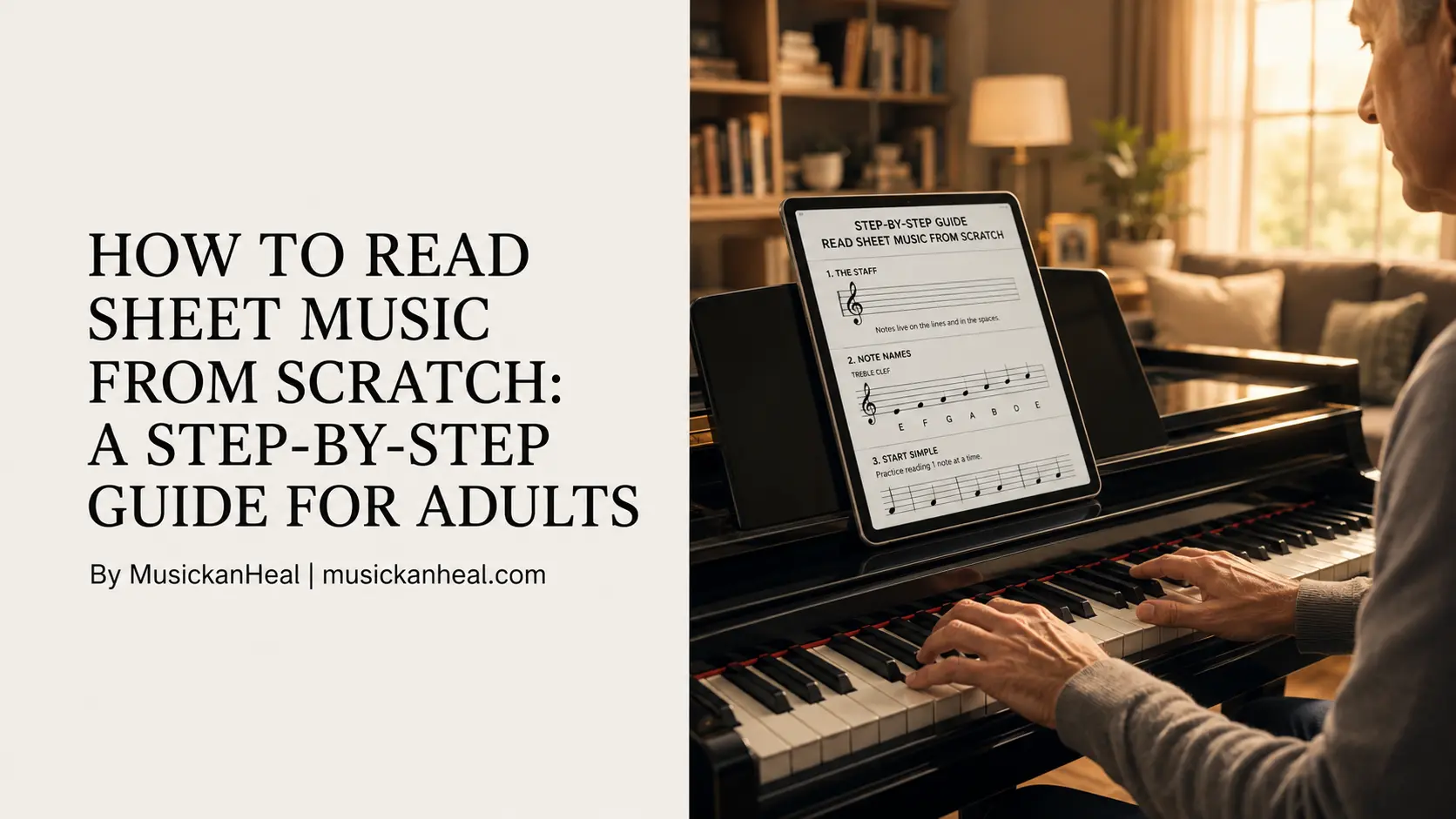
How to Read Sheet Music From Scratch: A Step-by-Step Guide for Adults
If you’ve opened a piece of sheet music and felt your brain short-circuit, you’re not broken and you’re not too old. Learning how to read sheet music from scratch as an adult is a sequence problem, not a talent problem — most guides throw pitch, rhythm, and theory at you all at once, and that’s what causes the shutdown.
This guide splits it into the order that actually works: pitch first, rhythm second, everything else after. No prior lessons required.
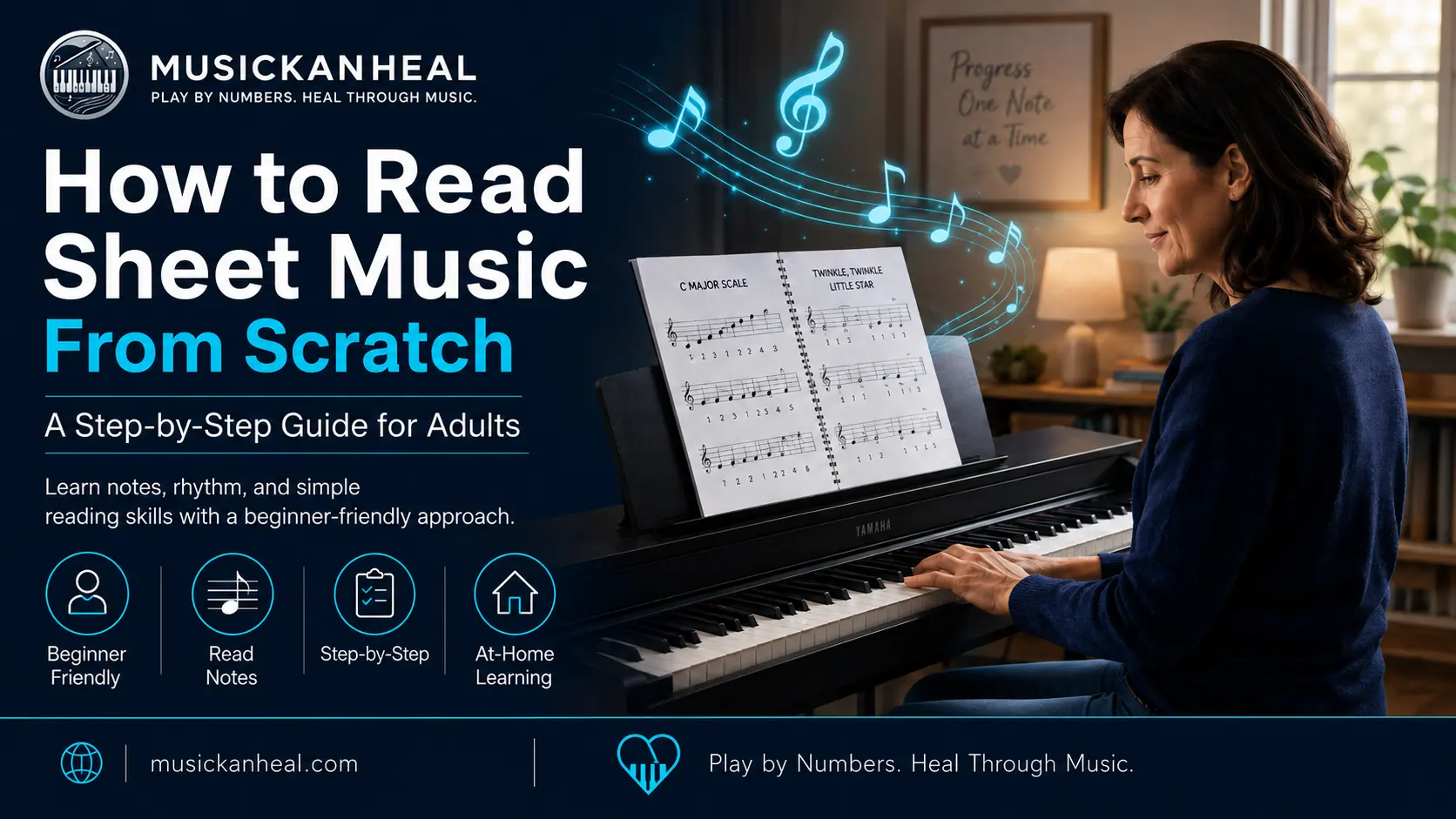
What Reading Sheet Music From Scratch Actually Means
Here’s the part most tutorials skip: reading sheet music isn’t one skill. It’s three smaller systems stacked on top of each other.
- Pitch — where a note sits on the page tells you which key to press
- Rhythm — how a note is drawn tells you how long to hold it
- Structure — a handful of symbols at the start of the line tell you the key and the beat
Learn these separately, and the page stops looking like static. Try to absorb all three at once — which is what most method books do — and you’ll hit the wall that makes so many adults quit in week two.
One more thing worth saying up front: reading notation isn’t the only path to playing real music. Some methods — like the Nashville Number System, which swaps notation for a 1–7 numbering scheme — let you play by chord relationships instead of decoding a staff. If your goal is specifically notation literacy, keep reading. If your goal is just “get me playing songs,” it’s worth knowing that’s a separate route, and a faster one for many adults.
Step 1–2: The Staff, Clefs, and Note Names
The staff is five horizontal lines with four spaces between them. Every note you’ll ever read sits on a line or in a space, and its vertical position tells you its pitch — higher on the page means a higher sound.
At the far left of the staff sits a clef, which tells you what those lines and spaces mean.
- Treble clef — covers higher notes, used for the right hand on piano
- Bass clef — covers lower notes, used for the left hand on piano
Piano sheet music stacks both clefs together, which is why a piano score looks busier than a single-instrument part. You’re not reading twice as much information — you’re reading two simpler systems side by side.
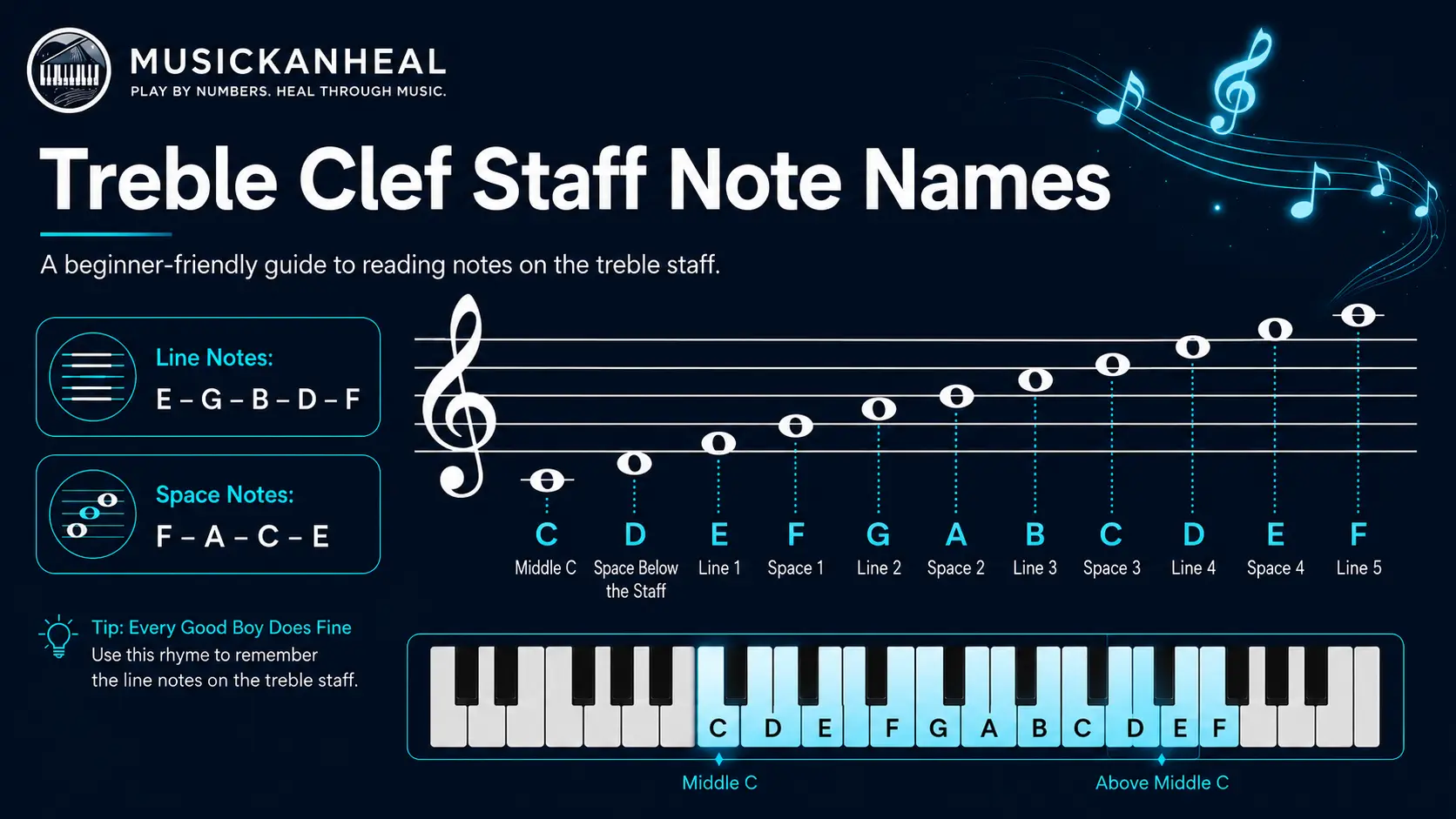
Music uses seven letter names, A through G, repeating as you go up. Two mnemonics do most of the work here:
- Treble clef lines (bottom to top): E-G-B-D-F — “Every Good Boy Does Fine”
- Treble clef spaces (bottom to top): F-A-C-E — spells “FACE”
Don’t try to memorize all nine positions in one sitting. Learn the four space notes first since FACE is easy to hold onto, then add the line notes once those feel automatic.
Step 3–4: Note Values, Rhythm, and Time Signatures
Once pitch stops being a puzzle, rhythm is next — and it’s worth practicing separately before you try to combine it with note names. Clap the rhythm of a line first. Count out loud. Add pitch only after the timing feels natural in your hands.
Each note shape tells you a duration relative to a quarter note, which gets one beat:
- Whole note (hollow, no stem) — 4 beats
- Half note (hollow, with stem) — 2 beats
- Quarter note (solid, with stem) — 1 beat
- Eighth note (solid, with stem and flag) — half a beat
A time signature — the two stacked numbers at the start of a piece — tells you how many beats fill each measure and which note value counts as one beat. 4/4 time, the most common by far, means four quarter-note beats per measure.
You don’t need to memorize every time signature that exists. Get comfortable with 4/4 and 3/4 first. Everything else is a variation you’ll pick up as you encounter it.
How Long Does It Take to Learn to Read Sheet Music as an Adult?
Most adults read simple melodies within a few weeks of consistent short practice — think 15 to 20 minutes a day, most days. Comfortable reading at a beginner-to-intermediate level usually takes a few months. Fluent sight-reading at full tempo takes longer and comes down to sheer reading volume over time, not talent.
Here’s the detail that surprises people: adults often pick this up faster than kids do. Children are usually taught to memorize note names by rote. Adults can reason through the pattern logic instead — “This note is one step higher than the last one, so it must be D” — which is a shortcut kids haven’t developed the abstract reasoning for yet.
Consistency matters more than session length. Twenty focused minutes daily will get you further in a month than one three-hour session on a Sunday.
Do You Actually Need to Read Sheet Music to Play Piano?
Honestly, no — not to play piano specifically — and pretending otherwise does adult beginners a disservice.
Reading notation unlocks a specific thing: access to any written piece, performed exactly as the composer intended, without needing someone else to have made a tutorial for it first. That’s genuinely valuable if you want to play classical repertoire, sit in an ensemble, or read charts professionally.
But if your goal is narrower — play songs you love, lead worship, or jam with other musicians — chord-based and numbering systems get you playing real music faster because they skip notation decoding entirely. This is common in professional session work too: studio musicians have used the Nashville Number System for decades specifically because it’s faster to read live and doesn’t require re-learning a song when the key changes.
If you’ve tried notation and keep stalling out, it’s worth trying a 90-day structured plan for learning piano as an adult that uses a number-based approach instead — same instrument, different entry point.
A Simple Daily Practice Routine That Works
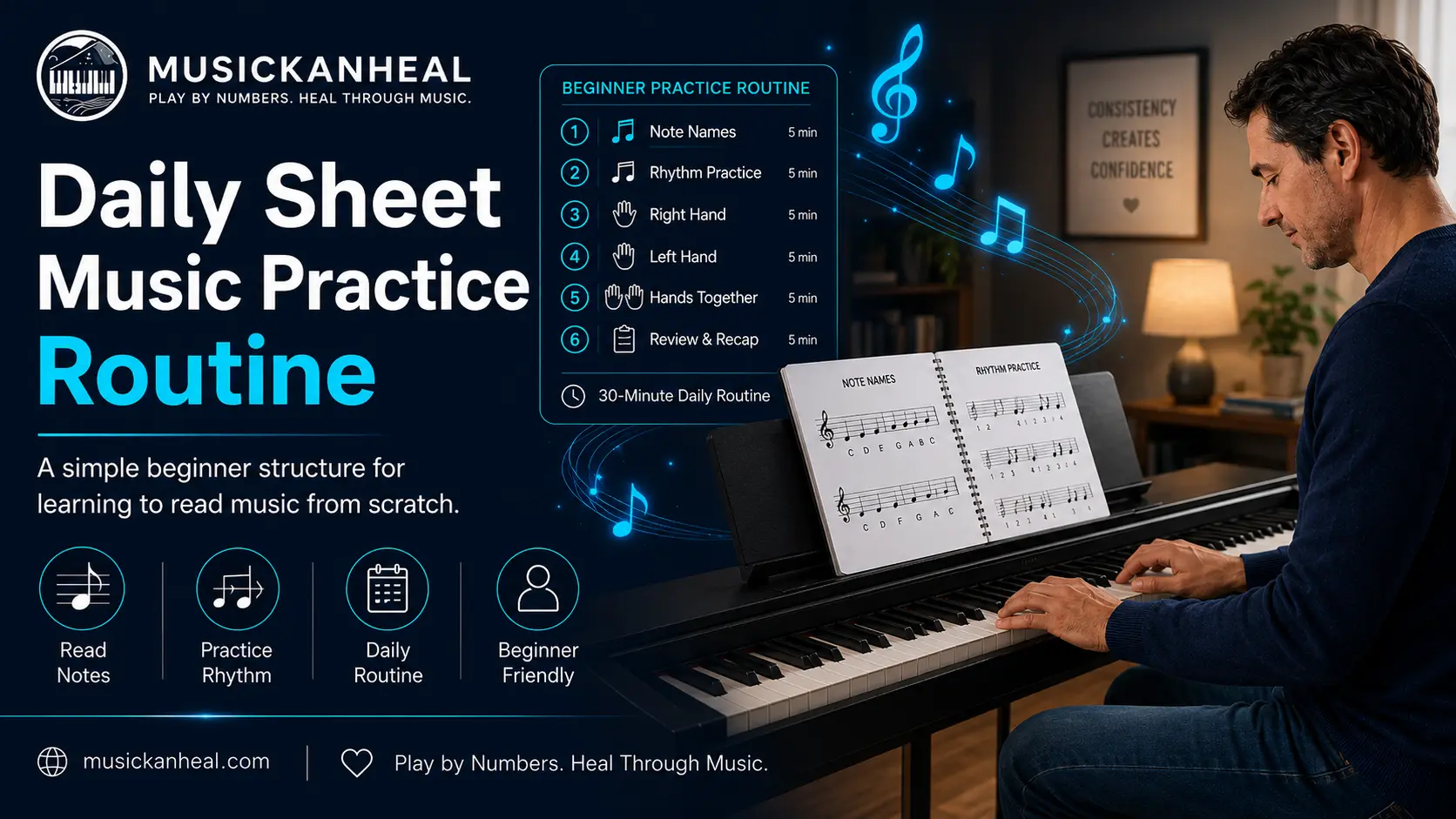
Reading is a physical skill as much as a mental one — the goal is making it automatic, not impressive. A routine that consistently works for adult beginners:
- 5 minutes — name notes on a staff, no instrument, just recognition
- 5 minutes — clap and count rhythms from a simple line, no pitch involved yet
- 10 minutes — play a simple piece slowly, combining both, stopping when you lose the thread rather than pushing through mistakes
Keep material easy enough that it’s almost boring in week one. That’s not a failure — it’s what lets your brain build fast, reliable associations between the page and the keyboard before you add difficulty.
If anxiety around “getting it wrong” is what’s actually derailing your sessions rather than the material itself, this guide on practicing piano with anxiety is worth a look before you troubleshoot the notation itself.
Conclusion
Reading sheet music from scratch isn’t the multi-year project it’s often made out to be — it’s a handful of small, learnable systems, tackled one at a time instead of all at once. Pitch, then rhythm, then structure. Twenty minutes a day beats an occasional marathon session every time.
And if you get through this and realize notation isn’t actually the tool you need — that you just want to be playing real songs faster — that’s a legitimate call too, not a shortcut for people who “can’t” read music. Compare Simply Piano, Flowkey, and Skoove against a number-based approach before you commit to either path.
Sources: Yamaha’s note-reading guidance on cognitive chunking and general practice-frequency findings referenced across adult piano-learning research.
Frequently Asked Questions About Reading Sheet Music From Scratch
Is it too late to learn to read sheet music as an adult?
No. There’s no age cutoff on pattern recognition, and adults often progress faster than children specifically because they can reason through relationships between notes instead of memorizing by rote. The only real barrier is consistency, not age.
How long does it take to learn to read sheet music from scratch?
Most adults can read simple melodies within a few weeks of 15–20 minute daily practice and reach comfortable beginner-to-intermediate reading within a few months. Full sight-reading fluency takes longer and depends on cumulative reading volume rather than a fixed timeline.
Do I need to learn music theory before I can read sheet music?
No. Basic notation reading — staff position, note values, simple time signatures — doesn’t require theory knowledge upfront. Theory becomes useful later, once you want to understand why chords and key signatures work the way they do, not before you start.
What’s the difference between reading sheet music and playing by ear?
Reading sheet music means decoding written symbols into pitch and rhythm; playing by ear means reproducing music you’ve heard without a written reference. They’re separate skills — many working musicians are strong at one and weak at the other, and neither is a prerequisite for the other.
Can I learn to read sheet music without a piano teacher?
Yes. Structured self-study using method books, apps, or guided routines works for most adult beginners, especially for foundational reading. A teacher becomes more valuable later for correcting technique and pacing a curriculum to your specific gaps, not for the initial notation basics.
All rights are reserved. Copyright 2026 MusicKanHeal | musickanheal.com