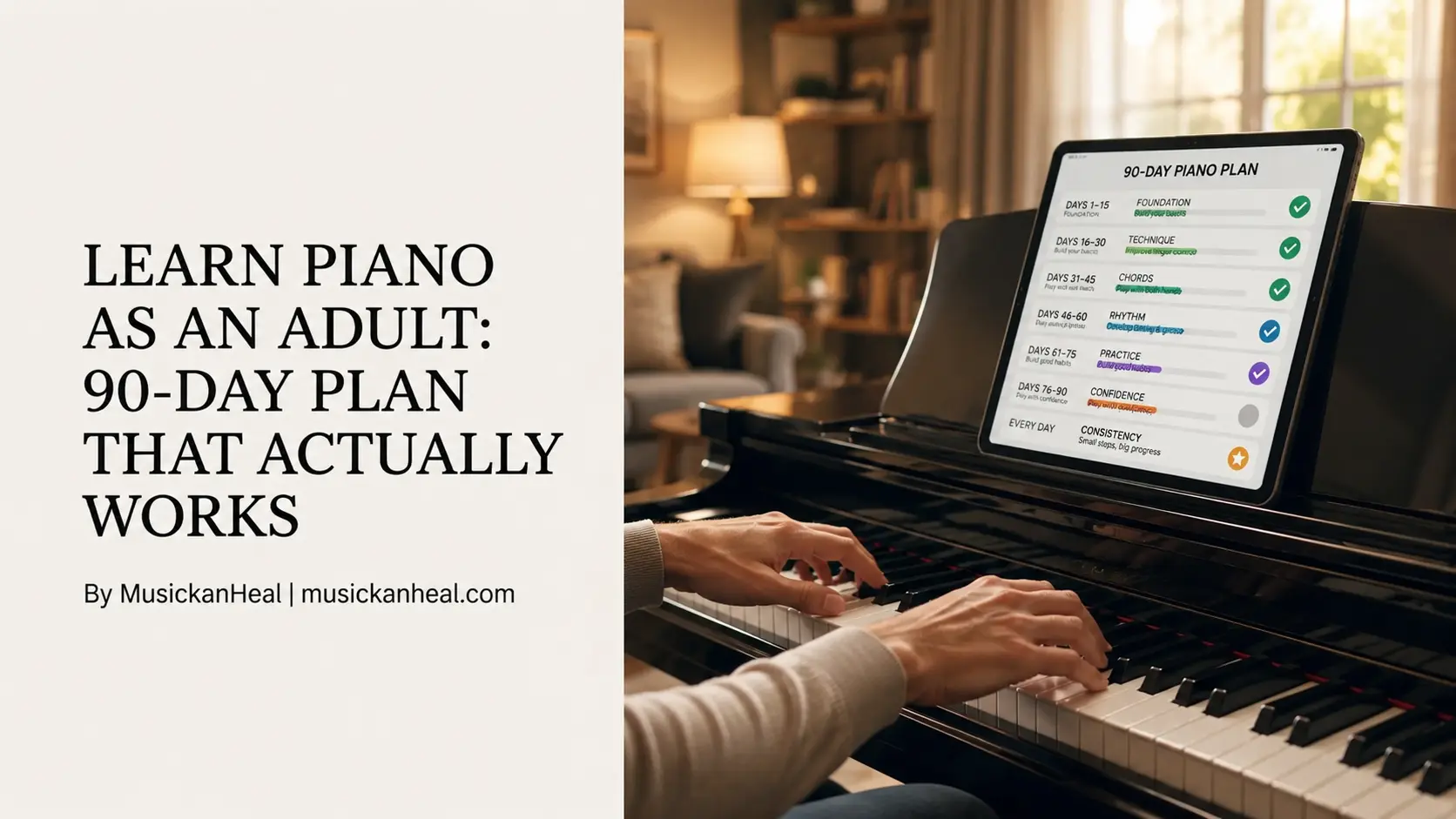
Learn Piano as an Adult: 90-Day Plan That Actually Works
Most adults who want to learn piano as an adult never actually start. Not because they lack ability, but because every guide they find either treats them like a five-year-old or jumps straight into music theory that reads like a foreign language.
This guide does neither. What follows is a realistic, week-by-week, 90-day roadmap built for adults with real lives—jobs, families, limited time, and zero patience for content that wastes it.
Is It Too Late to Learn Piano as an Adult? (The Real Answer)
No. But that answer alone isn’t useful, so here’s the more honest version: what do you actually want from this?
If the goal is Carnegie Hall, you need to start at six. If the goal is to play songs you love, unwind after work, or finally follow through on something you’ve been putting off for years, you have everything you need right now.
Adults bring real advantages to the piano. You’re self-motivated; nobody is forcing you to sit there. You absorb concepts faster—things like chord relationships and key patterns that take children months to internalize—you can work through in a single focused session. And your hands are fully developed, which matters more than people expect.
The disadvantage is also real: muscle memory forms more slowly in adults than in children. That’s not a reason to quit. It’s a reason to practice deliberately instead of just logging seat time.
What You Can Actually Achieve in Your First 90 Days
Let’s be specific. Here’s what a committed adult beginner — practicing 20–30 minutes per day — can reach in 90 days:
- Play simple songs with both hands together (not perfectly, but recognisably)
- Find any note on the keyboard without scanning
- Play basic chord progressions in 2–3 keys
- Complete a full song from start to finish without stopping
- Understand how time signatures and basic rhythm patterns work
What you won’t achieve in 90 days: fluid sight-reading, anything technically demanding, or the ability to play by ear across styles. That’s fine. The 90-day goal is functional — building a foundation that makes the next 90 days feel completely different.
How to Learn Piano as an Adult: Your 90-Day Week-by-Week Roadmap
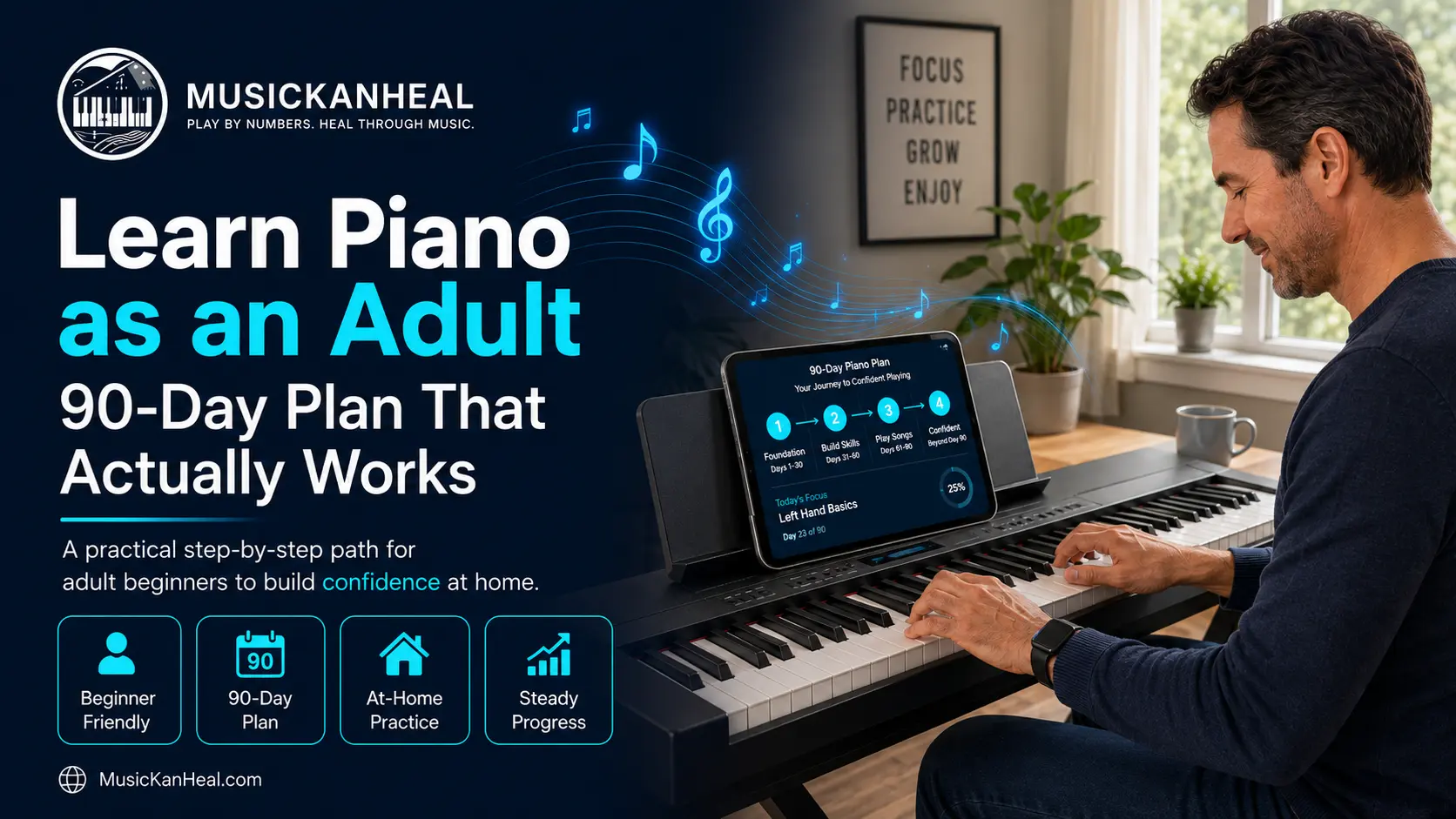
Here’s the actual plan, split into three phases.
Phase 1: Orientation — Weeks 1–4
This month is about getting comfortable. Nothing feels natural at the piano in week one. That’s expected and normal.
Weeks 1–2: Know Your Instrument
Spend the first week learning the keyboard layout. Find all the C notes. Learn the two-and-three pattern of the black keys. Practice moving your right hand to any note by feel — not by scanning the keyboard each time. This sounds too basic to matter. It isn’t. Do it anyway.
Weeks 3–4: Both Hands, Separately
Learn a simple melody with your right hand. Separately, learn a basic left-hand pattern — a single note or a simple two-note chord. Do not attempt to put them together yet. Adults almost always rush this step, and it almost always costs them two weeks of backtracking.
By the end of week four, your right-hand melody should be clean, and your left-hand pattern should run on autopilot on its own.
Phase 2: Building — Weeks 5–9
This is where most adults either lock in a practice habit or quietly drift away. The work gets harder, but the payoff gets more tangible.
Weeks 5–6: Hands Together (Slower Than You Think)
Now combine both hands. Set your metronome much slower than feels necessary. If you think you should practice at 80 BPM, practice at 50. Speed comes later. Coordination and accuracy come first — always.
Weeks 7–8: Chord Foundations
Learn the three most important chords in any key: the I, IV, and V. If that notation means nothing yet, that’s fine. The Nashville Number System is a number-based approach to understanding chord relationships without needing to read traditional sheet music — it’s the method built into MusicKanHeal specifically for adult learners who want to skip the notation barrier and start playing real songs sooner.
Week 9: Your First Complete Song
Pick one song you actually like — not something assigned to you, something you’d choose to listen to. Work through it section by section: intro, verse, chorus. By the end of week nine, play it from start to finish without stopping, even if it’s slow and rough around the edges.
Phase 3: Consolidation — Weeks 10–13
Weeks 10–11: Second Song + Tempo Work
Apply the same process to a second song. Simultaneously, go back to your first and increase the metronome by 5–10 BPM per session. Clean up any bars that still feel uncertain.
Weeks 12–13: Finish and Record
Play both songs cleanly from memory. Record yourself on your phone. Hearing your own playing tells you things your ears miss in real time. Fix what you notice. By day 90, you’ll have two complete songs, a daily practice habit, and the confidence that you know how to learn a piece — which is the actual skill.
For a deeper look at how skill development layers over time as you advance beyond the 90-day foundation, this overview of how MusicKanHeal builds your piano skills progressively maps what gets added at each stage.
How Much Practice Does an Adult Piano Beginner Actually Need?
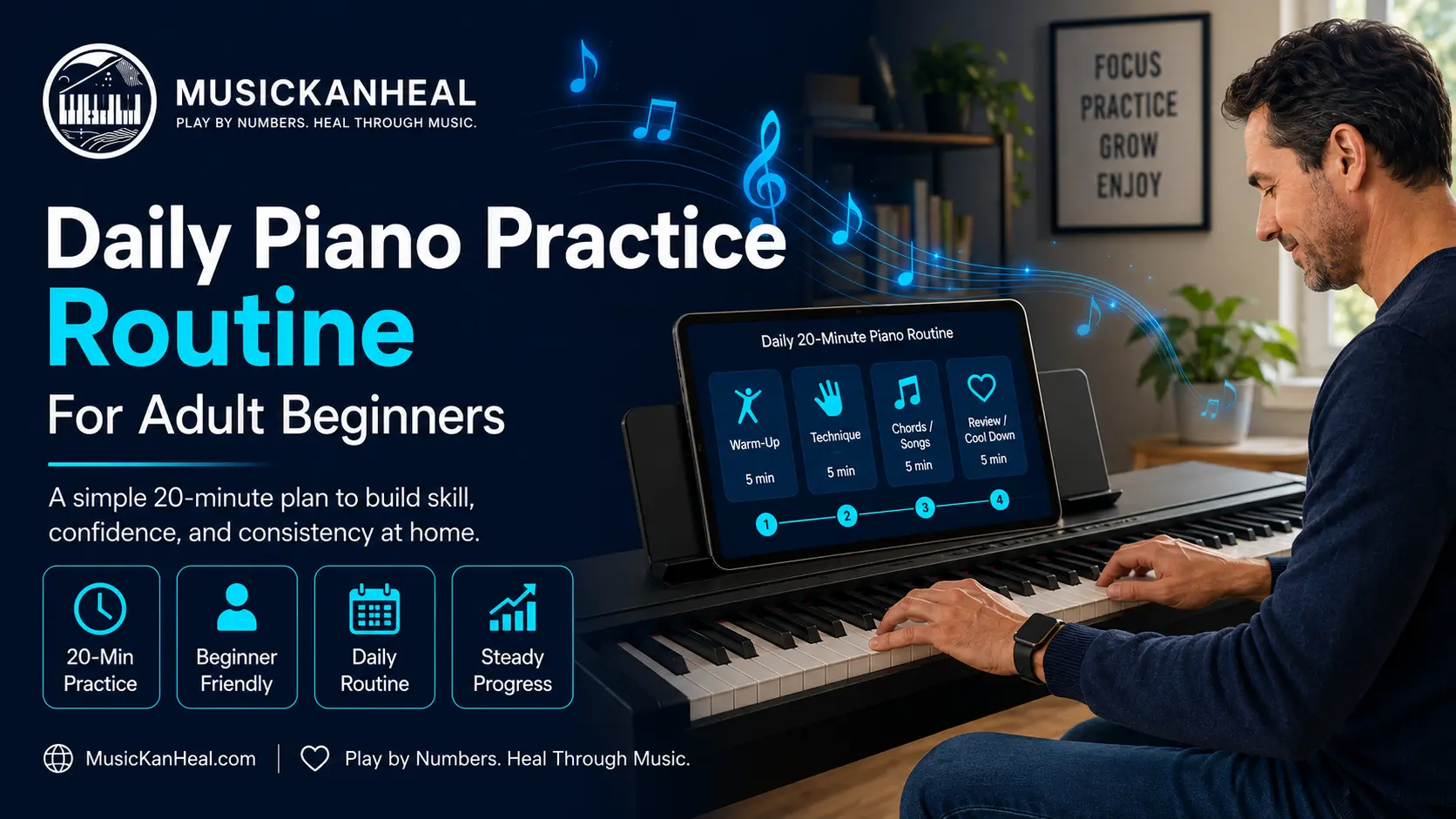
Twenty to thirty minutes per day is enough — if those minutes are focused.
The mistake most adults make is passive practice: sitting at the piano and playing through a piece repeatedly without fixing anything. That’s not practice. That’s repetition of errors, and it builds bad habits faster than it builds skill.
Effective practice looks like this:
- Identify one specific problem — a bar where the hands fall out of sync, or a chord change that keeps getting fumbled
- Isolate it and repeat it slowly until it’s clean
- Reconnect it to the bars around it
- Then play the full section through
That kind of focused, targeted work in 20 minutes produces more improvement than an hour of mindless run-throughs. On days when you only have 15 minutes, use them. Fifteen minutes of deliberate practice still moves you forward.
The 4 Mistakes That Kill Adult Piano Progress Before It Starts
1. Practicing at performance speed before earning it
Adults hear a song at 120 BPM and practice it at 120 BPM from day one. The hands fall apart, frustration builds, and the song gets abandoned. Practice at 60% of your target tempo until each section feels effortless, then increase gradually. This is how every professional pianist was taught. It works.
2. Neglecting the left hand
Most beginners spend the majority of practice time on the right hand because it carries the melody. The left hand ends up weak and hesitant when the hands finally come together. Give both hands equal practice time separately before combining them.
3. Starting multiple songs and finishing none
Beginning three songs simultaneously and never completing any of them is one of the most reliable ways to plateau early. One song, learned fully, sticks. Three songs at 50% completion teaches you very little. Finish what you start.
4. Expecting progress to be linear
Some weeks you’ll improve noticeably. Others will feel like regression. This is normal — it’s how motor learning works. The plateau isn’t a sign that you’re failing. It’s a sign your brain is consolidating what it’s already absorbed before taking the next step.
Why Learning Piano as an Adult Is Surprisingly Good for Your Mental Health
Most piano guides skip this section entirely because they’re focused on technique. That’s a mistake, particularly for adult learners.
A randomised controlled trial from the University of Bath, published in Scientific Reports, tracked 31 adults across three groups: one that took beginner piano lessons, one that listened to music passively, and one that used the time for quiet reading or studying. After 11 weeks, the piano group showed measurably reduced depression, anxiety, and stress scores. The listening and reading groups did not.
The active playing was the deciding factor. Listening to music is passive. Playing it engages your brain in a fundamentally different way — motor cortex, auditory processing, and emotional regulation circuits all fire simultaneously.
Piano also forces presence in a way very few activities do. You cannot play a piece while your mind is elsewhere. The music demands full attention, and that attention pulls you out of the background noise of the day — the low-grade stress that most adults carry without realizing it.
This is the deeper idea behind MusicKanHeal: that music’s role in personal wellbeing goes well beyond entertainment. When you’re learning piano as an adult, you’re not just picking up a skill. You’re giving your brain a structured, focused, emotionally rewarding activity that happens to be measurably good for it.
Even 10–15 minutes at the keys can shift your mood on a difficult day. That’s not a claim — it’s what the research shows.
Frequently Asked Questions About Learning Piano as an Adult
Can I learn piano as an adult if I’ve never played before?
Yes, with no prior experience needed. Adults who start from scratch regularly reach the point of playing complete songs within two to four months of consistent daily practice. Having no prior habits also means you won’t have any bad technique to unlearn — which is more of an advantage than most beginners realize.
How long does it take to learn piano as an adult from scratch?
With 20–30 minutes of daily practice, most adults can play simple songs in two to three months and reach a functional beginner level in six to twelve months. Reaching an intermediate level — where you can learn new pieces independently without help — typically takes one to two years. Consistency matters far more than natural talent across every timeline.
Do I need to read sheet music to learn piano as an adult?
No. Sheet music is one method, not a requirement. Many adult learners use chord charts, number-based systems, or ear training to play real songs without ever reading traditional notation. The Nashville Number System replaces complex notation with a simple 1–7 number framework, letting you play songs in any key without sheet music.
Is 20 minutes of daily piano practice enough for an adult beginner?
Yes — provided those 20 minutes are deliberate and focused. Passive repetition for an hour is less effective than targeted practice for 20 minutes where you actively identify and correct specific problems. In the first 90 days especially, session consistency matters more than session length.
Can playing piano reduce anxiety and stress for adults?
Research says yes. A randomised controlled trial from the University of Bath found that beginner adults who played piano for 11 weeks reported significantly lower anxiety, stress, and depression scores compared to groups who listened to music passively. The act of playing — not just hearing — drives the mental health benefit.
All rights are reserved. Copyright 2026 MusicKanHeal | musickanheal.com