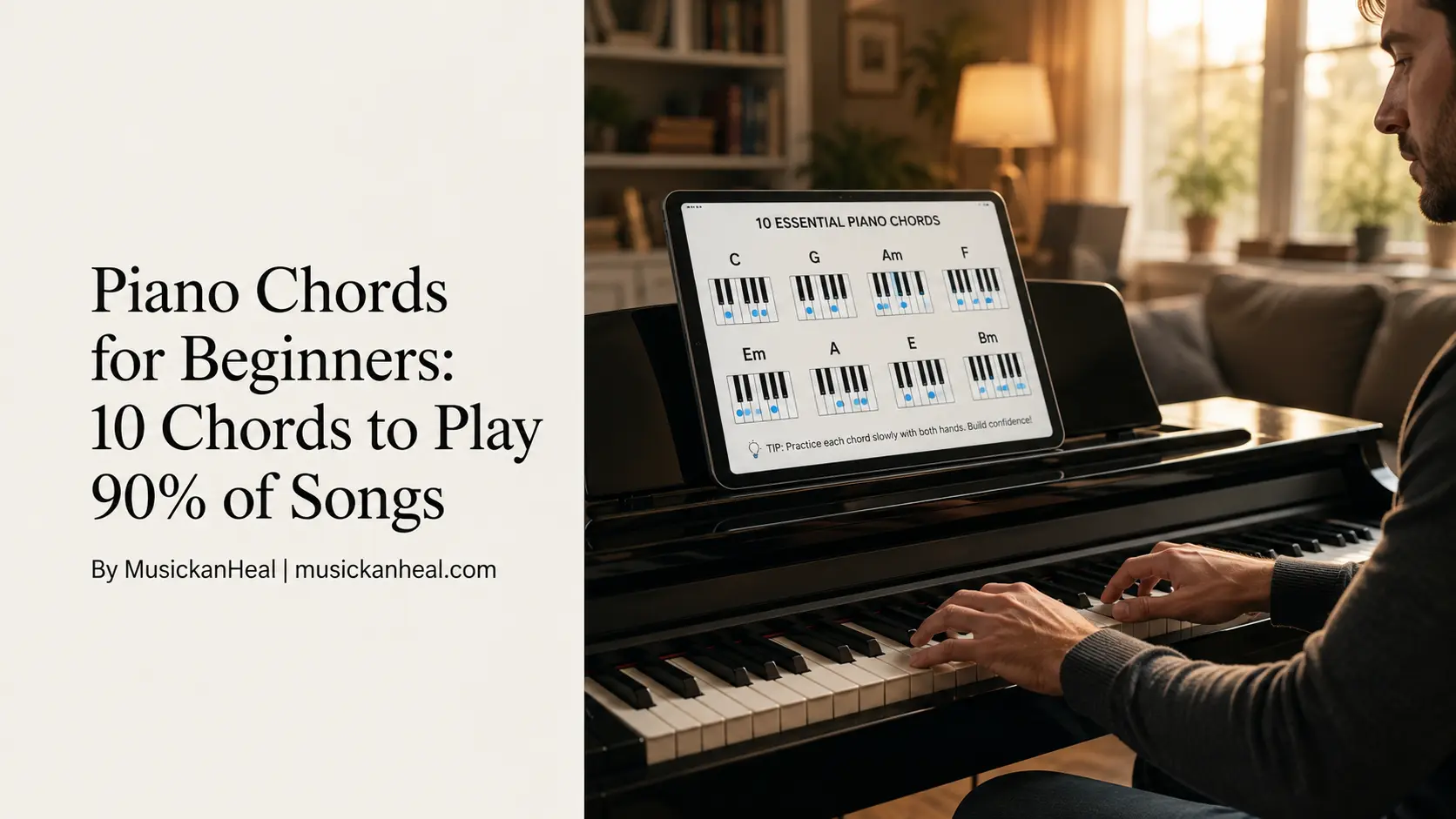
Piano Chords for Beginners: 10 Chords to Play 90% of Songs
Most people learn piano the wrong way—note by note, scale by scale, through weeks of exercises before playing anything that sounds like a real song. That’s not because it’s the best method. It’s just the traditional one.
Piano chords for beginners are a faster entry point, and the research backs it up. The I-V-vi-IV chord progression alone—just four chords—powers hundreds of recognizable pop, gospel, and rock songs. Add six more chords to that foundation, and you can play the vast majority of what gets requested at a piano. This guide covers exactly those 10 chords, why they work, and how to practice them in a way that actually sticks.

What Is a Piano Chord—and Why Start Here Instead of Notes?
A chord is three or more notes pressed at the same time. That’s the complete definition. Three fingers, three keys, pressed simultaneously.
The reason to start with chords instead of scales is that chords produce music immediately. You play C-G-Am-F once, and you’ve just played the harmonic backbone of Let It Be, Someone Like You, With or Without You, and dozens of other songs.
Every chord has three components:
- Root — the note the chord is named after (C in a C major chord)
- Third — the note that determines whether the chord sounds bright (major) or dark (minor)
- Fifth — the note that adds fullness and stability
Change the third up or down by one half step, and you move between major and minor. That’s the entire harmonic architecture of most pop music, sitting in three notes.
The 5 Major Piano Chords for Beginners to Learn First
Major chords have a bright, open, resolved sound. These five cover the keys you’ll encounter in most pop, gospel, and contemporary music.
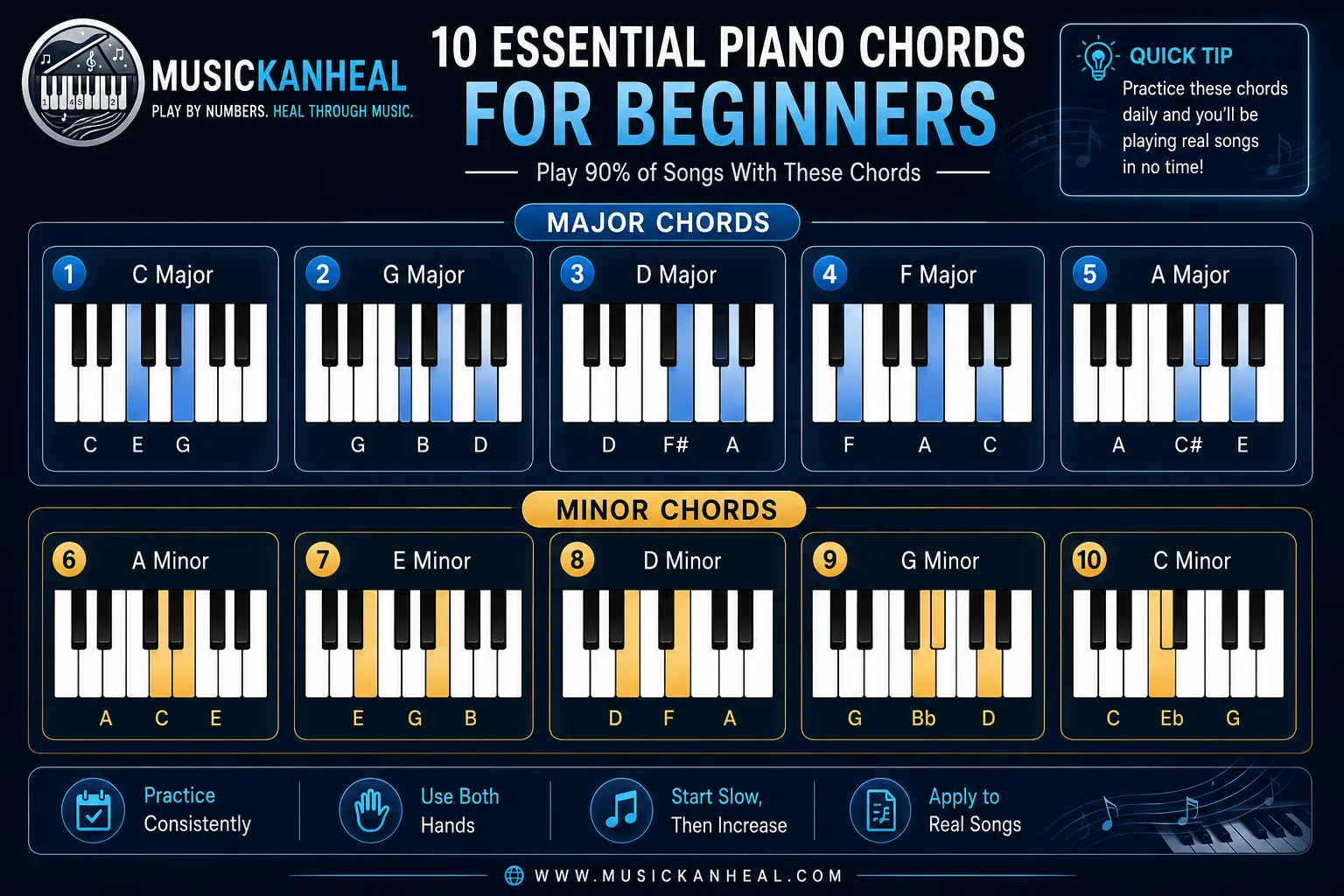
C major — C, E, G
Start here. All white keys. Your thumb (finger 1) on C, middle finger (3) on E, pinky (5) on G. This chord appears in more beginner songs than any other.
G major — G, B, D
Three white keys. Combined with C, Am, and F, this is part of the four-chord progression that powers hundreds of hit songs.
F major — F, A, C
All white keys, but the reach trips people up. Keep your wrist relaxed and train yourself to think of F-A-C as one hand shape, not three separate notes.
D major — D, F#, A
Your first chord with a black key. F# sits between F and G. Once this shape is in your hand, you’ve unlocked the key of D.
A major — A, C#, E
C# is the black key between C and D. A major appears constantly in songs played in E and D major keys.
The 5 Minor Piano Chords Every Beginner Should Add Next
Minor chords create the emotional tension in a progression — the pull that makes the resolution back to a major chord feel satisfying. Without them, everything sounds the same.
A minor — A, C, E
Compare this to A major: the only difference is C# becomes a natural C. One note. The entire shift from bright to subdued. Am is the sixth chord in the classic I-V-vi-IV pop progression.
E minor — E, G, B
All white keys. Easy to play and extremely common. Most songs in the key of G will use Em as their relative minor.
D minor — D, F, A
Three white keys. Dm has a melancholic quality and appears throughout pop, gospel, and R&B.
B minor — B, D, F#
One black key. Bm is the relative minor of D major, meaning these two chords pair naturally.
G minor — G, Bb, D
Bb is the black key between A and B. Gm has a heavier, more serious sound — common in gospel, soul, and R&B.
The 4-Chord Progression That Unlocks Hundreds of Songs
Most popular songs don’t use random chords. They use the same recurring pattern, built on the 1st, 5th, 6th, and 4th chords of a major key—written in music theory as I-V-vi-IV.
In the key of C major, that’s: C — G — Am — F
Play those four chords in that order and you’ve just played the harmonic skeleton of ‘Let It Be’ (Beatles), ‘No Woman No Cry’ (Bob Marley), ‘With or Without You’ (U2), ‘Someone Like You’ (Adele), and dozens of others. Pianote’s breakdown of the four most common piano chords documents how this progression alone covers an enormous percentage of modern pop and rock music.
The same I-V-vi-IV pattern works across multiple keys using the chords in this guide:
- G major: G — D — Em — C
- D major: D — A — Bm — G
Learn all 10 chords here, and you can play this progression in three different keys, which covers most requests you’ll ever get at a piano.
Why Most Beginners Plateau — and How to Avoid It
The most common reason beginners stall is practicing chords as isolated shapes rather than as transitions. They spend 20 minutes on C major, get it solid, move to G major, get it solid, and then when they try to play an actual song, the chord changes feel slow and foreign.
The fix is to practice chord transitions from day one, not individual chords. Pick two chords — C and G, or Am and F. Set a metronome to 60 BPM. Play four beats of C, then move cleanly to G on beat one of the next measure. Repeat until it’s automatic, then add a third chord.
Two other things worth stating plainly:
- Think of each chord as one hand shape, not three separate notes. The moment you start pressing C, then E, then G individually, your timing falls apart.
- The left hand will feel awkward for weeks. That’s normal. Fifteen minutes daily beats a two-hour Sunday session on results, because motor memory is built through repetition spread over time, not effort concentrated in one sitting.
How Long Does It Take to Learn Piano Chords for Beginners?
Realistic timeline: most people can play C, G, Am, and F with clean transitions within two to three weeks of consistent 15-minute daily practice. Getting all 10 chords solid enough for real song use typically takes six to eight weeks.
What extends that timeline isn’t the chords themselves. It’s skipping transition practice, practicing too infrequently, or trying to play at full song tempo before the shapes are automatic. Accuracy before speed — always.
Is There a Faster Way to Learn Chords Without Sheet Music?
Yes. The approach that removes the most friction for chord-based playing is the Nashville Number System—the method professional session musicians have used for decades that assigns a number (1 through 7) to each chord position in a key rather than naming each chord individually.
Instead of memorizing C-G-Am-F as four specific chords, you learn the pattern 1-5-6-4, which works identically in any key. The chord names change when you transpose; the number relationships stay the same. That shift turns chord progressions into patterns you actually understand rather than sequences you’ve memorized letter by letter.
The Nashville Number System removes the need to relearn songs every time a key changes—and it’s how most professional worship and session musicians communicate on stage.
For a direct comparison of the trade-offs: Traditional Sheet Music vs Number System
Once you have these 10 chords under your hands, the Best Piano App for Beginners guide is the logical next step for turning that foundation into actual songs.
Frequently Asked Questions About Piano Chords for Beginners
What are the easiest piano chords for beginners to learn first?
C major (C-E-G), G major (G-B-D), and A minor (A-C-E) are the easiest starting points — all three use only white keys. C major is the standard first chord because it teaches the root-third-fifth structure with the most accessible hand position.
How many piano chords do you need to know to play most songs?
Four chords in the key of C — C, G, Am, F — cover a remarkable percentage of pop, rock, and gospel music. The I-V-vi-IV progression built from those four chords appears in hundreds of well-known songs. Ten chords expand that coverage across three or four different keys.
Can I learn piano chords for beginners without reading sheet music?
Yes. Chord charts and number-based systems like the Nashville Number System let you play full chord progressions and real songs without reading a staff. Sheet music is a separate skill with a separate learning curve—it’s not a prerequisite for chord-based playing.
What is the I-V-vi-IV chord progression, and why does it appear in so many songs?
It’s a pattern of four chords built on the 1st, 5th, 6th, and 4th degrees of a major scale. In C major: C-G-Am-F. The progression works because it creates a natural tension-and-resolution cycle that sounds satisfying to Western ears. The pattern is the same emotional logic across every key.
How should I practice piano chords more effectively as a beginner?
Practice transitions, not isolated chords. Take two chords, set a metronome at a slow tempo, and practice switching between them until the movement is automatic before adding more. Think of each chord as a single hand shape—press all three notes simultaneously rather than individually. Fifteen minutes daily produces better results than longer occasional sessions.
Conclusion
Ten chords. C, G, F, D, A major. Am, Em, Dm, Bm, Gm. Get those hand shapes into your muscle memory and practice the transitions between them, and you’ll have access to the harmonic content of most music you’ll actually want to play.
The common error is treating this as a memorization challenge. It’s not; it’s a motor skill. The chords are simple. What builds over time is the speed and fluidity of moving between them.
All rights are reserved. Copyright 2026 MusicKanHeal | musickanheal.com