Best Piano App for Beginners
Search for the best piano app for beginners, and you’ll find the same fifteen articles recycling the same five app names—Simply Piano, Flowkey, Skoove, Yousician, and Piano Marvel—in slightly different orders, with slightly different star ratings.
What those articles don’t tell you is that picking the right app is the second decision, not the first. The first decision is understanding what kind of beginner you are and what you actually want to be able to do. Get that wrong, and the “best-reviewed” app in the world will plateau you within three months.
This article works differently. Instead of handing you a ranked list, it gives you the five questions that should shape your choice—and then explains where MusicKanHeal fits for beginners who’ve been let down by the standard options.
Why “Which App Is Best?” Is the Wrong First Question
The “best” label assumes all beginners want the same thing. They don’t.
A 12-year-old who wants to learn pop songs for fun has different needs than a 40-year-old who gave up on piano lessons in childhood and is trying again. Both of those people are different from a worship leader who needs to follow chord charts by Sunday. The app that works brilliantly for one will actively slow down another.
Most review articles crown a winner based on a single reviewer’s experience. That experience is real — but it’s theirs, not yours. The more useful frame is this: what does a good beginner piano app need to do for you specifically, and how do you evaluate one before committing to a subscription?
Here are the five things that actually matter.
The 5 Things That Actually Determine Whether a Beginner App Works for You
1. Does it teach a method, or just a song library?
This is the most important distinction in the entire market, and almost no one talks about it clearly. A song library gives you songs to follow along with. A method gives you a framework for understanding music—one that transfers from song to song, key to key, and genre to genre.
Apps with only a song library feel fast at first. You’re playing recognizable music in week one. But three months in, you realize you can only play the specific songs the app has taught you in the exact way the app showed you. Remove the app and you can’t reproduce what you learned. That’s not learning piano. That’s learning the app.
Apps with a real method behind the song library build transferable knowledge. They explain why the chord you’re playing is the “four chord,” what that means in any key, and how that pattern appears in dozens of songs you haven’t learned yet. Check the MusicKanHeal app features to see what a method-first structure looks like in practice—it’s a different architecture than most mainstream apps.
2. Does it assume you want to read sheet music?
Most beginner piano apps are built on the assumption that learning piano means learning to read traditional notation. For some beginners, that’s the right goal. For many adults — especially those who want to play by ear, play gospel, or lead worship — it’s a six-month detour before they can do the thing they actually came to do.
Ask yourself honestly: do you want to read sheet music, or do you want to play music? Those aren’t the same answer, and your response should filter out at least half the apps on the market immediately.
3. Is it designed for adults or dressed up for kids?
Many popular beginner piano apps are built with children in mind—falling colored dots, game-like reward systems, short attention-span pacing—and then marketed to adults as well. That’s not necessarily a problem, but adults learn differently. They want to understand why, not just follow what. They have less time for novelty mechanics and more need for efficient, structured progress.
If an app’s primary engagement hook is a points streak, ask whether that will still motivate you in month three when the novelty is gone.
4. Does it work with what you already have?
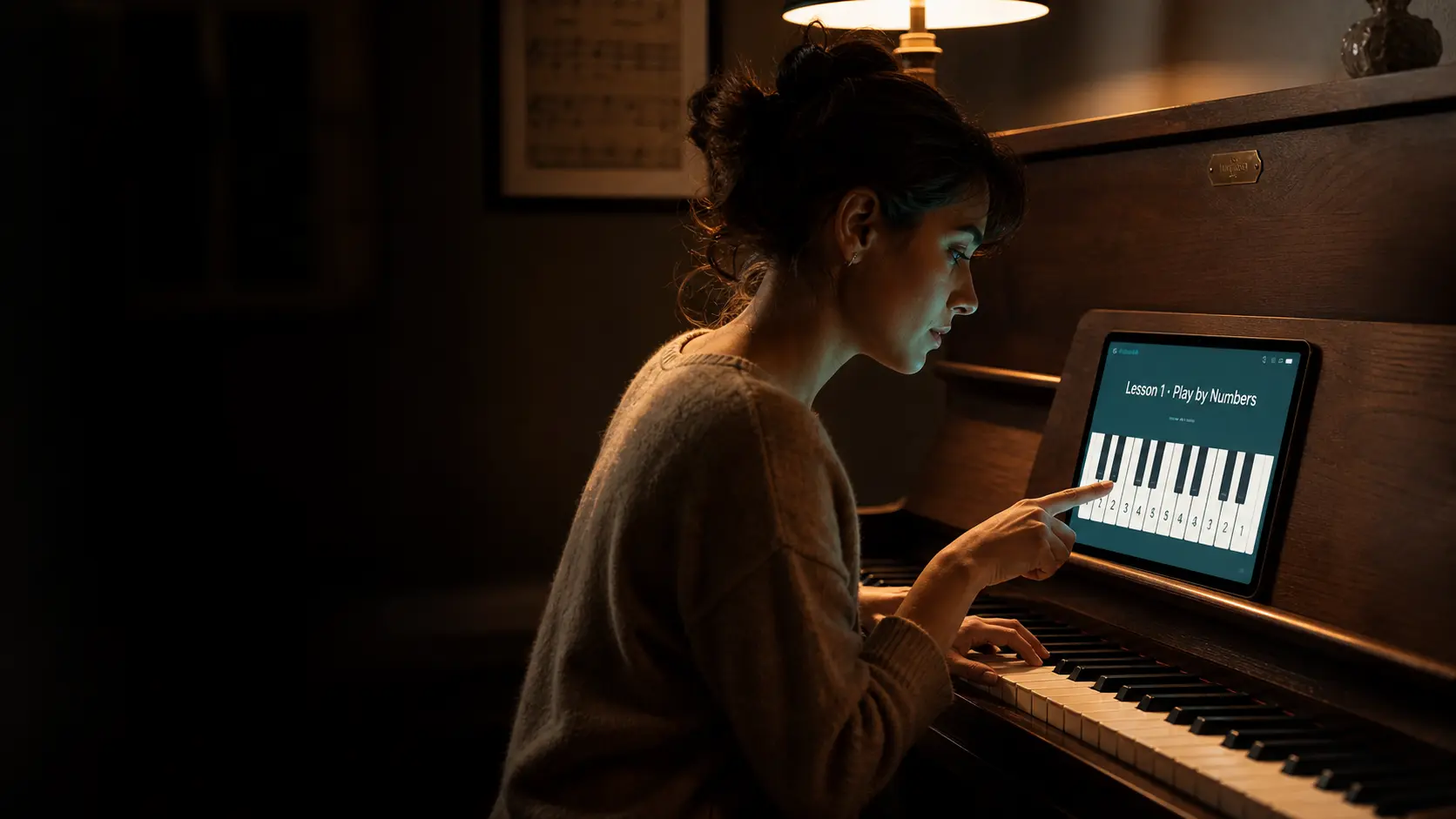
Some apps require a MIDI keyboard connected via USB or Bluetooth. Others work with a microphone listening to an acoustic or digital piano. Some have a virtual on-screen keyboard for people who don’t own an instrument yet. Each of these setups has different accuracy and learning quality.
Before subscribing to anything, confirm the app works well with your current setup—or check whether you’d need to buy additional hardware before it functions as advertised.
5. What happens when you hit a wall?
Every beginner hits a plateau, usually around weeks six to ten. The early songs clicked. The new ones feel impossible. This is the most important moment in the learning process, and apps handle it very differently.
Some apps have no answer for it — you’re expected to just keep repeating the hard section until it works, with no additional explanation or variation. Better apps offer alternative approaches to the same concept, let you slow sections down significantly, or provide some form of guided practice structure for difficult passages. Ask yourself, what does this app do when I’m stuck?
The App-Dependency Trap Most Beginners Walk Into
There are two fundamentally different ways apps display music to help beginners learn.
The first is falling notes — colored blocks dropping toward a keyboard diagram, telling you which key to press and when. It looks intuitive. It produces fast early results. And it creates a beginner who literally cannot play without the app running. The notes are the cue. Without them, there is no cue.
The second approach teaches real notation—either traditional sheet music or an alternative system like the Nashville Number System—so that you’re building knowledge that works independently of the app.
Research from music educators is consistent on this point: beginners who learn through falling-note apps develop what one educator called “app dependency.” They are playing the app, not the piano. The skill doesn’t transfer to other songs, other settings, or any context where a screen isn’t in front of them.
This doesn’t mean falling-note apps are useless—they’re fine for total beginners who want to dip their toes in before committing. But if your goal is to actually play piano, you want an app that builds a system in your head, not just a habit of following lights.
What Beginners Who Want to Play by Ear—or at Church—Actually Need
Most mainstream app reviews ignore this entirely, so it gets its own section.
If your goal is to play at church, lead a small worship group, or play by ear in any social setting, the standard beginner app roadmap is likely to frustrate you. Here’s why: traditional sheet music apps spend the first several months teaching you to decode notation before you can play a single song you recognize. For a classical pianist, that’s the foundation. For a worship musician, it’s a detour.
What you actually need is a system that teaches chord relationships—a way of understanding that the “one chord” is the home, the “four chord” is a tension, and the “five chord” wants to resolve back. Once that framework is in your head, you can play in any key, follow a chord chart in real time, and adapt when the worship leader changes key mid-song.
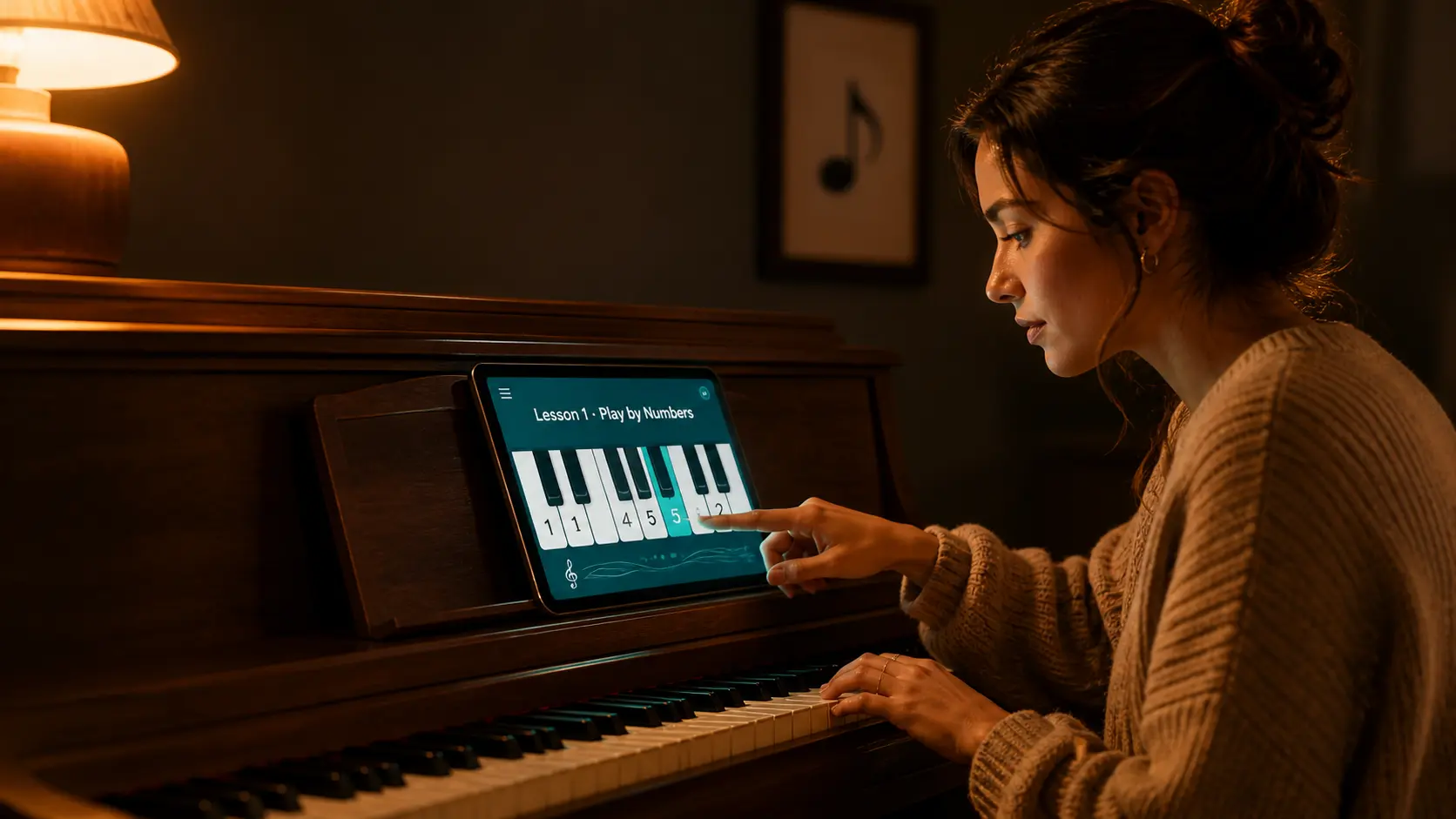
The Nashville Number System is exactly that framework. It’s the shorthand professional studio musicians use—not because it’s a beginner shortcut, but because it’s efficient and transferable in a way that written notation sometimes isn’t for live performance. For beginners who want to reach a functional worship playing level in weeks rather than months, this approach is a genuine alternative to the sheet-music default.
How to Find Your Right Starting Point Without Wasting Months
Before you download anything, answer these four questions:
- What do I want to be able to do in 90 days? Be specific. “Play piano” is not specific. “Play three worship songs without looking at a screen” is specific.
- Do I want to read sheet music or play by feel and chord structure? Both are valid. They lead to different apps.
- How much time will I realistically practice each day? If the answer is 10–15 minutes, you need an app designed for short daily sessions, not one that expects 45-minute commitments.
- Do I want to just learn, or do I also want a space to decompress? This one matters more than most apps account for. MusicKanHeal is built around both a structured number-system learning path and a dedicated healing audio and therapy mode for the days when you need to listen rather than practice. That dual purpose is unusual in this market, and it matters if music is as much about mental health for you as it is about skill-building.
Once you’ve answered those four questions, the right app becomes obvious—not because one app is objectively best, but because one app matches your actual situation.
The Bottom Line: Matching the App to Your Goal
The best piano app for beginners is the one that matches what you’re actually trying to do—not the one with the most downloads or the highest App Store rating.
If your goal is casual playing and you want a gamified, song-first experience: Simply Piano or Flowkey will get you started quickly.
If you want proper musical literacy and don’t mind a structured, sheet-music approach, Skoove or Piano Marvel are solid choices for adult learners.
If you want to play gospel or worship music, learn by chord relationships rather than notation, and have a space in the app to decompress with healing audio when you don’t feel like practicing, MusicKanHeal is built for exactly that combination—and it’s a starting point none of the mainstream apps cover.
Frequently Asked Questions
What is the best free piano app for beginners?
Several strong options offer free tiers: Flowkey and Simply Piano both have free trials covering a limited song selection, while Hoffman Academy offers genuinely free video lesson content without requiring an instrument. MusicKanHeal is free to download on the App Store, giving beginners immediate access to the Nashville Number System and healing audio tracks without an upfront cost. The honest caveat with any free tier is that the full curriculum usually sits behind a subscription—the free version is best used to test whether an app’s approach actually suits how you learn.
Can you learn piano as a beginner without reading sheet music?
Yes, and for many adult beginners, it’s the better path. Traditional sheet music is a skill in its own right—learning it while also learning to play piano adds significant time before you can play anything satisfying. The Nashville Number System is the most practical alternative: it teaches chord relationships using numbers, which lets beginners play in any key and follow chord charts without ever touching a staff or a clef. It’s not a simplified version of “real” music theory—it’s a different system that professional musicians actually use.
Which piano app is best for adult beginners specifically?
Adults tend to do best with apps that explain the reasoning behind what they’re playing, not just the steps. Skoove and Piano Marvel are frequently cited for their structured, less gamified approach suited to adult learners. For adults who specifically want to skip the sheet music learning curve and reach functional playing faster — especially for worship or gospel music — a number-system-based app like MusicKanHeal covers ground that neither of those apps touches.
Do piano apps actually work, or do beginners just learn to follow the app?
Both outcomes are real, and which one you get depends almost entirely on the app’s approach. Falling-note apps — where colored keys light up and you follow along — produce beginners who are dependent on visual cues. Remove the app and the skill largely disappears. Apps that teach a transferable system (sheet music notation or chord-number relationships) build knowledge that works without the app open. The difference isn’t about effort or talent — it’s about what the app is actually teaching underneath the songs.
What should I look for in a piano app if I want to play worship music?
Prioritize chord-based learning over melody-focused or sheet-music-focused apps. Most worship settings run on chord charts, not written notation—so the skill you need is recognizing chord movements and transitioning between them in real time. Look for an app that teaches the Nashville Number System or chord theory from day one, not one that introduces chords only after you’ve spent weeks on single-note exercises. Also consider whether the app covers common gospel and worship chord progressions specifically, since those patterns repeat across hundreds of songs.
All rights are reserved. Copyright 2026 MusicKanHeal | musickanheal.com