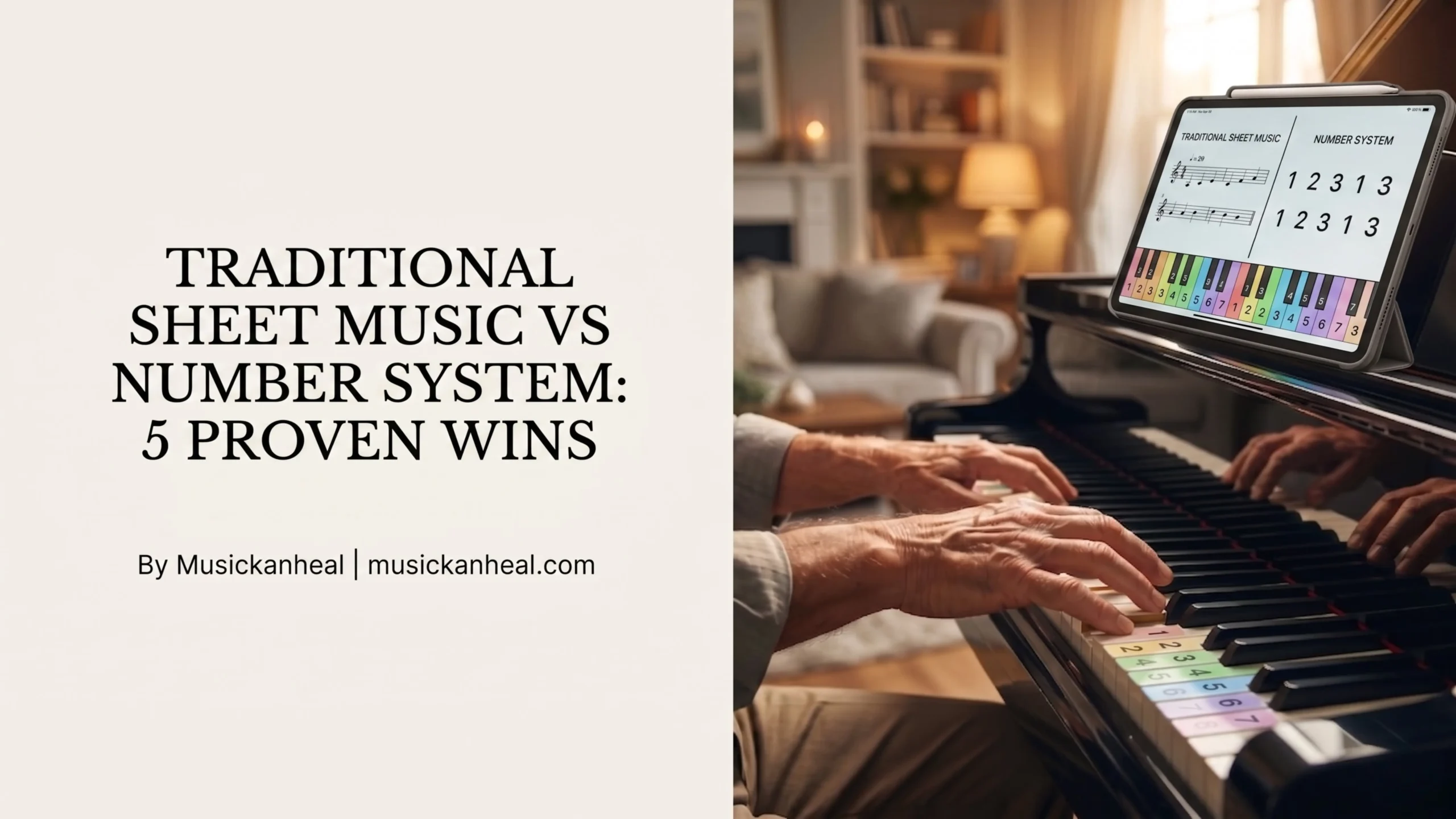
Traditional Sheet Music vs Number System
If you have ever sat down with a piece of piano sheet music and felt your eyes glaze over, you are not alone. The stacked lines, clef symbols, key signatures, and note heads can make even a simple song look like a foreign language. That is exactly why the debate around traditional sheet music vs number system has been growing louder among beginners, adult learners, and worship musicians.
Both systems lead to the same destination: playing music. But the road each one takes is completely different. One takes years. The other can have you playing real chords in an afternoon.
This guide breaks down what each system is, where each one wins, and which approach actually makes sense depending on what you want from music.
What Is Traditional Sheet Music — and Why Does It Feel So Hard?
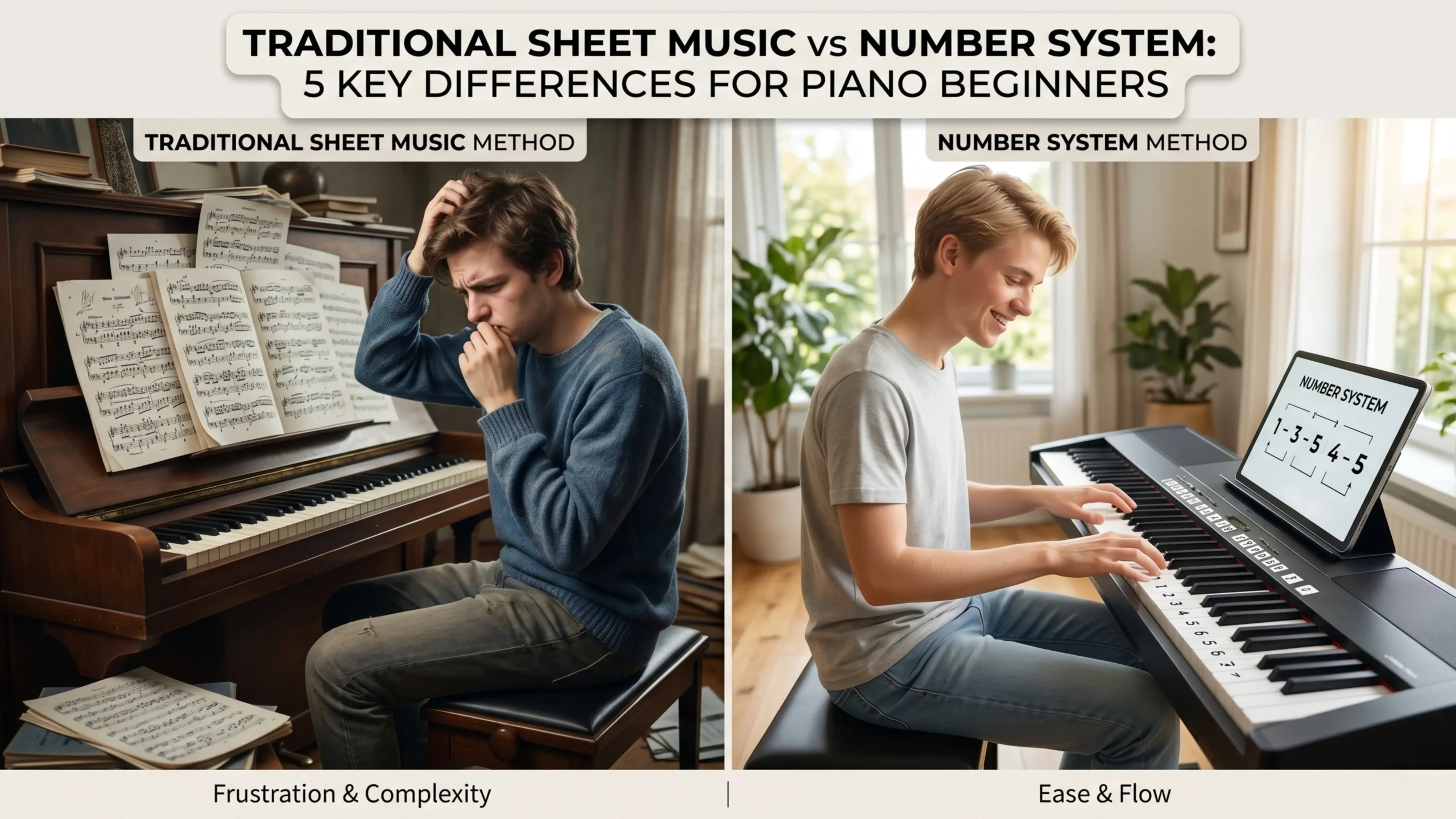
Traditional sheet music is the standard Western notation system that has been in use for centuries. It uses a five-line staff, clef symbols, note heads, time signatures, key signatures, dynamic markings, and a range of other symbols to tell a player exactly what to play, when to play it, and how loud to play it.
It is a thorough and precise system. A classically trained pianist can sit down with a Beethoven sonata they have never seen before and work through it note by note. That level of musical literacy is genuinely impressive and genuinely useful in specific contexts.
But here is the practical problem for most beginners: sheet music requires a completely separate literacy. You cannot skim it. You have to decode every symbol on the page before your fingers move. Most new students spend several months just learning to identify where notes sit on the five lines before they ever play a full song.
The cognitive load involved is significant. Reading two staves at once — treble clef for the right hand and bass clef for the left — while also watching your fingers, maintaining rhythm, and keeping time is a lot to ask of a brain doing it for the first time. For most adults who simply want to play the music they love, the gap between that desire and actually producing something satisfying is frustratingly wide with traditional sheet music.
What Is the Number System in Music?
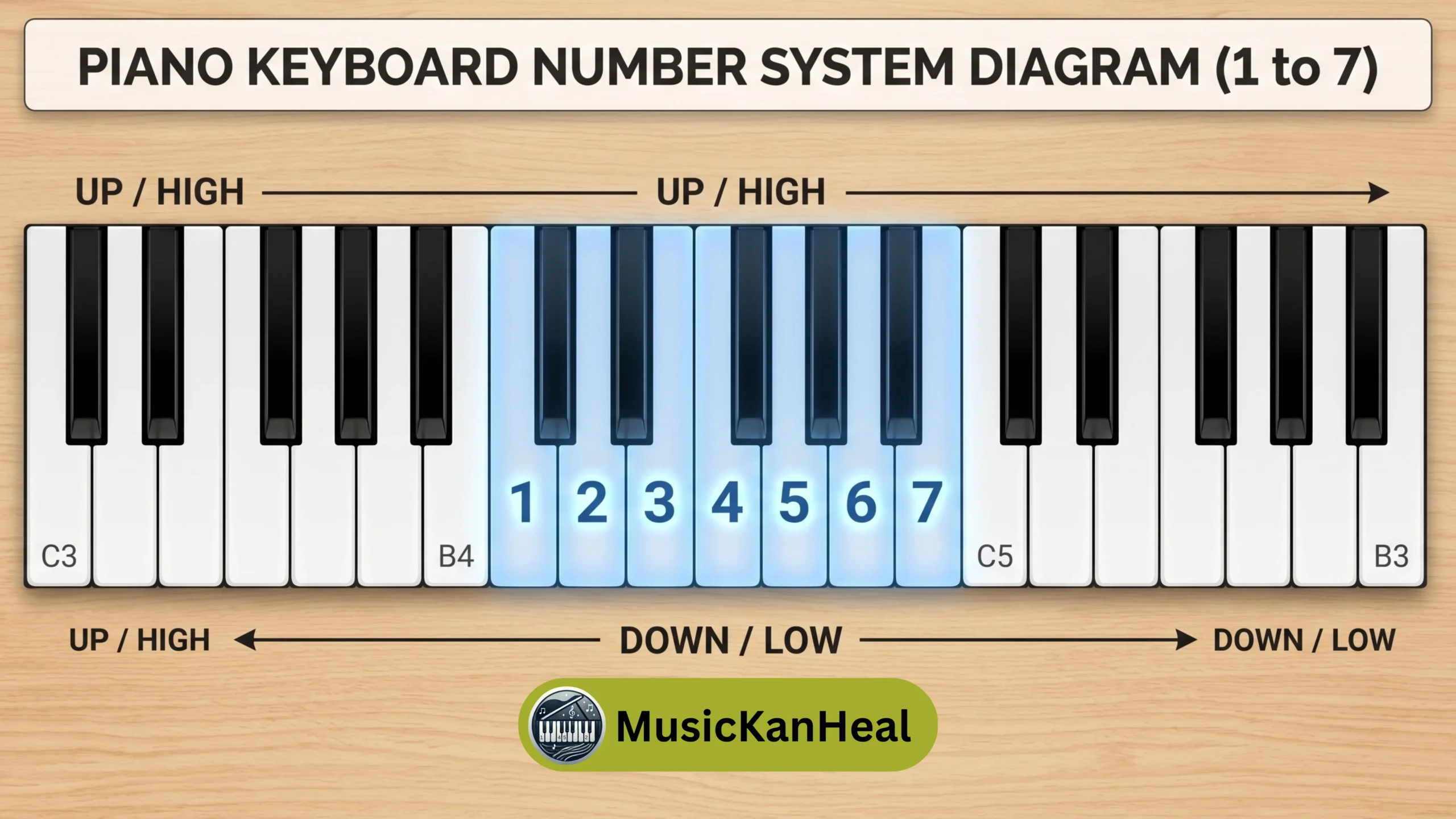
The number system assigns the numbers 1 through 7 to the notes of a major scale. Instead of decoding a staff full of symbols, you follow a simple sequence of numbers that tells you which chords or notes to play.
The most widely known version is the Nashville Number System. According to Sweetwater, it was developed in the 1950s by a Nashville vocal group called the Jordanaires, who needed to learn and perform 12 to 15 songs per recording session without time to work from full written charts. The system spread quickly because it worked immediately.
The core structure is simple. Every note in a major scale gets a number:
- 1 = root note (Do)
- 2 = Re
- 3 = Mi
- 4 = Fa
- 5 = Sol
- 6 = La
- 7 = Ti
Once you know where these numbers land on your keyboard, a chord progression like 1–4–5–1 is something you can play on day one. No staff. No symbols. No decoding required.
Traditional Sheet Music vs Number System: 5 Key Differences That Actually Matter
When you put traditional sheet music vs number system side by side, five differences stand out. These are not minor stylistic preferences. Each one has a direct effect on how fast you learn, how freely you play, and how much you actually enjoy the process.
1. Learning Curve
Traditional sheet music typically requires six to twelve months of consistent lessons before a student can read unfamiliar music with any fluency. The number system can be understood in a single session. The underlying concept takes about ten minutes to explain, and most people are playing real chord progressions within their first hour of trying it.
2. Changing Keys
This is where traditional notation creates a genuine wall for most players. If you learn a song in C major and the vocalist needs it in G major, you effectively have to relearn the chord shapes or find a rewritten chart. With the number system, you play the same numbers regardless of key. The “1” just starts on a different note.
3. How You Read While Playing
Sheet music keeps your eyes locked on the page. You decode, then play. The number system works in the opposite direction. Once you have internalized the numbers, you look up. You listen. You respond to what you hear rather than what is printed in front of you. This shift from page-dependent to ear-connected playing is a genuine change in how musicians experience music.
4. Usefulness in a Band Setting
Sheet music requires separate printed parts for each musician, sometimes transposed for different instruments. The number system works for every player in the room off one chart, in whatever key the vocalist chooses, without reprinting anything. For bands, this saves enormous amounts of time in rehearsal and removes a common source of confusion.
5. Enjoyment vs Stress
This one is harder to measure but consistently shows up in how musicians talk about learning. Traditional sheet music in the early stages tends to feel like academic study. There are rules to memorize, symbols to identify, and a constant low-level fear of getting something wrong. The number system removes most of that friction. You learn the pattern once, and then you apply it. That shift — from stressful memorization to actual playing — is a significant reason why more beginners are sticking with it.
Which Is Better for Beginners: Traditional Sheet Music or the Number System?
It depends on your goal, and most people are honest with themselves about this if they think it through for a moment.
If you want to play classical repertoire, read orchestral scores, or perform in an ensemble with fully written arrangements, traditional sheet music is genuinely necessary. The time investment is worth it for that specific path, and there is no real shortcut around it.
But if your goal is to play your favorite songs, lead a worship set, sit at a piano and produce something that sounds good, or simply enjoy music without a years-long detour through theory—the number system is a dramatically better entry point. You will play real music far sooner, and you will not lose momentum waiting for the literacy skills to catch up with your desire to play.
Most adult beginners fall into that second group. They do not want to become classical concert pianists. They want to sit at a keyboard and feel good. The number system gets them there without the detour.
It is also worth pointing out that these two systems are not mutually exclusive. Many professional session musicians read traditional notation fluently and use the number system in live settings. Learning one does not prevent you from learning the other. It just determines where you start.
Why Worship Bands Are Moving Away from Sheet Music
If you play in a church context, the traditional sheet music vs number system debate has already been settled in most professional worship settings. Bands like Hillsong, Jesus Culture, and the majority of touring worship musicians use the number system. The reason is simply practical.
Worship music changes key constantly depending on who is leading, who is singing that week, and what the congregation can follow. Sheet music cannot keep up with those real-world demands. With the number system, a worship leader can call out a song mid-service, change the key on the spot, and the entire band adjusts without chaos or reprinting.
There is also a less obvious benefit. Playing by numbers encourages musicians to listen more carefully to each other rather than keeping their heads buried in a paper chart. That attentiveness is what makes a live worship set feel present and connected rather than mechanical.
For worship leaders who want to teach their team this way, the MKH Method at Musickanheal was built specifically to walk beginners through the Nashville Number System in a structured, guided way — from understanding the scale to playing full songs across multiple keys.
How the Musickanheal App Makes This Practical
Understanding the debate between traditional sheet music vs number system is one thing. Actually making the switch requires the right tool.
Most resources that teach the Nashville Number System assume you already have some musical background. The Musickanheal app takes a different approach. It was designed for people who have never played before—people who looked at a page of sheet music and decided music was not for them.
The app maps numbers 1 through 7 directly onto the piano keyboard, guides you through chord patterns in real-time, and lets you play along to gospel, worship, and popular songs from your very first session. There is no separate theory module to work through before you touch the keys. You learn by playing.
The app also works across 127 different instruments, so the same number logic you learn on the piano can be applied to organs, synths, and more. If you are curious about the full approach, you can explore how MusicKanHeal enhances your piano skills before downloading.
Frequently Asked Questions
Is the number system in music better than traditional sheet music for adult piano beginners?
For most adults who want to play modern music, gospel, or worship songs, yes. Traditional sheet music takes months before a beginner can play anything satisfying. The number system lets you play real progressions within your first session. If your goal is enjoyment over classical performance, the number system is the faster and less stressful starting point.
Can you learn the traditional sheet music system after starting with numbers?
Yes, and many musicians do exactly this. The two systems do not conflict. Players often start with the number system to build ear training, confidence, and chord awareness, then add sheet music reading later when they need it for specific arrangements or classical pieces. Starting with numbers does not close any doors.
What is the Nashville Number System and how does it compare to traditional sheet music?
Traditional sheet music uses fixed staff notation with symbols for exact pitches, rhythms, and dynamics. The Nashville Number System replaces note names with numbers 1 through 7, where “1” is always the root of whatever key you are playing in. The critical difference is that the number system is movable—one chart works in any key—while traditional sheet music is written for a specific key and must be rewritten or transposed to change it.
How long does it take to learn the number system compared to traditional sheet music?
Most beginners understand the number system concept within one session and can play simple chord progressions the same day. Fluent sight-reading in traditional sheet music typically takes six to twelve months of consistent practice. For anyone with limited time who wants to play music soon, the number system has a clear advantage.
Does using the number system instead of traditional sheet music limit your musical growth?
It depends on where you want to go. The number system accelerates skills like ear training, chord awareness, and key transposition — areas that sheet music reading does not directly build. Where it falls short is in complex polyphonic classical music, where the full detail of sheet music is genuinely necessary. For most modern music genres, gospel, and worship settings, the number system supports strong musical development without limitation.
All rights are reserved. Copyright 2026 MusicKanHeal | musickanheal.com