Healing Frequencies Explained: Binaural Beats, Solfeggio, and Sound Therapy in 2026
Healing frequencies are specific sound tones — measured in hertz (Hz) — used intentionally to shift the brain and nervous system toward calmer, more restorative states. A 2026 systematic review published in Acta Neuropsychiatrica (Cambridge University Press) found that music-based and binaural beat interventions produced significant improvements in anxiety, sleep quality, and cognitive function, with standardized effect sizes between 0.3 and 0.6 across multiple studies.
That’s meaningful evidence. It’s also more nuanced than most healing frequency content admits. This guide covers what the research actually shows — not what wellness marketing claims — across every major category: binaural beats, solfeggio frequencies, sound baths, noise therapy, and healing music apps.
What Are Healing Frequencies, and How Do They Work?
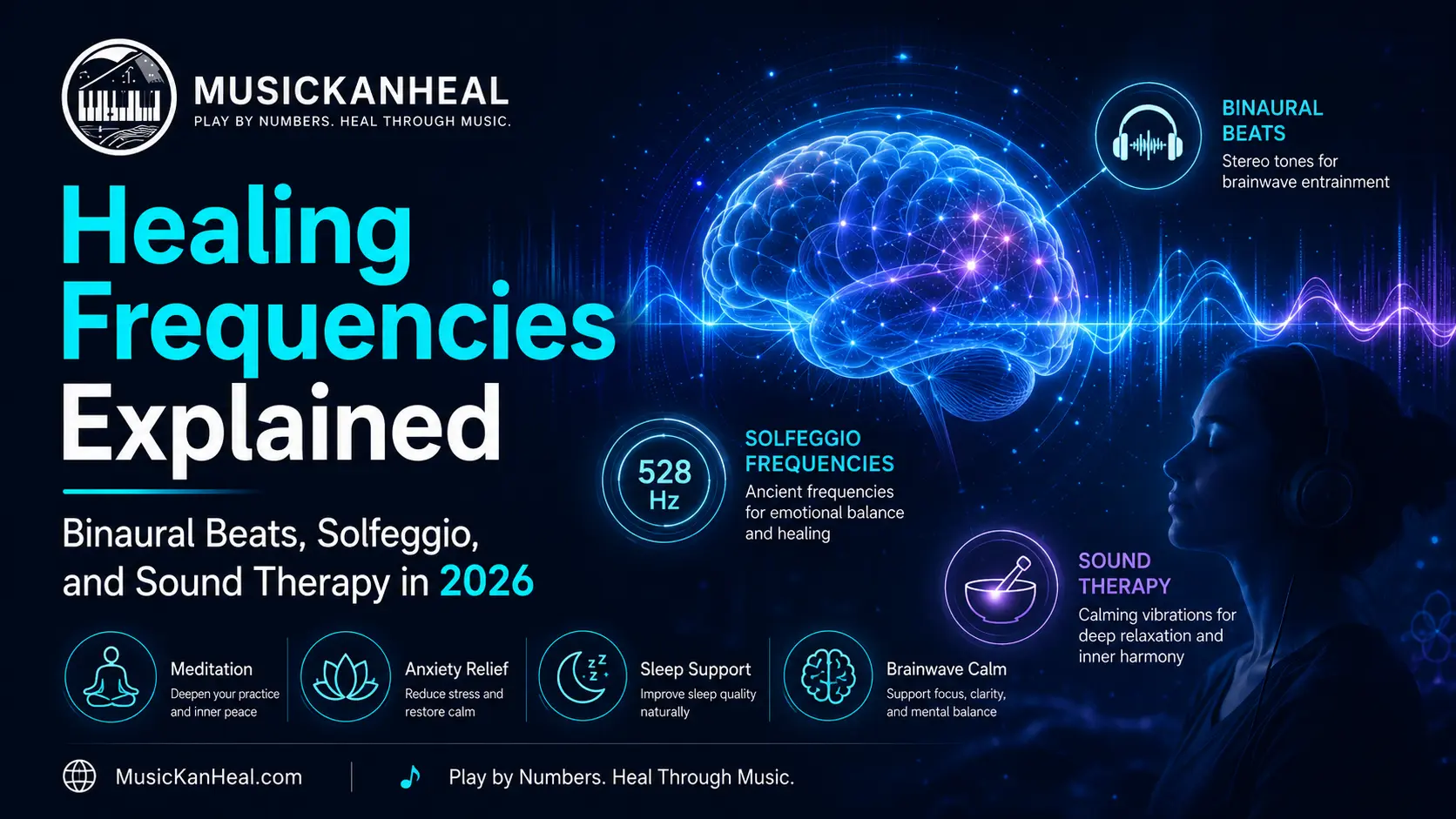
Sound is vibration. Every sound you hear is air moving at a specific number of cycles per second, measured in hertz. A frequency of 40 Hz means 40 vibrations per second. Human hearing spans roughly 20 Hz to 20,000 Hz, with most speech and music falling in the 250–4,000 Hz range.
The term “healing frequencies” describes sounds specifically chosen because of how they interact with the brain’s electrical activity, the nervous system, or — in some traditions — the body’s own energetic field.
The mechanism with the most scientific support is called brainwave entrainment. Your brain produces its own electrical oscillations — brainwaves — at different frequencies depending on your mental state. Beta waves (13–30 Hz) dominate during alert, analytical thinking. Alpha waves (8–13 Hz) appear during calm, relaxed focus. Theta waves (4–8 Hz) characterize light sleep and deep meditation. Delta waves (0.5–4 Hz) dominate deep, restorative sleep.
When your brain is exposed to rhythmic external sound, it tends to synchronize its own electrical activity to match — a process called the frequency-following response. This is the biological foundation for most healing frequency practices. It’s real. It’s measurable in EEG studies. What varies is how reliably different sound types produce it and how significant the resulting effects are.
The global sound therapy market was valued at $1.12 billion in 2024 and is projected to reach $9.5 billion by 2032 — an 8.1% annual growth rate. That commercial momentum sits well ahead of the clinical evidence in some areas and behind it in others. Knowing the difference is the starting point for using any healing frequency practice effectively.
Binaural Beats: The Most Research-Supported Healing Frequency Tool
Binaural beats are the most scientifically studied category of healing frequencies, and the evidence behind them is the most specific.
Here’s how they work: your left ear hears a tone at 200 Hz; your right ear hears a tone at 210 Hz. Because these tones don’t literally meet in the air, your brain creates a “phantom” tone at the difference between them — in this case, 10 Hz. That 10 Hz phantom tone sits in the alpha brainwave range, associated with calm, focused relaxation. Your brain’s electrical activity begins to entrain to it.
Critical requirement: binaural beats only work with headphones. Without stereo separation — one frequency per ear — the effect doesn’t occur. This is the most commonly misunderstood limitation of the technology.
What the 2026 Research Shows
A 2025 randomized controlled trial published in Nursing Reports (Ratanalerdnawee et al., Dhurakij Pundit University, Bangkok) tested binaural beats in surgical patients experiencing preoperative anxiety. The binaural beat group showed significantly greater reductions in anxiety scores (p < 0.001), systolic blood pressure (p = 0.011), heart rate (p = 0.003), and respiratory rate (p = 0.009) compared to both a music control group and no-treatment control. No adverse events occurred.
The 2026 systematic review in Acta Neuropsychiatrica — covering interventional clinical trials from 2015 to 2025 — found that binaural beat interventions consistently produced moderate improvements across anxiety, sleep quality, and short-term cognitive performance. The effect sizes (0.3–0.6 on standardized scales) are comparable to those seen with many pharmaceutical approaches, without the side effect profile.
Brainwave Ranges and Their Uses
| Brainwave | Frequency | Use |
|---|---|---|
| Delta | 0.5–4 Hz | Deep sleep, physical restoration |
| Theta | 4–8 Hz | Meditation, creativity, emotional processing |
| Alpha | 8–13 Hz | Relaxed focus, anxiety reduction, calm alertness |
| Beta | 13–30 Hz | Active thinking, focus, energy |
| Gamma | 30+ Hz | High-level cognitive processing |
For anxiety and sleep, delta and theta binaural beats are most commonly used and most studied. For focus and calm productivity, alpha range is the target.
The honest caveat: most binaural beat studies are small. The Acta Neuropsychiatrica review noted “heterogeneity in design and small sample sizes limit the certainty of findings.” The direction of evidence is consistently positive. The magnitude and durability of effects need larger trials to confirm. What the research does support clearly is: binaural beats are low-risk, accessible, and produce measurable short-term shifts in anxiety and sleep onset.
Solfeggio Frequencies: Ancient Tones, Honest Science
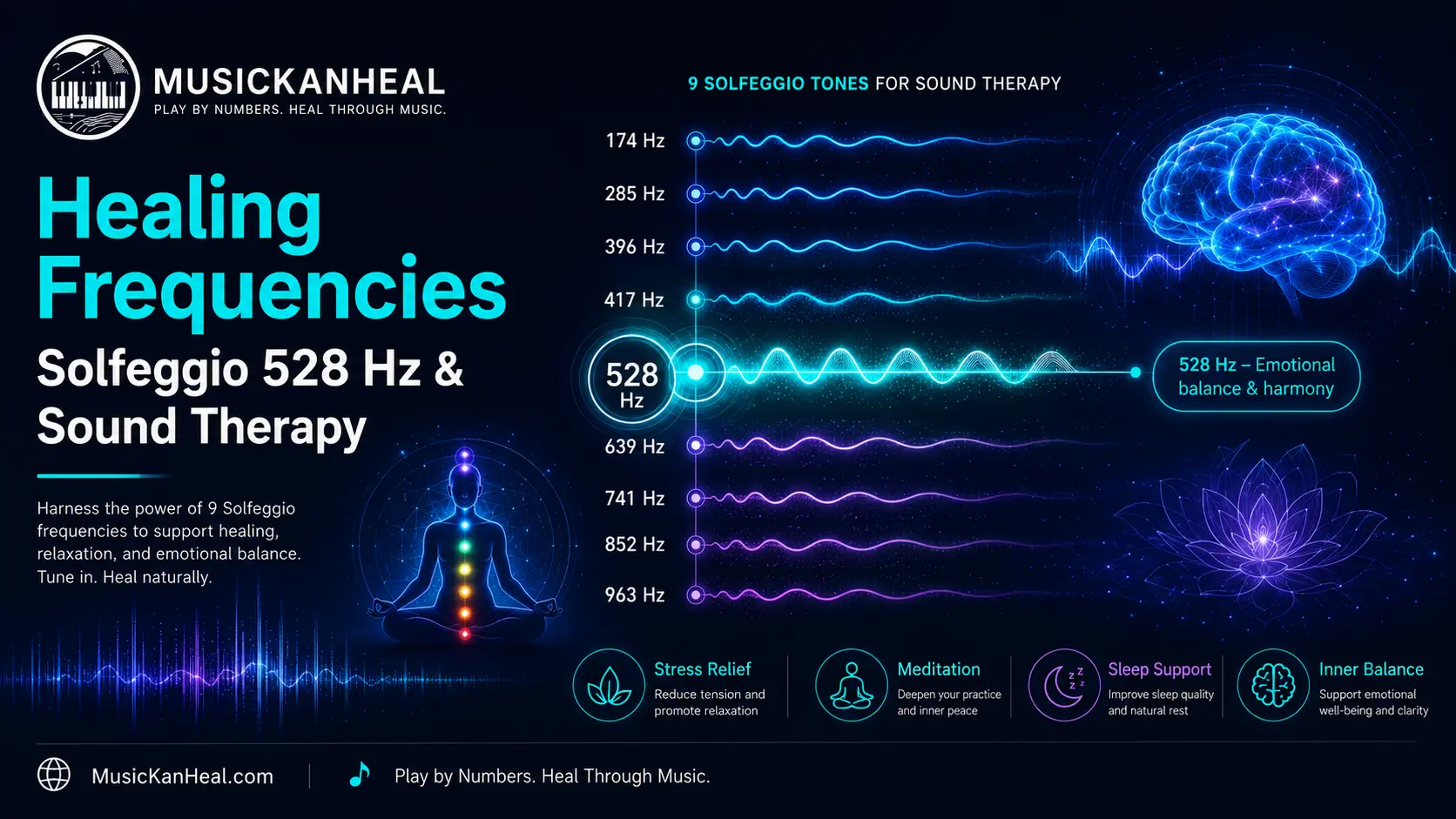
Solfeggio frequencies are a set of specific tones — 174 Hz, 285 Hz, 396 Hz, 417 Hz, 528 Hz, 639 Hz, 741 Hz, 852 Hz, and 963 Hz — rooted in Gregorian chant traditions and rediscovered in modern sound healing practices.
Unlike binaural beats, solfeggio frequencies don’t require headphones. They are actual sound frequencies that you hear directly, not a brain-generated perception from two different tones.
The most researched is 528 Hz — often called the “Love Frequency” or “Miracle Tone.” A study published in the Journal of Health Science (Akimoto, Hu, and Yamaguchi, 2018) measured participants’ endocrine and autonomic nervous system responses after just five minutes of music tuned to 528 Hz. Results showed measurably lower cortisol levels and significantly higher oxytocin levels compared to conditions using standard 440 Hz music.
A separate study found that 528 Hz sound waves increased cell viability in human astrocyte cell cultures and reduced reactive oxygen species — markers of cellular stress. The research on 528 Hz at the cellular level is early but consistent in direction.
What the Research Supports and What It Doesn’t
According to the Calm Blog’s editorial team — which applies a notably rigorous standard to wellness claims — the evidence on solfeggio frequencies is “still emerging,” with small studies showing stress hormone reduction and oxytocin increases, but “not enough to guarantee results.” That’s an accurate summary of the current state. The effects are real and measurable in some studies. The specific claims made by some practitioners — “DNA repair,” “spiritual transformation,” and “pineal gland activation” — are not supported by peer-reviewed evidence.
The practical frame: solfeggio frequencies produce measurable physiological relaxation responses in available studies. They are low-risk and widely accessible on major streaming platforms. The spiritual and metaphysical claims associated with them are tradition, not science. Both can coexist. Using 528 Hz as a relaxation and stress-reduction tool is supported. Using it as a substitute for medical care is not.
The Nine Solfeggio Frequencies and Their Traditional Associations
- 174 Hz — Physical pain relief and sense of security
- 285 Hz — Cellular repair and tissue healing
- 396 Hz — Releasing fear and guilt
- 417 Hz — Facilitating change, dissolving energetic blockages
- 528 Hz — Stress reduction, emotional healing, cortisol reduction (most studied)
- 639 Hz — Relationships, communication, emotional connection
- 741 Hz — Mental clarity, problem-solving, self-expression
- 852 Hz — Intuition, returning to spiritual order
- 963 Hz — Connection to higher states of awareness
For a complete breakdown of what each frequency is used for, how to listen, and which have the most clinical backing, the dedicated solfeggio frequency guide covers all nine in depth.
Sound Baths: The 2026 Wellness Trend With Real Neurological Backing
Sound baths were named by the Atlanta Journal-Constitution as one of the top wellness trends of 2026 — and unlike many wellness trends, the neurological mechanism behind them is reasonably well established.
A sound bath is an immersive listening experience in which participants lie down while a practitioner plays instruments — Tibetan singing bowls, crystal bowls, and gongs — that sustain long harmonic tones. The experience is passive: you don’t play, you receive.
The core mechanism is brainwave entrainment, the same as binaural beats. Tibetan singing bowls typically produce frequencies between 110 and 660 Hz, often aligning with alpha and theta brainwave ranges. Gongs produce a full spectrum from deep bass (around 50 Hz) to highs above 1,000 Hz, creating a layered sonic environment that sustains the entrainment effect.
Research published in the Journal of Evidence-Based Integrative Medicine found that sound meditation significantly reduced tension and improved mood. Multiple EEG studies confirm that sound bath environments shift participants from beta (alert, stressed) brainwave states into alpha and theta states — the same shift that prolonged meditation training produces, but accessible to people with no meditation experience.
Malinie Feeney, a master sound teacher, described the experience as “a lazy form of meditation” — meaning that the sound does the neurological work that active mental effort normally requires. That framing is consistent with what the EEG data shows.
A sound bath helps “downshift” the brain from the frantic beta state into the restorative alpha and theta states. An experienced practitioner can reach theta or delta brainwave states usually by seven or eight minutes into a session. For new participants, the shift typically takes longer but still occurs.
Practically: in-person sound bath sessions typically cost $30–$50. They’re available as recordings on YouTube, Spotify, and healing audio apps. The in-person experience differs from recordings primarily because live instruments produce full-spectrum vibration that you feel physically as well as hear — recordings capture the auditory component but not the somatic one.
Binaural Beats vs. Solfeggio Frequencies: Which One Should You Use?
The question most people have is which to use when. The short answer depends entirely on your goal.
Use Binaural Beats When:
- Your goal is sleep improvement or anxiety reduction with measurable effect
- You have headphones and can commit to wearing them
- You want the intervention with the most clinical trial backing
- You’re targeting a specific brainwave state (delta for sleep, alpha for calm focus)
Use Solfeggio Frequencies When:
- You want a relaxation tool that doesn’t require headphones
- You’re integrating sound into meditation, breathwork, or prayer
- You’re drawn to the emotional and spiritual associations of specific tones
- You want background sound during work, rest, or sleep
The honest answer about their relationship: they work through different mechanisms and are not interchangeable. Binaural beats create a neurological perception through frequency difference. Solfeggio frequencies interact directly with the nervous system through specific tonal resonance. Both produce measurable relaxation responses. The research base for binaural beats is currently more robust; the accessibility and versatility of solfeggio frequencies are greater.
Many practitioners combine them. Some tracks layer a solfeggio tone (e.g., 528 Hz) under a binaural beat structure. If you’re using such a track, headphones are still required for the binaural component to work.
For a direct head-to-head comparison of what each does best and which to choose for specific conditions, the dedicated binaural beats vs. solfeggio guide will cover that in full.
Noise Colors: White, Pink, and Brown Noise for Focus and Sleep
Outside of solfeggio and binaural beats, a separate category of healing frequencies has seen explosive growth: colored noise.
White noise contains all frequencies equally — the sound of static. Pink noise weights lower frequencies more heavily — the sound of rainfall. Brown noise weights even lower frequencies — the sound of distant thunder or a deep river.
The healing frequency application here is different from solfeggio or binaural beats. Colored noise doesn’t produce brainwave entrainment in the same way. Instead, it works through auditory masking — covering intrusive ambient sounds that interrupt sleep or focus — and through specific resonance effects on the nervous system.
A growing body of research has examined brown noise specifically for ADHD focus and anxiety management. Users report that the low-frequency rumble of brown noise creates a calm, immersive listening environment that reduces hyperarousal — one of the primary physiological features of both ADHD and generalized anxiety.
For focus during work or study, pink or brown noise is the most commonly reported effective option. For sleep, white noise has the longest research history for masking environmental disruption. For anxiety, brown noise is currently the most discussed, particularly for ADHD populations.
Healing Music Apps in 2026: Brain.fm, Endel, Calm, and MusicKanHeal
The sound therapy market has produced a category of apps that apply healing frequency principles to on-demand audio. Their quality varies significantly.
Brain.fm uses AI to generate music specifically designed to target neural oscillations for focus, relaxation, and sleep. Its approach is scientifically distinct from simply providing calm music — the audio is engineered to produce specific brainwave effects. It’s the most clinically oriented app in this space.
Endel generates personalized soundscapes adapted to your time of day, heart rate (via Apple Watch integration), and stated goal. Its design philosophy is elegant; the science behind personalization is harder to evaluate without independent research.
Calm is primarily a meditation platform that includes ambient sound and healing frequency tracks. Its 528 Hz and solfeggio content is supplementary rather than primary.
MusicKanHeal occupies a different position from all three. Rather than replacing active practice with passive listening, MusicKanHeal’s guided healing audio and sound therapy tools are designed as a complement to piano-based active music-making — for days when the active practice feels like too much, or as a stand-alone healing experience. The research distinction matters: passive listening and active playing produce different neurological effects, and both have therapeutic value.
As the piano brain healing research documents, active musical practice produces structural brain changes that passive listening does not match. But that doesn’t make healing audio apps valueless — it clarifies the role they’re best suited for.
The Honest Limits of Healing Frequencies
Anyone writing about this topic with intellectual honesty has to acknowledge what the research doesn’t support.
The Most Overstated Claims in the Healing Frequency Space
- “Frequencies repair DNA.” The 528 Hz DNA repair claim originates from a single researcher (Dr. Leonard Horowitz) and has not been replicated in peer-reviewed studies under controlled conditions. Small in vitro studies show cellular effects from sound exposure; extrapolating that to DNA repair in living humans is not supported by the current evidence.
- “Specific frequencies cure specific diseases.” Sound therapy is a complementary intervention, not a replacement for medical treatment. Its evidence base supports stress reduction, sleep improvement, mood regulation, and anxiety management — not disease treatment.
- “Any frequency that feels good is healing you.” This is unfalsifiable. Feeling calm during or after listening to any pleasant sound is a real experience, but it doesn’t confirm the specific mechanism being claimed.
What the Evidence Does Cleanly Support
- Binaural beats in the alpha, theta, and delta ranges produce measurable shifts in brainwave activity and improve anxiety and sleep outcomes in controlled trials
- Solfeggio frequencies (particularly 528 Hz) show cortisol reduction and oxytocin increase in small studies
- Sound baths shift EEG patterns toward alpha and theta states and reduce self-reported tension and anxiety
- All three are low-risk, accessible, and complement rather than conflict with evidence-based mental health care
How to Build a Personal Sound Healing Practice
The practical question is not “do healing frequencies work?” but “how do I actually use them?”
For anxiety in the moment: Binaural beats in the alpha range (8–13 Hz) with headphones, 15–30 minutes. Or 528 Hz solfeggio in a quiet environment, same duration. Both produce measurable acute cortisol reduction. This is the most evidence-supported application.
For sleep: Binaural beats in the theta or delta range, beginning 20–30 minutes before sleep target. Or solfeggio frequencies (432 Hz or 528 Hz) as ambient background. Do not use headphones in bed if sleep discomfort is a concern — pillow speakers are a practical alternative for binaural beats.
For focus and work: Pink or brown noise as ambient background. Alpha-range binaural beats during deep work sessions requiring sustained attention. Brain.fm is specifically engineered for this use case.
For a daily practice: Combine active music-making with passive healing audio. The research is consistent that active playing — even beginner-level piano practice — produces deeper neurological change than listening alone. If you’re building a beginner piano practice for stress relief, healing audio on rest days maintains the therapeutic engagement on days when active practice isn’t possible.
One consistent finding across all modalities: consistency produces compounding benefit. A single session produces acute stress reduction. Weekly practice produces mood and sleep improvement. Monthly practice begins to produce the structural changes — brainwave baseline shifts, sustained cortisol reduction — that the long-term outcome research documents.
Frequently Asked Questions About Healing Frequencies
What healing frequencies are best for anxiety?
Binaural beats in the alpha range (8–13 Hz) have the strongest clinical evidence for acute anxiety reduction. A 2025 randomized controlled trial published in Nursing Reports found alpha-range binaural beats significantly reduced anxiety scores, heart rate, and blood pressure in a surgical population compared to both music controls and no-treatment controls. Solfeggio frequencies at 528 Hz also show measurable cortisol reduction in available studies. For anxiety during the day, alpha binaural beats with headphones are the most evidence-supported choice.
Do healing frequencies actually work, or is it placebo?
Both. The brainwave entrainment produced by binaural beats is measurable on EEG — it is not a placebo. The cortisol reduction from 528 Hz music is measurable in blood assays — not placebo. Placebo effects also contribute, as they do with virtually every therapeutic intervention including many pharmaceuticals. The 2026 systematic review in Acta Neuropsychiatrica confirmed effect sizes (0.3–0.6) across multiple controlled trials — effect sizes that are considered clinically meaningful. The direction of evidence supports real effects, even if the magnitude varies by individual and context.
What is the difference between binaural beats and solfeggio frequencies?
Binaural beats are a perceptual illusion created when two slightly different tones are played separately to each ear — the brain generates a third tone at the difference between them, which entrains brainwave activity. They require headphones. Solfeggio frequencies are specific tones that interact directly with the nervous system — they don’t require headphones and don’t create an auditory illusion. They work through direct tonal resonance rather than neurological entrainment. Both produce relaxation responses; the mechanisms are distinct.
What healing frequency is best for sleep?
For sleep onset, theta binaural beats (4–8 Hz) begin the transition from waking to sleep states. For deep sleep, delta binaural beats (0.5–4 Hz) are most aligned with the brain’s natural deep sleep oscillations. Solfeggio frequencies at 432 Hz are widely reported to reduce physical tension and prepare the body for sleep. A 2025 study in the Journal of Sleep Medicine used customized binaural beats for chronic insomnia treatment with positive results. For most people, the most practical starting point is theta-range binaural beats 20–30 minutes before the intended sleep time.
Can I use healing frequencies while sleeping?
Yes, and many people do. The concern is headphone comfort — standard headphones are impractical during sleep. Options include flat sleep headphones (thin enough to wear while lying on your side), pillow speakers (one speaker per pillow side, delivering stereo separation for binaural beats), or solfeggio frequencies without headphones through a room speaker (headphones are not required for solfeggio effects). Extended overnight exposure to any audio at low-to-moderate volume (below 60 dB) is not associated with adverse effects in available research.
All rights are reserved. Copyright 2026 MusicKanHeal| musickanheal.com