Binaural Beats vs. Solfeggio Frequencies: Which One Actually Works for Sleep and Anxiety?
Binaural beats have stronger clinical evidence for anxiety and sleep than solfeggio frequencies do — but solfeggio frequencies have real physiological research behind them too, and they work without headphones. The right choice depends on your goal, your situation, and whether you can wear headphones comfortably for 20 to 30 minutes.
This is the honest comparison most sound healing articles avoid. Both tools work through different mechanisms, serve different contexts, and have different evidence bases. Here’s what the research actually shows and exactly when to use each.
What Is Actually Different Between Them?
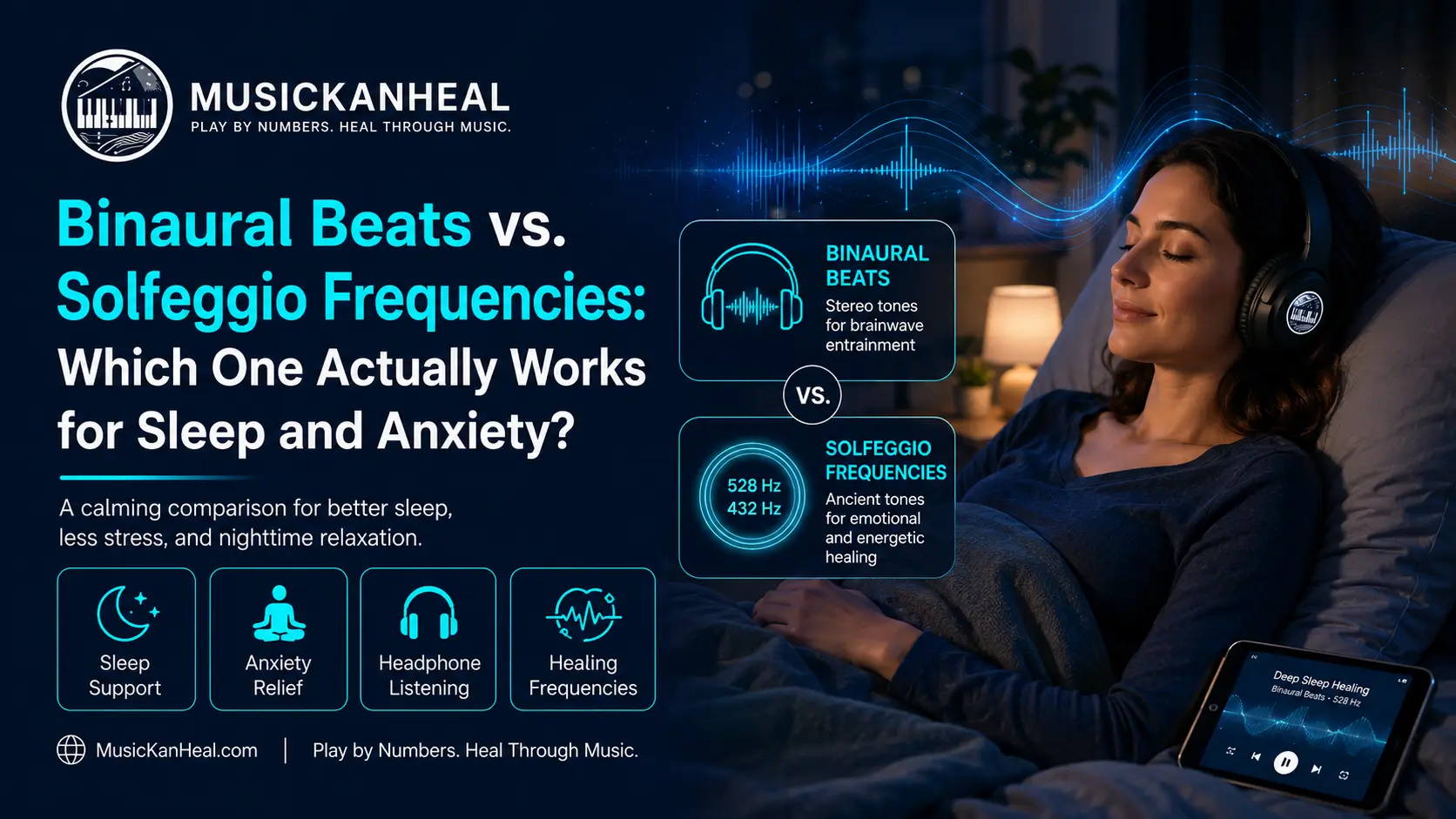
Most comparisons say one is “scientific” and one is “spiritual” and leave it there. That framing misses something important: both have measurable physiological effects. The mechanisms are genuinely different, and understanding that difference is what tells you which to reach for.
Binaural beats are an auditory illusion. Play a tone at 200 Hz in your left ear and 210 Hz in your right ear — your brain perceives a third “phantom” tone at the 10 Hz difference between them. That 10 Hz tone falls in the alpha brainwave range. Your brain’s own electrical activity begins to synchronize with it, a process called brainwave entrainment. The effect is neurological, not auditory — the phantom tone doesn’t actually exist in the air, only in your brain’s processing.
This is why binaural beats require headphones. Without stereo separation — one frequency delivered to each ear independently — the illusion cannot form. If you play binaural beats through speakers, you hear two tones. Nothing happens neurologically. This is the single most important practical fact about binaural beats, and it’s underemphasized in most content about them.
Solfeggio frequencies work entirely differently. They are actual tones — specific Hz values (528 Hz, 432 Hz, 396 Hz, and so on) — that you hear directly, no neurological illusion required. They interact with the nervous system through direct acoustic resonance rather than through brainwave entrainment. They work through speakers, phone audio, or headphones equally well.
The downstream effects are different too. Binaural beats target brainwave states — you’re choosing a frequency designed to shift your brain toward delta (deep sleep), theta (meditation), or alpha (calm focus). Solfeggio frequencies target the endocrine and autonomic nervous systems more directly — the research measures cortisol, oxytocin, heart rate variability, and autonomic response rather than brainwave patterns.
Binaural Beats: What the Clinical Research Actually Shows
The binaural beats research base is the strongest in the healing frequencies space. That doesn’t mean it’s conclusive, but the direction is consistent across multiple study designs.
A 2025 randomized controlled trial published in Nursing Reports (Ratanalerdnawee et al., Dhurakij Pundit University, Bangkok) allocated 111 surgical patients to three groups: superimposed binaural beats, plain music, or silence. The binaural beat group showed significantly greater reductions in anxiety scores on the State-Trait Anxiety Inventory (p < 0.001), alongside measurable drops in systolic blood pressure (p = 0.011), heart rate (p = 0.003), and respiratory rate (p = 0.009). No adverse events were recorded.
A separate randomized controlled trial testing binaural beats in patients undergoing fiberoptic bronchoscopy, published in Medicine, found that the binaural beat group had a mean anxiety score reduction of −7.26 points, compared to −3.92 in the plain music group and −1.12 in the no-music group. Binaural beats outperformed ordinary calming music by nearly double.
The 2026 systematic review in Acta Neuropsychiatrica (Elnazer, Cambridge University Press) synthesized 10 interventional clinical trials covering binaural beats and music interventions for anxiety, sleep, and cognition in young adults. Standardized effect sizes ranged from 0.3 to 0.6 — described as moderate and clinically meaningful. A separate meta-analysis calculated an overall effect size of g = 0.45 for binaural beats on anxiety reduction specifically.
A 2025 study published in Physiologia went further: researchers developed a real-time EEG feedback algorithm that dynamically tailored binaural beat frequencies to each participant’s live brainwave state. Results showed enhanced relaxation and cognitive performance compared to static binaural beat tracks, suggesting that the effect is real enough to be worth optimizing.
What the research doesn’t yet resolve: most studies are small. Blinding is difficult — participants generally know they’re receiving a treatment. The Acta Neuropsychiatrica review explicitly noted heterogeneity in design and small sample sizes as limits on the certainty of findings. The effect is real, but its magnitude and durability under different conditions still need larger trials.
For sleep specifically: research on binaural beats and sleep is promising but less established than the anxiety data. A study of young elite soccer players found that binaural beats in the 2–8 Hz range (theta/delta) improved sleep quality. Delta-range beats (0.5–4 Hz) are the primary target for deep sleep support.
Solfeggio Frequencies: What the Evidence Shows
Solfeggio frequencies have a smaller and more recent research base than binaural beats — but the studies that exist are more specific than most people realize.
The most important study on 528 Hz was conducted by Akimoto, Hu, and Yamaguchi (2018), published through Scientific Research Publishing. Researchers had participants listen to five minutes of music tuned to 528 Hz versus the same music at the standard 440 Hz tuning. The results were notable:
- Salivary cortisol dropped from 0.43 to 0.25 micrograms per deciliter after 528 Hz exposure
- Oxytocin — the bonding and calming hormone — increased significantly after 528 Hz compared to 440 Hz
- Only the 528 Hz group showed a significant shift in CVRR, a measure of parasympathetic nervous system activity (the “rest and digest” state that counters stress)
That’s not placebo-level noise. Salivary cortisol and oxytocin are hard biomarkers measured in blood and saliva assays. The effect size was measurable after five minutes.
A separate randomized clinical trial published in BMC Oral Health tested 432 Hz music against 440 Hz music and a no-music control group in patients undergoing tooth extractions. The 432 Hz group showed salivary cortisol levels of 0.49 μg/dL, compared to 1.35 μg/dL in the 440 Hz group and 1.59 μg/dL in the control group. The cortisol difference between 432 Hz and standard music was more than twofold.
A 2019 double-blind crossover study published in Explore found that participants listening to music at 432 Hz showed statistically significant reductions in heart rate, blood pressure, and respiratory rate compared to the same music at 440 Hz.
What the solfeggio evidence doesn’t support: the DNA repair claims associated with 528 Hz are not backed by peer-reviewed human clinical trials. The cell-level studies are interesting; extrapolating them to whole-body DNA repair in living humans is not scientifically justified. The honest summary: the stress hormone effects are real and measurable. The mechanisms are plausible. The sample sizes are small. The metaphysical claims are unverified.
Head-to-Head: Which Is Better For What?
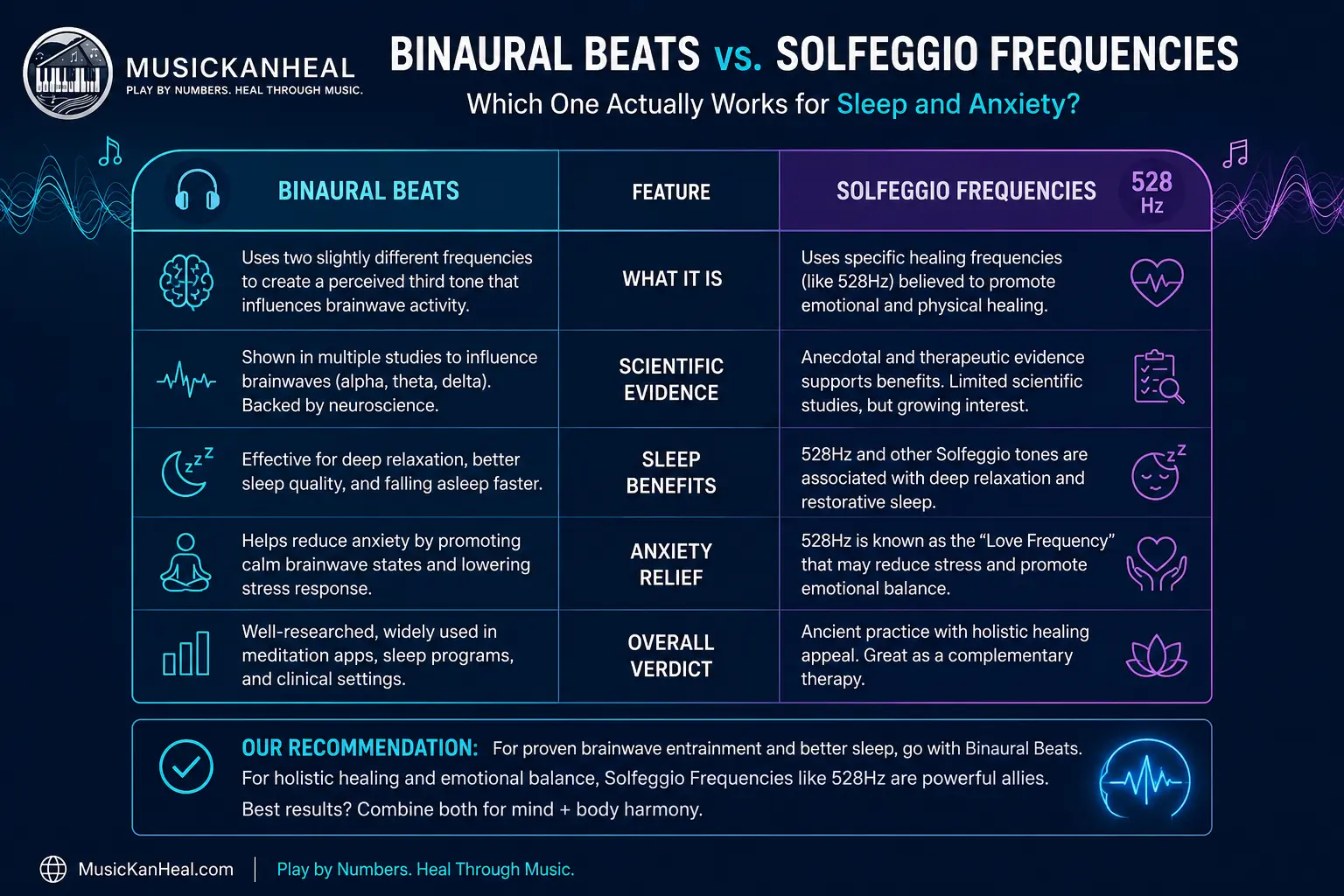
| Factor | Binaural Beats | Solfeggio Frequencies |
|---|---|---|
| Headphones required? | Yes, essential. | No — speakers work fine |
| Clinical evidence for anxiety | Strong — multiple RCTs, g = 0.45 meta-analysis | Moderate — cortisol/oxytocin studies, smaller samples |
| Clinical evidence for sleep | Moderate — delta/theta range studies | Emerging 432/528 Hz cortisol studies support relaxation |
| How quickly it works | Within 15–20 minutes of listening | Effects measured after 5–30 minutes |
| Works during sleep? | Requires sleep headphones or pillow speakers | Yes — room speaker works fine |
| Spiritual/emotional tradition | None — modern neuroscience technology | Deep — Gregorian chant, ancient music theory |
| Best combined with | Meditation, pre-sleep wind-down, focused work | Ambient background, prayer, yoga, passive rest |
| Can you combine them? | Yes — a solfeggio tone can be layered under binaural beats | Yes — requires headphones for the binaural component |
Which Should You Use for Sleep?
Sleep is where the most practical guidance can be given — and where the answer depends heavily on one variable: can you comfortably wear headphones in bed?
If yes: binaural beats in the theta or delta range (4–8 Hz or 0.5–4 Hz, respectively) are the more evidence-supported starting point. Delta-range binaural beats are the primary target for supporting deep, slow-wave sleep. Start listening 20–30 minutes before your target sleep time to allow brainwave synchronization to build. Use earbuds if over-ear headphones are uncomfortable. Sleep-specific flat headphones designed to be worn horizontally are an option for chronic use.
If no (sleeping alone, partner in bed, no headphone tolerance): solfeggio frequencies at 432 Hz or 528 Hz through a room speaker at low volume is the better option. The cortisol data on 528 Hz is the strongest of any single solfeggio frequency. Many people run these tracks on a continuous loop at 20–30 dB overnight without sleep disruption. No stereo separation is needed — a single phone speaker works.
The combination approach works for some people: 20 minutes of delta binaural beats with headphones while falling asleep, then switch to speaker-based 432 Hz for the remainder of the night. The binaural beats support sleep onset; the solfeggio maintains a low-cortisol environment during sleep.
One finding from the binaural beats literature worth noting: some listeners report mild irritability or headaches with extended binaural beat sessions. Tracks that layer binaural beats under white noise or ambient sound are more tolerable for long sessions than bare tones.
Which Should You Use for Anxiety?
For acute anxiety — a stressful meeting ahead, an anxious morning, or a difficult situation — binaural beats in the alpha range (8–13 Hz) have the most direct clinical evidence. The Nursing Reports RCT and the bronchoscopy RCT both found binaural beats outperforming plain calming music for anxiety reduction in high-stress contexts. The effect appears within 15 minutes of listening.
For ongoing background anxiety throughout a day — the kind that doesn’t peak but never quite settles — solfeggio frequencies are more practical. They don’t require headphones, can run continuously in a workspace, and the 528 Hz cortisol data suggest sustained exposure maintains lower basal stress hormone levels. MusicKanHeal’s guided healing audio tracks are built around this exactly — therapeutic audio designed for ambient, ongoing use rather than focused, acute sessions.
For anxiety management over weeks and months, the research perspective shifts. The piano brain healing research shows that active music-making — not just listening — produces the structural brain changes that reduce anxiety long-term. Healing frequencies are powerful complements to an active musical practice; they’re less effective as standalone chronic anxiety treatments than a combination approach.
Can You Use Binaural Beats and Solfeggio Frequencies Together?
Yes — and the combination is used deliberately in some of the better-designed healing audio products.
The combination works like this: a solfeggio tone (say, 528 Hz) is embedded as an underlying carrier frequency in the audio. A binaural beat is layered on top, delivered through the stereo separation required for the entrainment effect. The listener gets the cortisol-reducing properties of 528 Hz plus the brainwave entrainment effect of the binaural component simultaneously.
The requirement: headphones are still necessary when the binaural component is present. The solfeggio component works without them; the binaural component does not. If you remove headphones from a combined track, you lose the brainwave entrainment but retain the solfeggio frequency effects.
For most beginners, the combination adds complexity without much practical gain. Start with one modality, learn what it does for you, then experiment with combining. The most important variable in both practices — more important than choosing between binaural beats and solfeggio — is consistent use over time. A 2026 review found that repeated sessions produced compounding improvements that single sessions did not.
The One Mistake Most Beginners Make With Both
Treating either as a passive fix that works automatically without context.
Both tools produce their strongest effects when combined with a supportive environment: a quiet space, low lighting, reduced screen time before use, and ideally a still or reclined body position. Listening to 528 Hz while scrolling social media or watching a stressful news cycle is unlikely to produce the cortisol reduction the Akimoto study measured.
The research protocols that produced positive results weren’t just “play the audio.” They involved participants who were still, receptive, and not simultaneously processing stress-generating input. The frequencies do real physiological work — but they do it on a nervous system that’s given a chance to respond.
The Bottom Line
Binaural beats have more randomized controlled trial evidence for anxiety and sleep than solfeggio frequencies. Solfeggio frequencies have real hormonal research behind them, don’t require headphones, and integrate more naturally into daily life as ambient sound.
The competition framing — which one is better — misses that they serve different needs. Binaural beats are a better acute intervention for anxiety with headphones available. Solfeggio frequencies are the better ambient, headphone-free option for background stress management throughout the day and overnight sleep support.
For most people, the answer is both strategically. Alpha binaural beats before a stressful situation. 528 Hz through a speaker during sleep. And if you want to build the kind of deep, structural resilience to anxiety that passive listening of either type can’t fully provide, the research on active piano practice for mental health makes a consistent case that making music changes the brain in ways that listening to it does not.
Frequently Asked Questions About Binaural Beats vs. Solfeggio Frequencies
Do binaural beats actually work, or is it just a placebo?
The brainwave entrainment effect of binaural beats is measurable in EEG studies — it is not a placebo. Multiple randomized controlled trials have found binaural beats outperforming plain music controls for anxiety reduction, including a 2025 RCT in Nursing Reports where binaural beats produced significantly greater reductions in anxiety scores, blood pressure, and heart rate than both standard music and no music. Placebo effects also contribute, as they do with most therapeutic interventions. The 2026 systematic review in Acta Neuropsychiatrica confirmed effect sizes of g = 0.3–0.6 across 10 clinical trials. The effect is real; how much of it is specific to brainwave entrainment versus general relaxation from music remains an open question.
What is the best solfeggio frequency for anxiety?
528 Hz has the strongest research basis for anxiety and stress reduction among the solfeggio frequencies. The Akimoto et al. (2018) study found measurable cortisol reduction and oxytocin increase after just five minutes of 528 Hz exposure. For anxiety with a physical tension component — tight chest, shallow breathing, body holding stress — 432 Hz has shown reductions in heart rate and blood pressure in a randomized dental anxiety trial. If you’re unsure where to start, 528 Hz is the evidence-supported first choice.
Do binaural beats vs. solfeggio frequencies require different equipment?
Yes, and this is the most practical difference between them. Binaural beats require stereo headphones or earbuds — the two different tones must be delivered separately to each ear for the brain to generate the entrainment frequency. Without that stereo separation, the effect doesn’t occur. Solfeggio frequencies work through any audio output: room speakers, phone speakers, headphones, or earbuds. For sleep use specifically, solfeggio frequencies are more practical precisely because they don’t require wearing anything while lying down.
How long does it take for binaural beats to work for sleep?
Most protocols recommend starting binaural beats 20–30 minutes before the target sleep time. The brainwave synchronization effect builds gradually — it doesn’t produce an immediate state change. Research protocols typically use 15–30-minute sessions. For sleep onset specifically, delta-range binaural beats (0.5–4 Hz) begin supporting the transition from waking beta activity to sleep-associated theta and delta states within that window. Some people notice effects within 10 minutes; others need several nights of consistent use before the association between the audio and the sleep state strengthens.
Is 528 Hz or binaural beats better for deep sleep?
For sleep onset — transitioning from wakefulness to sleep — binaural beats in the theta range (4–8 Hz) have more direct clinical backing. For maintaining a low-stress physiological state throughout the night, 528 Hz through a room speaker is more practical and has documented cortisol-reduction effects. The combination approach — binaural beats for the first 20–30 minutes via headphones, then switching to 528 Hz through speakers — is what many practitioners recommend. Neither eliminates the need for basic sleep hygiene: consistent bedtime, dark room, limited screen exposure in the final hour, and a cool temperature all amplify whatever sound therapy you use.
All rights are reserved. Copyright 2026 MusicKanHeal | musickanheal.com