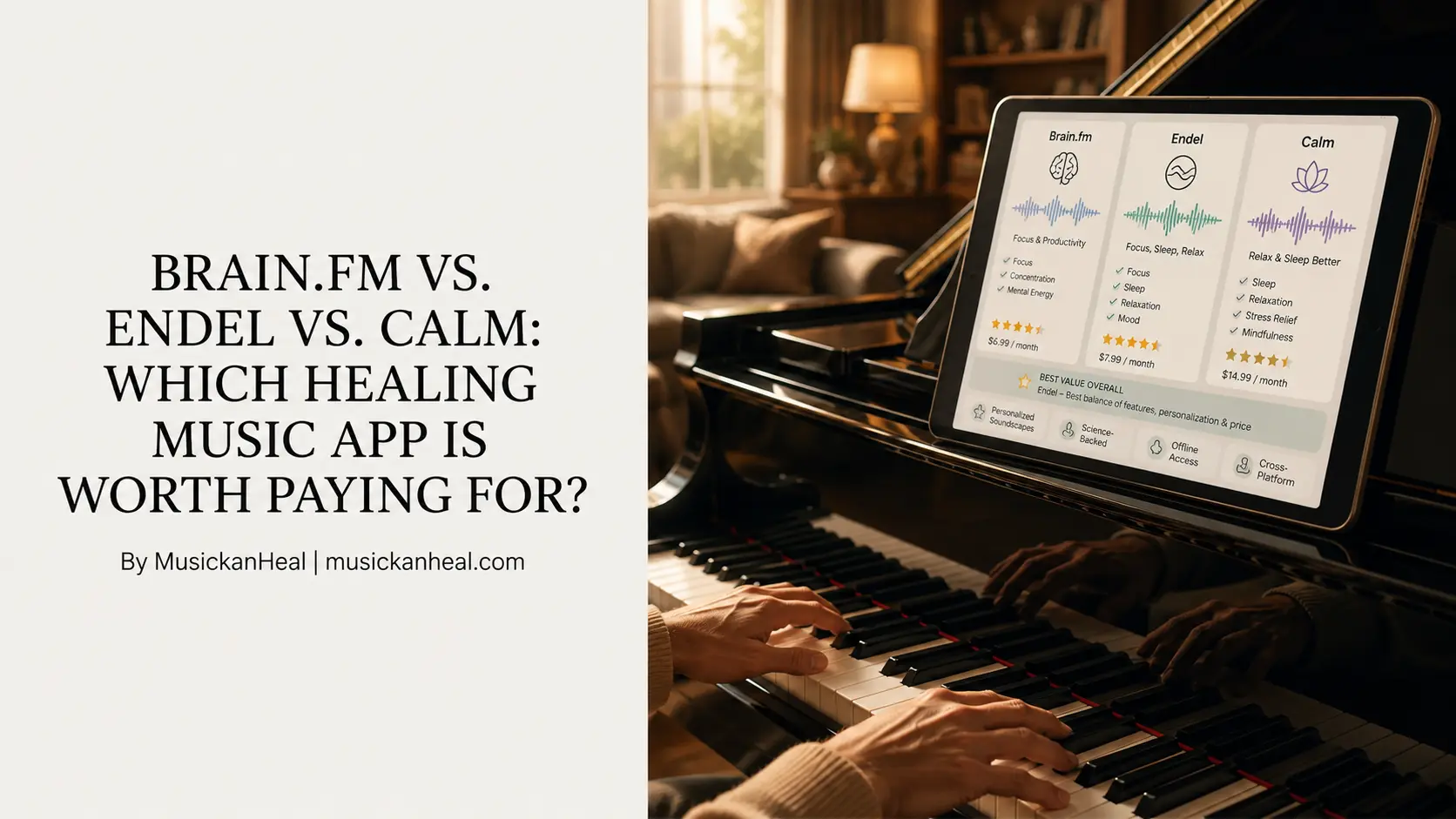
Brain.fm vs Endel vs Calm: 3 Verdicts, 1 Pick
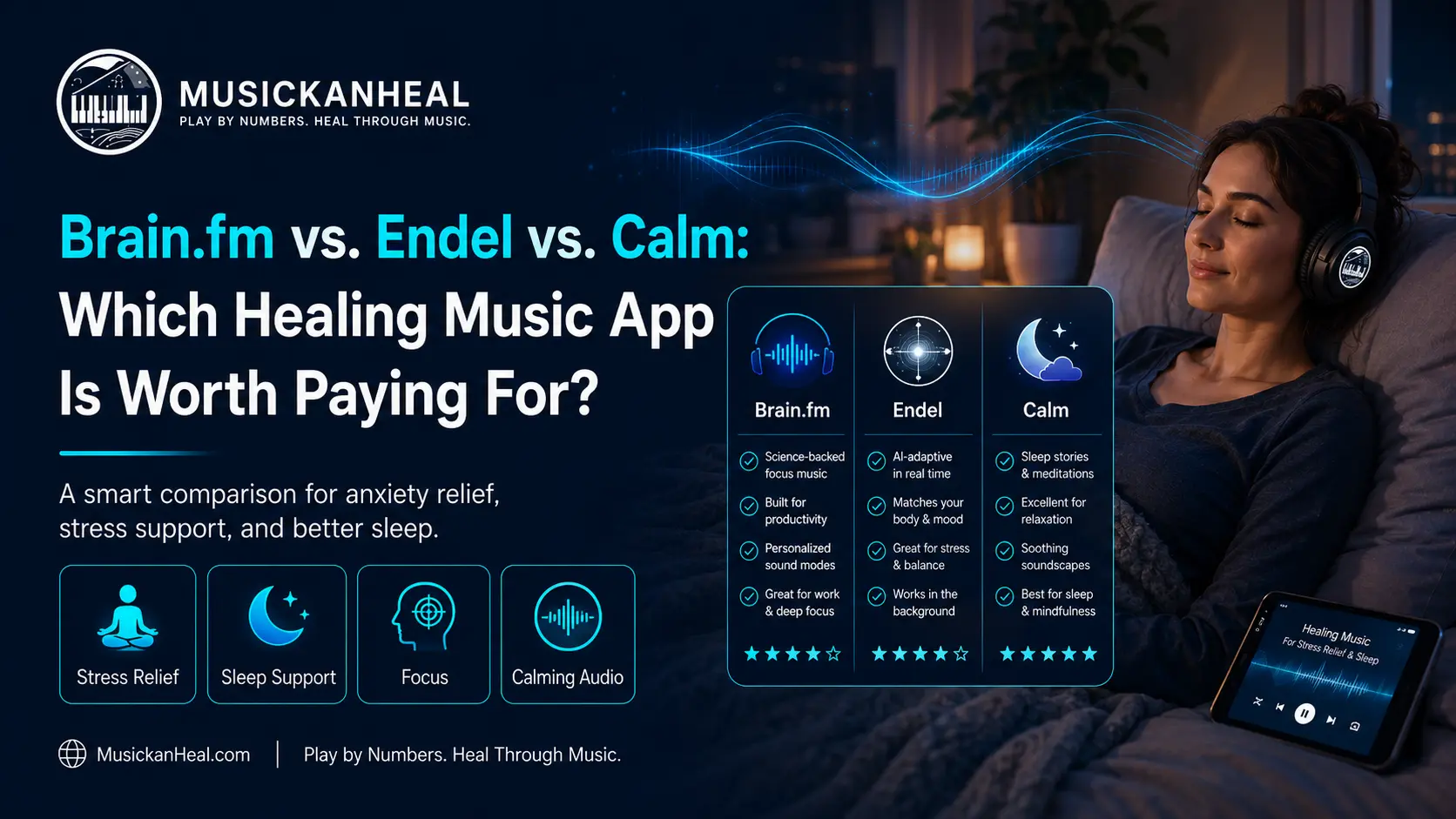
Three apps dominate every “healing music” conversation right now: Brain.fm, Endel, and Calm.
They promise versions of the same thing — reduced anxiety, better sleep, a calmer nervous system. They all charge you monthly for it. And every comparison article online lands on some variation of “they’re all great, it depends on your preference.”
That is not useful. The Brain.fm vs Endel vs Calm question has real answers based on what each app is actually doing to your brain, what the independent research says, and which one delivers measurable value for the price. This article gives you all three verdicts without softening any of them.
One important thing to flag before the details: all three apps involve listening to audio. None of them involve creating or playing music. That distinction matters more than anything else in this comparison — and we will come back to it.
Brain.fm vs Endel vs Calm: Side-by-Side Comparison
Before the details, here is what the three apps actually offer:
| Feature | Brain.fm | Endel | Calm |
|---|---|---|---|
| Core Approach | Neural phase locking via rhythmic modulation | AI-generated adaptive soundscapes | Guided meditation + ambient audio |
| Peer-Reviewed Research | Yes — NSF-funded, published studies | Limited — internal whitepapers + Berlin TU | Yes — mindfulness research base |
| Adapts in Real Time? | No | Yes (weather, heart rate, time of day) | No |
| Free Tier | Free trial (limited) | 5 minutes then paywalled | Limited free content |
| Modes | Focus, Relax, Sleep, Meditation, ADHD | Focus, Relax, Sleep, Recovery, Study | Meditation, Sleep Stories, Soundscapes, Breathwork |
| Offline Access | Yes (paid) | Yes (paid) | Yes (paid) |
| Desktop / Web | Yes | Yes | Yes |
| Price (Monthly) | ~$6.99/mo | ~$7.99/mo | ~$14.99/mo |
| Price (Annual) | ~$49.99/yr | ~$59.99/yr | ~$69.99/yr |
| Lifetime Option | Yes (~$199) | Yes (~$119) | No |
The Brain.fm vs Endel vs Calm pricing gap is smaller monthly than most people expect. The real gap is in what you are getting for that price — and that is where the comparison gets interesting.
What Makes Brain.fm Different from Every Music App You’ve Tried?
Brain.fm is not ambient music with a science veneer. It is a different category of audio product, and understanding why matters before you dismiss it or pay for it.
The technology is called neural phase locking. Rather than playing calming music and hoping your nervous system responds, Brain.fm embeds rhythmic amplitude modulations directly into the audio itself. These modulations are designed to synchronize your brain’s oscillatory activity — encouraging neural patterns associated with focus, relaxation, or sleep depending on the mode selected.
This is not the same mechanism as binaural beats, which require headphones and rely on a perceived third tone created by slightly different frequencies in each ear. Binaural beats produce relatively weak neural synchrony. Brain.fm applies modulation within each stereo channel, which independent analyses show produces measurably stronger effects on brain activity.
The research behind this is real. Brain.fm’s science page documents EEG and fMRI studies validating the approach — and the company has received funding from the National Science Foundation, which requires peer review of the underlying research claims. A 2024 Woods et al. study found that the 16 Hz modulation used in Brain.fm produced greater attention benefits specifically in users with higher ADHD symptom scores — meaning the technology appears to work differently for different brain profiles rather than applying a one-size-fits-all approach.
An independent audit published by Biology Insights found that Brain.fm’s neural phase locking technology is grounded in established neuroscience, specifically the well-documented mechanism by which the brain’s auditory cortex synchronizes to external rhythmic stimuli. The caveat the same audit raised: individual variability is significant. Some users report clear, immediate effects. Others report nothing.
Brain.fm vs Endel vs Calm: Which One Actually Helps with Anxiety?
Anxiety is the reason most people find this comparison. Here is how each app handles it, honestly.
Brain.fm for Anxiety
The relax and sleep modes use the same neural phase-locking technology applied to lower-frequency modulations associated with calm states. The 2024 data showing Brain.fm reduces tension and anxiety by 2x compared to standard relaxing music is their own claim — but it is backed by a placebo-controlled study design, which is more than most apps can say. For acute anxiety — the kind that spikes before a presentation or during a stressful afternoon — Brain.fm’s ability to shift brain states quickly is its strongest use case.
Endel for Anxiety
Endel approaches anxiety differently. Rather than targeting brainwave states directly, it creates a sound environment that removes friction from your mental state. The AI adapts the soundscape to your circadian rhythm, current weather, time of day, and heart rate (if you have an Apple Watch). The logic is that anxiety is partly driven by environmental mismatch — the wrong level of stimulation at the wrong time of day. Endel tries to correct that mismatch in real time. One reviewer who tested all three apps found that only Endel consistently supported three-hour work sessions without mental fatigue or audio awareness — suggesting that Endel’s adaptive approach sustains calm over longer periods where Brain.fm can feel fatiguing.
Calm for Anxiety
Calm takes the mindfulness route. Its anxiety-relevant content includes guided breathing exercises, body scan meditations, and a large library of ambient soundscapes. The science base here is not functional audio — it is decades of mindfulness research showing that consistent meditation practice reduces anxiety over time. That is legitimate. But it means Calm is a long-game tool, not an acute intervention. It will not shift your state in 10 minutes the way Brain.fm claims to. It builds habits that reduce your baseline anxiety over weeks and months.
Endel: The Right App for the Wrong Reasons?
Most people download Endel for focus. The app earns those reviews. But it is the relaxation and sleep functionality that is genuinely underrated.
The real-time adaptive element is not a marketing trick. The soundscape that plays at 7am when your heart rate is elevated does sound and feel different from the one playing at 11pm when your body is winding down. Whether you consciously notice the adaptation or not, the environmental signal is shifting. Multiple reviewers note that by month two of daily use, the app had integrated into their routines without conscious effort — which is the best indicator that something is working.
A detailed Endel vs Brain.fm comparison concluded Brain.fm wins on scientific effectiveness and pricing, but that Endel wins on long-session stamina and personalization. The “right app for the wrong reasons” problem is that many users expect Endel to feel dramatic. It does not. It feels ambient. That is intentional, and it is exactly why it sustains longer without mental fatigue.
The practical limitation: Endel’s free tier is effectively a demo. You get five minutes before the paywall. If you are testing whether adaptive soundscapes work for you, that is not enough to know.
Endel verdict: Best for long-session ambient calm. Underrated for sleep. Oversold as a focus productivity tool. The lifetime plan at $119 is the best value in this comparison if you commit long-term.
Why Calm Is the Most Expensive App for What It Actually Delivers
Calm costs nearly twice as much per year as Brain.fm. That requires a clear justification, and the honest answer is that Calm is not a healing music app in the same category as Brain.fm or Endel.
Calm is a meditation platform that includes ambient audio. That is a meaningful distinction. If guided meditation, sleep stories narrated by celebrities, structured mindfulness courses, and breathing programs are what you need, Calm is genuinely the strongest product in that category. The content library is unmatched. The guided programs are professionally produced. The sleep story feature is reported by many users as the most effective thing they have ever used for insomnia.
But if you are specifically looking for functional audio designed to shift your brain states — what Brain.fm and Endel are built for — Calm is not that. Its nature soundscapes are pleasant but static. Multiple reviewers note that after 45 minutes, Calm’s ambient audio becomes noticeable as a loop, which breaks concentration rather than supporting it.
You are also paying a significant premium for content breadth that most users never fully access. The majority of Calm subscribers report using the sleep stories and a handful of guided meditations regularly, leaving most of the library untouched.
Calm verdict: Worth the price only if you will actively use the guided meditation and structured program content. If you want healing music specifically, it is the weakest of the three.
The Passive Listening Problem: What All Three Apps Get Wrong
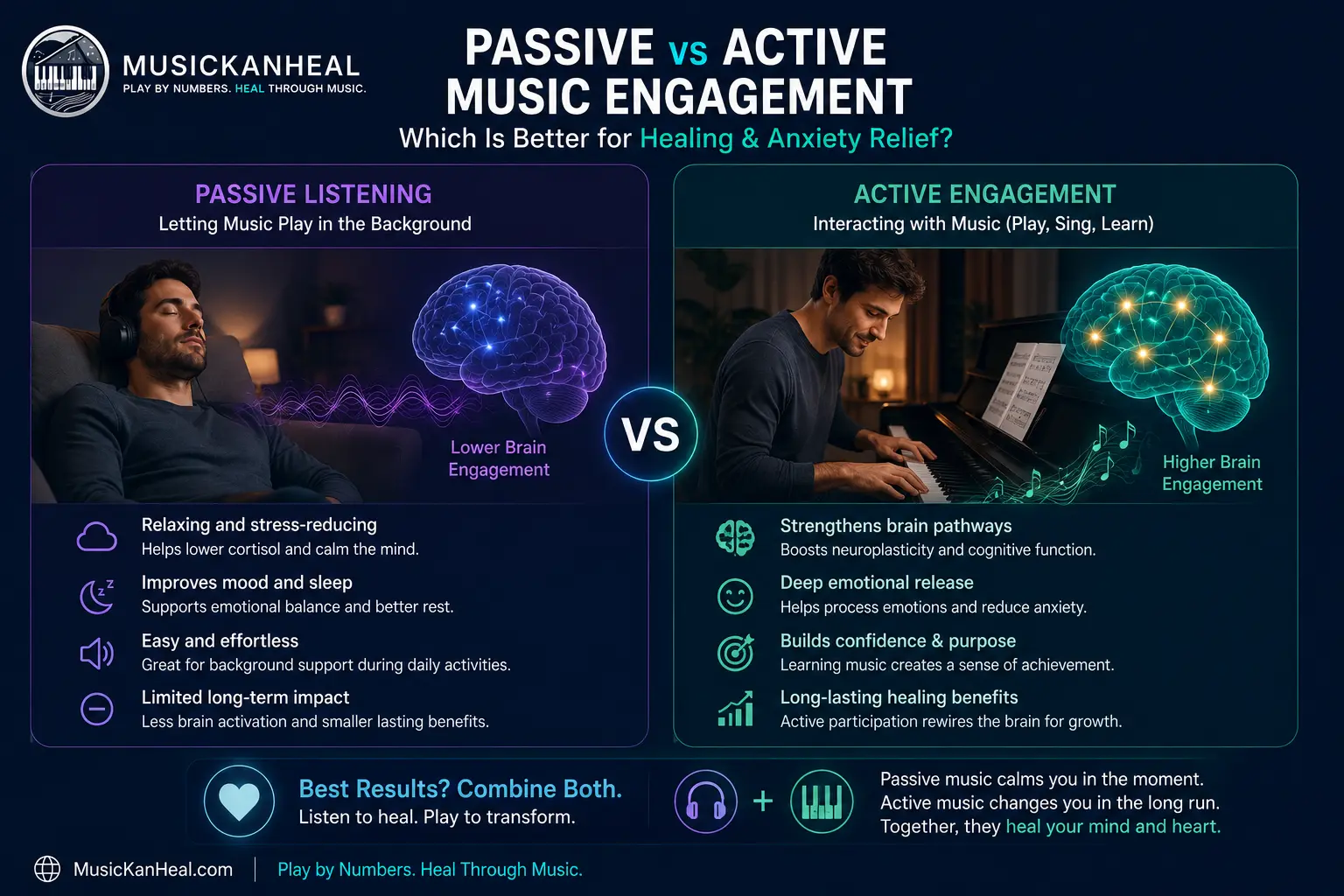
Here is the thing no comparison of Brain.fm, Endel, and Calm says clearly: all three are passive listening tools.
You open the app. You press play. You listen.
That structure has value — but it has a ceiling. A 2022 randomized controlled trial from the University of Bath published in Nature Scientific Reports assigned 31 adults to three groups: active piano learning, music listening, and a passive control group. The music-listening group heard the same pieces as the piano group. By the end of 11 weeks, the piano-playing group showed significant reductions in depression, anxiety, and stress. The music-listening group showed none.
Passive listening did not move the mental health needle. Active engagement with music did.
This does not mean Brain.fm, Endel, and Calm are useless for mental health. The neuroscience of functional audio — particularly Brain.fm’s neural phase locking and Endel’s adaptive environments — has real mechanisms behind it. But the type of change these apps can produce is different in nature from what active musical engagement produces. Passive listening creates contextual states. Active playing builds structural change.
The question to ask before subscribing to any of these apps is what you actually need. For environmental management — soundtracking work sessions, easing into sleep, managing acute stress — any of the three apps above can help. For building long-term resilience against anxiety and depression through music, the research points to playing, not listening.
MusicKanHeal explores the role of music in personal wellbeing from both angles — passive healing audio for moments when you need immediate calm, and active piano learning through the Nashville Number System for people who want the deeper transformation the research supports. Understanding how MusicKanHeal builds piano skills differently from traditional methods is worth reading before deciding your music-for-mental-health strategy.
Frequently Asked Questions About Brain.fm vs Endel vs Calm
Is Brain.fm vs Endel vs Calm really that different, or do they all do the same thing?
They are genuinely different at the mechanism level. Brain.fm uses patented rhythmic modulation to directly influence brainwave states — a technique grounded in peer-reviewed neuroscience. Endel generates AI-adaptive soundscapes that respond to your environment and biometrics in real time. Calm is a meditation platform that includes ambient audio as one component of a broader mindfulness system. The surface experience can feel similar — you press play and hear calming audio — but the underlying technology and long-term applications are distinct.
Can a healing music app replace therapy or medication for anxiety?
No, and any app claiming otherwise should be treated with skepticism. Brain.fm, Endel, and Calm are wellness tools — they are designed to support mental well-being, not treat clinical anxiety disorders. The research supporting functional audio and mindfulness practices consistently positions them as complements to existing treatment, not replacements. If you are managing clinical anxiety, discuss these tools with your healthcare provider rather than substituting them for professional support.
Does Brain.fm actually work, or is it just sophisticated marketing?
Brain.fm is backed by more independent scientific evidence than the other two apps in this comparison. EEG studies show measurable changes in brain activity during Brain.fm sessions compared to placebo audio. An NSF-funded peer-reviewed study demonstrated differential benefits for users with ADHD symptoms. That said, individual variability is real and documented — a meaningful percentage of users report no noticeable effect. The most honest framing: it works for many people, the mechanism is legitimate, and the free trial is long enough to test whether you are one of the people it works for.
Which app works best for sleep — Brain.fm, Endel, or Calm?
Calm wins for sleep, but not because of its ambient audio. The sleep stories feature — long-form narrated fiction designed to occupy enough of your attention to prevent racing thoughts without being engaging enough to keep you awake — is consistently the top-rated feature across all three apps. Brain.fm’s sleep mode uses 3D audio spatialization designed to create a calming effect, and it works well for many users. Endel’s sleep mode adapts to your heart rate via Apple Watch and gently shifts soundscapes as your body winds down. If sleep is your primary use case, try Calm for the sleep stories and Brain.fm for the sleep music, and keep whichever one you actually use consistently.
Can I use a healing music app and learn piano at the same time for better mental health results?
Yes — and the research suggests combining passive and active music engagement produces different types of benefit. A healing music app manages your environmental state in the moment: it can lower acute anxiety before practice, help you focus during learning sessions, or ease you into sleep afterward. Active piano learning builds the structural changes the Bath University research documented — measurable improvements in depression and anxiety scores over weeks. Used together, they address both the immediate and the cumulative dimensions of music-based mental wellness.
Conclusion: Which App Is Actually Worth Your Money?
The Brain.fm vs Endel vs Calm answer breaks down cleanly once you know what you need:
- Choose Brain.fm if you want science-backed functional audio for acute stress relief, anxiety during focused work, or faster sleep onset. Best scientific credibility. Best free trial. Lifetime plan offers long-term value.
- Choose Endel if you want effortless, adaptive ambient audio that fits itself to your day without you managing it. Better for sustained long-session calm than Brain.fm. The $119 lifetime plan is the best-value option in this comparison.
- Choose Calm only if you will actively use the guided meditation programs, sleep stories, and structured mindfulness courses — not just the soundscapes. If you want healing music specifically, you are overpaying for content you will not use.
All rights are reserved. Copyright 2026 MusicKanHeal | musickanheal.com