Best Beginner Piano Keyboards 2026: 8 Ranked by a Teacher
The best beginner piano keyboards all promise the same thing — that you will be playing in no time. Most of them are wrong about how that actually happens.
After 25+ years of playing piano for church, worship services, and community events, Keith A. Norris has watched students struggle not because they lacked talent, but because they started on the wrong instrument. Too small, too stiff, or so loaded with buttons they never found the keys that mattered.
This list cuts through that noise. Eight keyboards, ranked honestly, across every budget from $150 to $500. No filler picks. No brand deals. Just what actually works for beginners who want to make real music — not spend six months getting past the setup.
What Actually Matters in a Beginner Piano Keyboard (Not What the Box Says)
The box will tell you about 600 built-in sounds, demo songs, and auto-accompaniment. Ignore all of it.
Here is what actually determines whether you will still be playing three months from now:
- Key action. This is how the keys feel under your fingers. Weighted keys push back like an acoustic piano. Unweighted keys feel like pressing buttons on a calculator. Weighted keys build the finger strength and muscle memory that transfer to any instrument. Unweighted keys build habits that have to be unlearned later — if you stick with it at all.
- Key count. 88 keys is the full piano range. 61 keys is where most budget keyboards stop. You won’t use all 88 keys in your first month, but starting on 61 creates a ceiling you will hit faster than you think. If you are learning chords, progressions, and full songs, go to 88 when your budget allows.
- App connectivity. In 2026, Bluetooth MIDI is not a luxury feature. Learning apps like Simply Piano and Flowkey respond to what you play in real time — that feedback loop accelerates progress significantly. A keyboard with Bluetooth MIDI removes the cable entirely and pairs in seconds.
- Budget reality. Under $300, you are making real compromises on key action. That is not a sales pitch — it is just physics. The mechanisms inside cheap keyboards are lighter and less precise. If $300–$500 is a stretch, the Alesis Recital Pro and Casio CDP-S110 in this list hold their own. But if you can reach $449–$499, the Yamaha P-145 or Roland FP-10 are genuinely different instruments.
Do You Need Weighted Keys as a Beginner? (Honest Answer)
The honest answer is it depends on what you want to do.
If your goal is to eventually play an acoustic piano, transfer skills to a church instrument, or develop proper hand technique, yes, weighted keys matter from day one. The resistance trains your fingers to control dynamics. Without it, soft passages and loud chords feel the same.
If your goal is to learn chord progressions by ear, play worship music by number, or just start making music without overthinking the gear — you can begin on semi-weighted or even unweighted keys and progress plenty fast. The MKH Method works on lighter-action keyboards because you are training your ear and your chord shapes simultaneously. Your fingers will adjust.
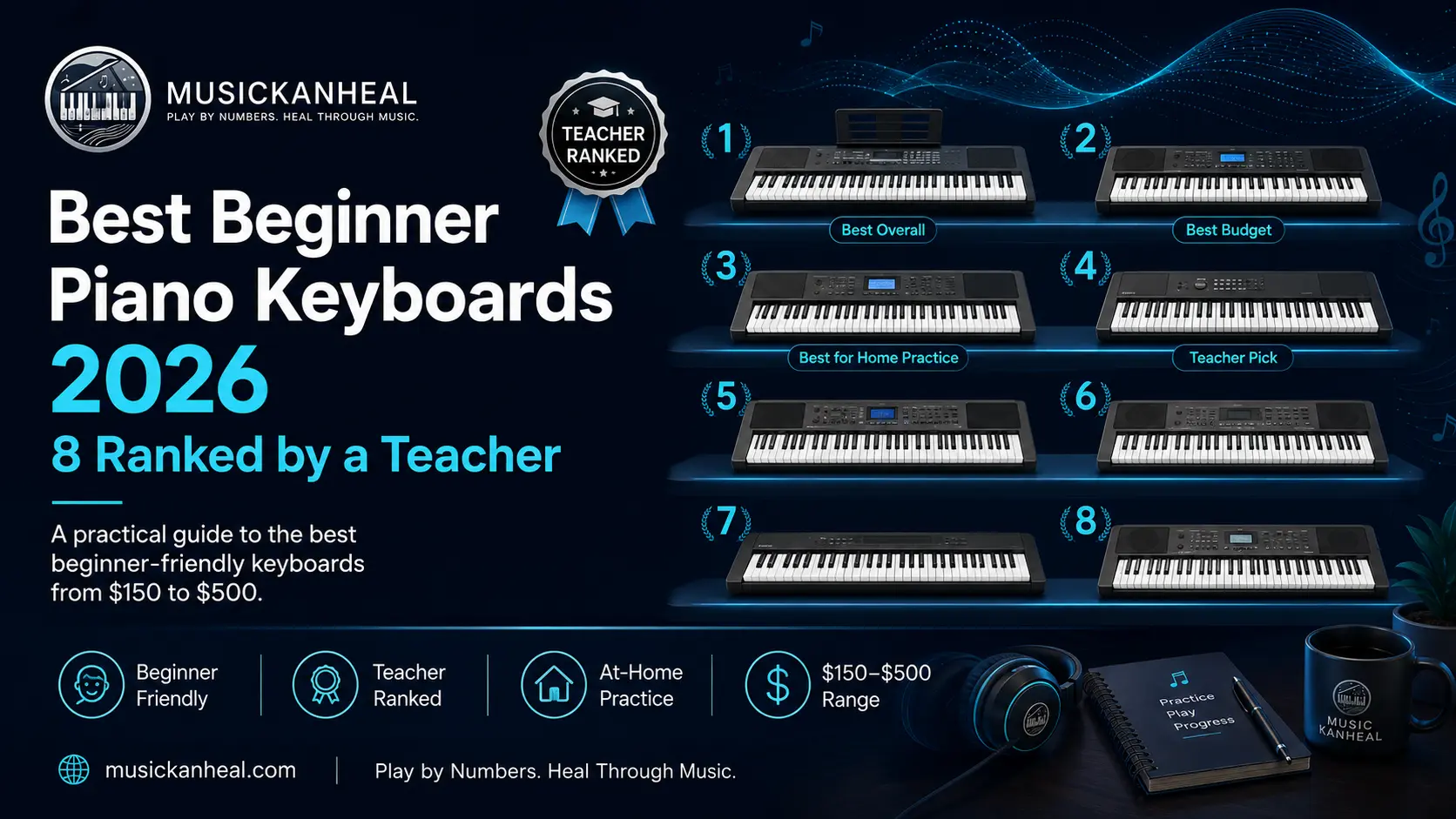
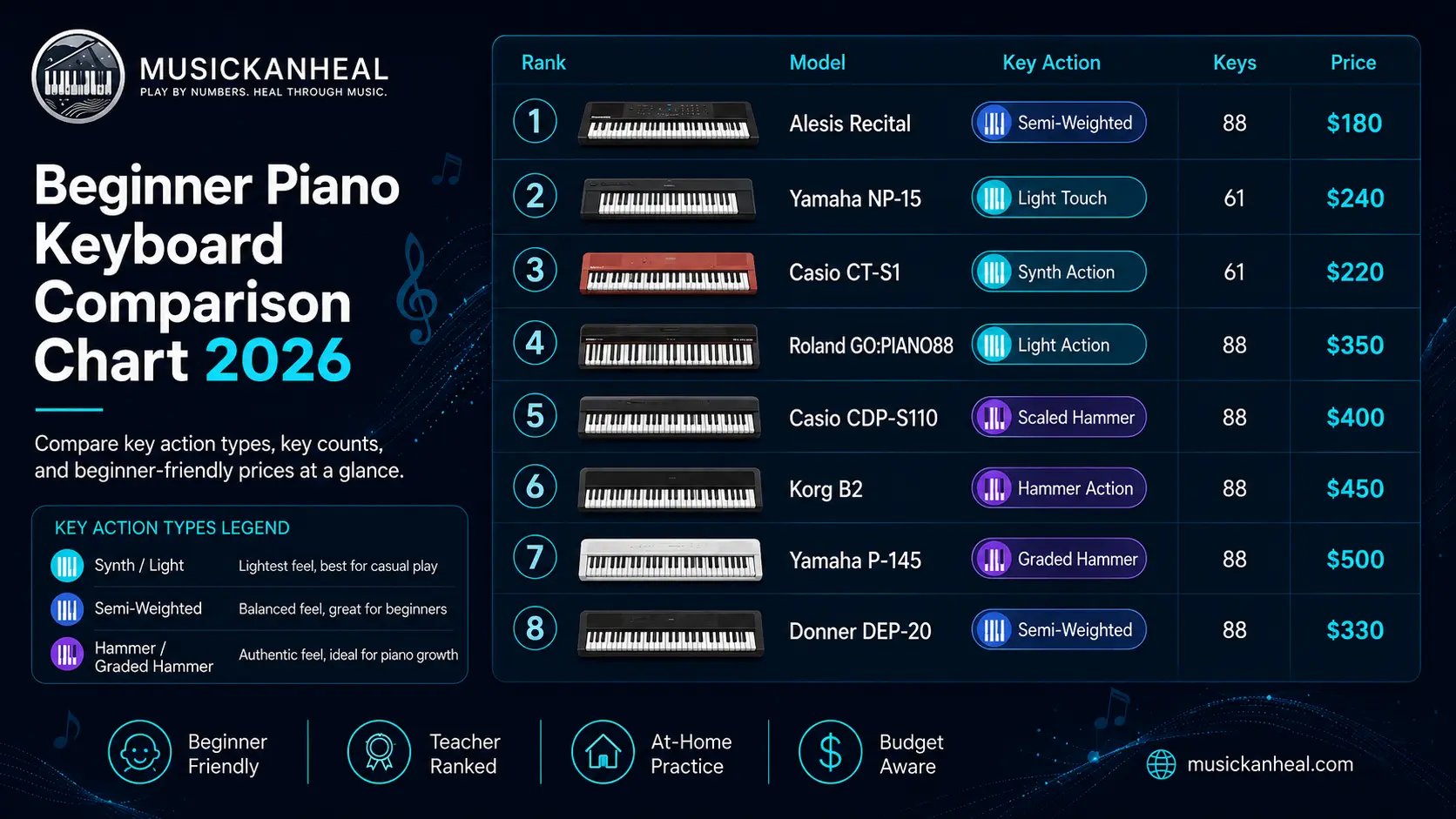
Best Beginner Piano Keyboards Ranked: $150 to $500
These eight keyboards are ranked by overall value for a genuine beginner — not by specs alone. Prices reflect current Amazon and major retailer listings as of mid-2026.
1. Roland FP-10 — Best Overall (~$499)
If you can spend $499, this is the keyboard most music teachers would buy for themselves at this price. The PHA-4 Standard key action features triple-sensor detection, an escapement mechanism, and textured ivory-feel key tops. That is the same action Roland uses in significantly more expensive models.
The difference you feel immediately: repeated notes register cleanly; soft playing responds the way it should; and the keys get heavier toward the bass — just like an acoustic piano. The SuperNATURAL sound engine is warm and dynamic without sounding digital.
Bluetooth MIDI is built in. Pairs with Simply Piano, Flowkey, or GarageBand instantly.
Best for: Beginners who want the best possible start and plan to stick with it. Tradeoff: Basic feature set — 15 sounds only, modest built-in speakers.
See the Roland FP-10 official product page →
2. Yamaha P-145 ($449) / P-145BT ($479)
The P-145 is the direct successor to the P-45, one of the best-selling beginner digital pianos ever made. The GHC (Graded Hammer Compact) action is lighter than Roland’s PHA-4 but still fully weighted and graded — it feels like a real piano, just slightly less heavy in the low register.
Yamaha’s CFIIIS concert grand sampling is clean, bright, and immediately recognizable. Music teachers tend to recommend this one because the tone is familiar and honest — no artificial enhancement that sounds impressive in a store but tiring at home.
Get the P-145BT version if you can. The Bluetooth audio addition lets you stream lesson audio directly through the piano’s speakers, which is genuinely useful for beginner practice sessions.
Best for: Beginners who want the most teacher-approved, low-drama setup. Tradeoff: 64-note polyphony is the lowest on this list (though you will not notice as a beginner).
See the Yamaha P-145BT official product page →
3. Kawai ES60 — Best Sound Quality (~$499)
Kawai released the ES60 as their first-ever sub-$500 digital piano, and the sound quality at this price is remarkable. The piano samples are sourced from the Shigeru Kawai SK-EX, a handmade concert grand used by professional performers in recital halls. That sound in a $499 instrument is genuinely surprising.
The Responsive Hammer Lite (RHL) key action is smooth and comfortable, with a lighter feel than Roland’s PHA-4. At 24 lbs, it is also one of the most portable options on this list.
One real downside: no Bluetooth connectivity. You will need a USB cable to connect to learning apps, which is a minor inconvenience for most beginners but worth knowing upfront.
Best for: Beginners who prioritize the quality and feel of the piano tone above everything else. Tradeoff: Wired app connection only — no Bluetooth MIDI.
See the Kawai ES60 official product page →
4. Casio CDP-S110 — Best Compact Option (~$299–$349)
The slimmest keyboard on this list. The CDP-S110 is roughly four inches deep — thin enough to slide under a bed or lean against a wall in a small apartment. For beginners with limited space, that matters more than any spec on a box.
The Scaled Hammer Action II delivers a fully weighted feel in a smaller mechanism. It is a genuine step below Yamaha’s GHC or Roland’s PHA-4 in terms of action depth, but it is still hammer-action — not a spring-loaded cheap substitute. It will not hurt your technique in year one.
The AIR sound engine produces a rich German grand piano tone that punches above its price. It runs on batteries, which is a bonus if you want to play somewhere without a power outlet.
Best for: Apartment dwellers, students, or anyone prioritizing portability over premium key feel. Tradeoff: Key action depth is lighter than the $449–$499 options. Fine for beginners, limiting for serious long-term players.
See the Casio CDP-S110 official product page →
5. Korg B2 — The Underrated Pick (~$349–$399)
The Korg B2 does not get mentioned as often as Yamaha or Roland in beginner roundups. That is a mistake. The Natural Weighted Hammer (NH) action is solid, the 120-note polyphony handles complex chord work without notes cutting off, and the German and Italian grand piano samples have a warmth that many buyers find more musically satisfying than Yamaha’s brighter tone.
The Motional Feedback (MFB) speaker technology reproduces bass frequencies more accurately than the speaker wattage numbers suggest. It sounds bigger than it should at this price.
The B2 also comes bundled with a three-month Skoove learning app subscription, which is a real bonus for absolute beginners who need guided lessons alongside a new keyboard.
Best for: Beginners who want a warm, rich piano tone and are not drawn to the Yamaha or Roland sound. Tradeoff: Key action does not match Roland’s PHA-4 for technique development, but it is fully adequate for beginner through intermediate learning.
See the Korg B2 official product page →
6. Alesis Recital Pro — Best Budget Fully-Weighted (~$349–$379)
The Alesis Recital Pro is the cheapest 88-key, fully weighted keyboard on this list. That alone makes it worth knowing about.
The key action is fully weighted but not graded — the resistance is uniform across the keyboard rather than heavier in the bass. That is a real difference from acoustic piano feel, but it will not harm a beginner who is still building basic hand coordination and chord shapes.
Built-in sounds are decent for the price, though non-piano voices feel thin. The 1-track MIDI recorder is a useful practice tool — hearing yourself play back is one of the fastest ways to identify what to fix. Battery power makes it practical for practice outside the home.
Best for: Beginners on a tighter budget who still want the full 88-key, hammer-action experience. Tradeoff: Key feel is the most basic of the fully weighted options. Stick to major brands (Yamaha, Roland, Casio, Korg, and Kawai) if budget allows.
See the Alesis Recital Pro official product page →
7. Alesis Recital 88 — Best Under $250 (~$199–$249)
Semi-weighted keys, 88 keys, and an honest sub-$250 price. If you are not yet certain you will stick with piano, or if you are buying for a child who needs to demonstrate commitment before a bigger investment, this is the entry point.
The semi-weighted action feels about 70% as real as a fully-weighted keyboard — more resistance than cheap unweighted keys and less than hammer action. For a beginner who is still learning where the notes are and how basic chords feel, that is enough.
Do not expect this keyboard to carry you past the first year if you get serious. But as a start, it works.
Best for: Total beginners who want to test commitment before spending $350+. Tradeoff: Semi-weighted keys will need to be unlearned if you graduate to a better instrument or acoustic piano.
See the Alesis Recital official product page →
8. Yamaha PSR-E383 — Best for Chord-Based Learners (~$169–$199)
This one is different from every other keyboard on this list. The PSR-E383 has 61 touch-sensitive, unweighted keys. By traditional piano standards, it is the bottom of the range.
But if you are learning piano through chord progressions and a number system rather than traditional sheet music — the way the MKH learning approach works — this keyboard makes sense at $169.
The 622 built-in voices, 205 accompaniment styles, and arranger features mean you can play chord shapes over a full band arrangement instantly. That is genuinely fun, and fun is the single biggest driver of whether a beginner keeps practicing. The USB audio/MIDI port connects to learning apps and works on six AA batteries for true portability.
If you later want to upgrade to a weighted keyboard with 88 keys, nothing you learned on the PSR-E383 will have to be thrown away. Chord knowledge transfers completely.
Best for: Beginners learning by ear, by number, or by chord — not sheet music readers. Tradeoff: No weighted keys means technique transfer to acoustic piano will require adjustment. Not ideal if your long-term goal is classical playing.
See the Yamaha PSR-E383 official product page →
Which Keyboard Works Best If You’re Learning by Ear, Not Sheet Music?
Most buying guides assume you are going to sit down with lesson books and learn to read music notation. Plenty of people do not want that — and they learn to play real music anyway.
The Nashville Number System is exactly this kind of approach. Instead of reading notation, you learn the relationship between numbers and chord positions. A 1-4-5 progression sounds the same whether you are in C, G, or any other key. You build a musical vocabulary that transfers across songs, keys, and styles with no sheet music involved. It is how professional session musicians in Nashville have operated for decades, and it is the method behind the MKH learning approach.
For this style of learning, the Yamaha PSR-E383 at $169 is a strong starting choice. The built-in accompaniment patterns let you hear your chord progressions in a full musical context immediately. When you are ready to develop more refined technique, the Korg B2 or Roland FP-10 handles chord-based playing beautifully on fully-weighted keys.
What Accessories Do You Actually Need to Get Started?
Keep it simple. Three things matter at the beginning:
- A sustain pedal. Most beginner keyboards do not include a good one. A sustain pedal lets notes ring out naturally after you lift your fingers — you will need it the moment you start playing real songs. A basic sustain pedal costs $20–$30 and makes an immediate difference in how your playing sounds.
- A keyboard stand. Playing with your keyboard on a table at the wrong height causes bad posture and hand fatigue. An X-style stand runs $30–$50 and positions the keyboard correctly for seated or standing play.
- Headphones. This is underrated for beginners. Playing through headphones at any hour without bothering anyone means you will practice more consistently. Closed-back headphones in the $40–$80 range are all you need.
Once you have the keyboard set up, the next decision is how you learn. If you want to compare the most popular apps — Simply Piano, Flowkey, and Skoove — there is an honest breakdown of all three here that covers what each one does well and where they fall short.
If you are an adult starting from scratch, the 90-Day Piano Plan at MusicKanHeal gives you a realistic week-by-week roadmap built for people with busy schedules who still want to make real progress.
Frequently Asked Questions About Beginner Piano Keyboards
What is the best beginner piano keyboard under $300?
The Casio CDP-S110 (~$299–$349) is the strongest option under $300 with fully weighted hammer action. If you need to stay under $250, the Alesis Recital 88 ($199–$249) with semi-weighted keys is a workable entry point. Avoid no-name brands in this range — the key action tends to be noticeably inferior to established manufacturers like Casio, Yamaha, and Roland.
Do beginner piano keyboards need 88 weighted keys?
88 keys is strongly recommended if your goal is to eventually play an acoustic piano or develop full technique. Most piano music uses the complete range, and starting on 61 keys creates limitations you will hit within a year. Weighted keys are important because they build the finger strength and dynamic control that transfer directly to acoustic instruments. According to Sweetwater’s beginner piano guide, weighted action gives beginners the right resistance to touch that unweighted keyboards simply cannot replicate.
Can you learn piano on a keyboard without weighted keys?
Yes — with realistic expectations. Non-weighted and semi-weighted keys are adequate for learning chord shapes, ear training, and number-system playing. The limitation shows up when you move to an acoustic piano or try to develop fine dynamic control (the ability to play very softly or very loudly with precision). If chord-based playing is your primary goal, unweighted keys will not hold you back significantly in the beginning.
What is the difference between a keyboard and a digital piano for beginners?
A keyboard typically has 61 unweighted or semi-weighted keys and prioritizes built-in sounds, rhythms, and portability. A digital piano has 88 weighted keys and is designed to replicate the feel and sound of an acoustic piano. For beginners who want to develop genuine piano skills, a digital piano is the better starting point. For beginners who want to learn chords and arrangements by ear without traditional lessons, an arranger keyboard like the Yamaha PSR-E383 can be the smarter first instrument.
How do I connect a beginner piano keyboard to a learning app?
Most current keyboards connect to learning apps via USB-MIDI or Bluetooth MIDI. Bluetooth MIDI (available on the Roland FP-10 and Yamaha P-145BT) is the easiest — open the app, enable Bluetooth, and the keyboard pairs automatically with no cables. USB-MIDI requires a USB-A to USB-B cable, which most keyboards include. Some apps like Simply Piano also use the phone’s microphone to detect your notes, so even an unconnected keyboard will work, though response is slower than a direct MIDI connection.
The Bottom Line: Which One Should You Buy?
Start with your budget and your learning goal.
Under $200: Yamaha PSR-E383 if you are learning chords by ear. Alesis Recital 88 if you want 88 keys and a weighted feel matters more than arranger features.
$300–$400: Casio CDP-S110 for tight spaces and portability. Korg B2 for a warm, full piano tone. Alesis Recital Pro for the cheapest fully weighted 88-key experience.
$450–$500: Roland FP-10 for the best key action at this price. Yamaha P-145BT is the most teacher-friendly, reliable all-rounder. Kawai ES60 if sound quality is your top priority.
Whatever you choose, the instrument matters less than what you do with it on day two, week three, and month six. Piano rewards consistent, curious practice — not expensive equipment.
All rights are reserved. Copyright 2026 MusicKanHeal | musickanheal.com