How Long Does It Take to Learn Piano with an App?
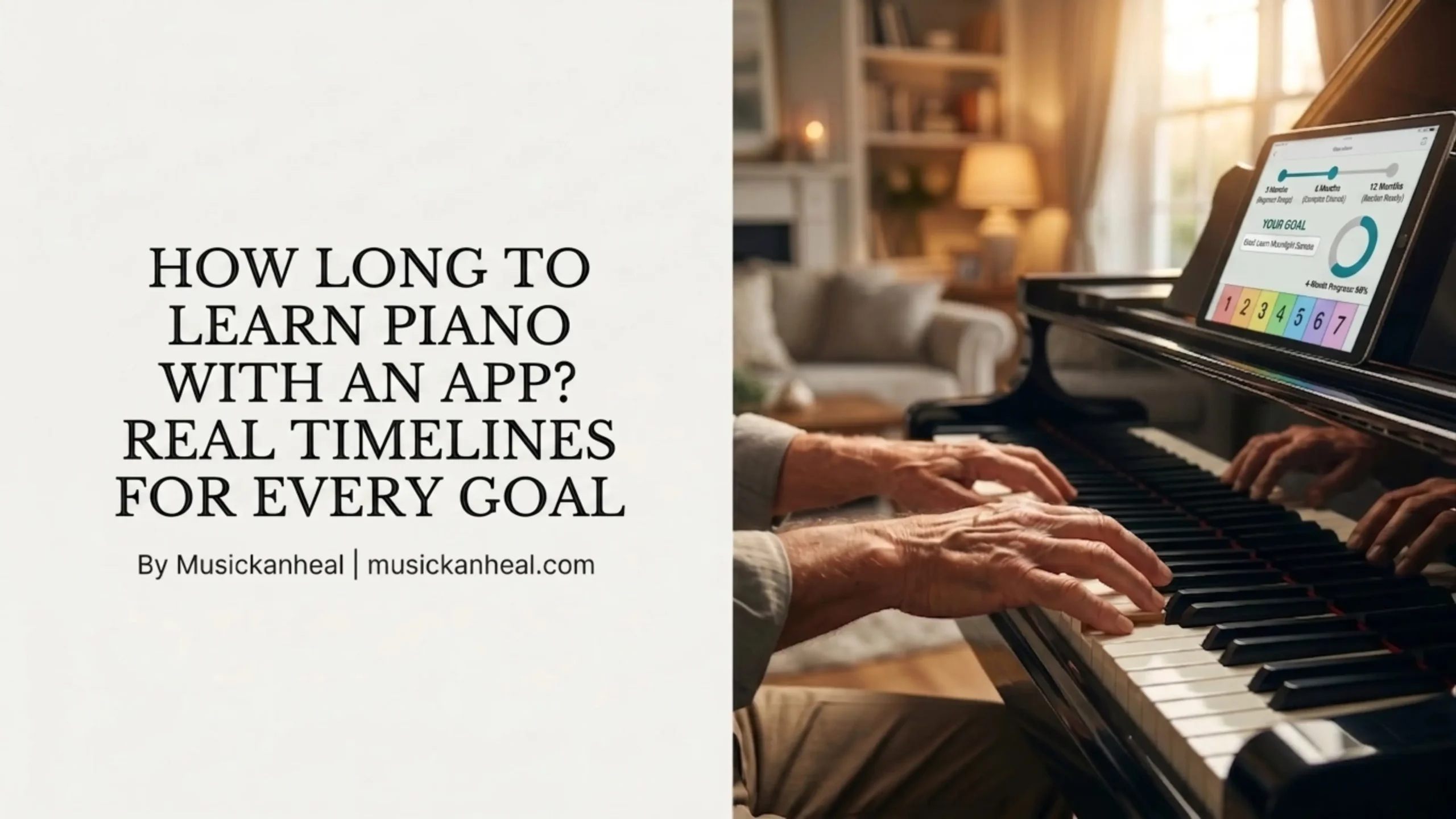
So, how long does it take to learn piano with an app — really? Most articles hand you a number — “three to six months” — and move on. That answer is technically true and practically useless, because what you can do after three months of app-based practice depends entirely on what goal you’re working toward and how honest your app has been with you about the process.
Learning piano means different things to different people. It means something different for the person who wants to impress at a family gathering, the adult who tried lessons as a kid and gave up, and the worship leader who needs to follow a chord chart under pressure on Sunday morning. The timeline shifts significantly depending on which of those you are.
This article breaks it down by real milestones — not vague skill levels — so you can set expectations that match your actual life.
The Honest Answer to “How Long Does It Take to Learn Piano with an App?”
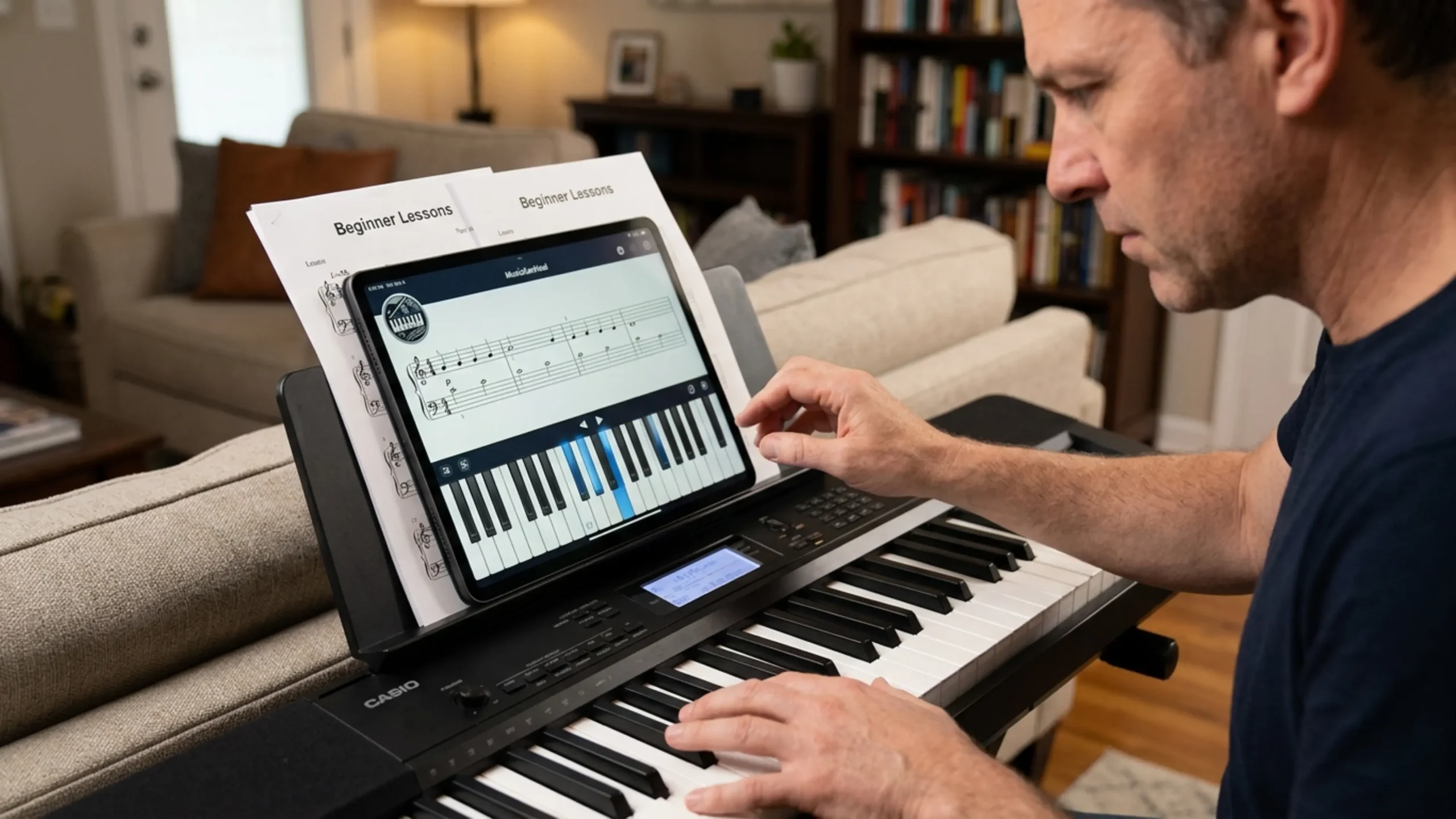
Here’s what the research consistently agrees on, across teachers, apps, and musicians who’ve done this themselves: frequency beats duration every time.
Practicing 15–20 minutes a day, five days a week, produces faster results than a two-hour session on the weekend. This isn’t a motivational talking point—it’s how motor memory actually builds. Studies on skill consolidation show the brain encodes physical patterns during rest periods between sessions, not during the sessions themselves. As research published in Cognitive Research: Principles and Implications demonstrates, spacing out music practice significantly boosts long-term song retention compared to massed practice (cramming). One long Sunday session doesn’t give your hands that consolidation time. Five short weekday ones do.
That single variable — whether you show up daily or batch your practice — will shift your timeline by months. Before asking how long it takes to learn piano with an app, ask a harder question: how often will you actually sit down? Your honest answer to that second question is what determines your real timeline, not the app you pick.
With that settled, here’s what you can realistically expect at each stage.
Milestone 1: How Long Until You Play Your First Real Song?
Realistic window: 1–3 weeks with daily practice.
This is the milestone most beginners underestimate how quickly they can hit—and then overestimate what it means. With a decent app and 15 minutes a day, most people can play a simple, recognizable song with both hands within two to three weeks. Some people manage it in a few days, especially if they already play another instrument.
The catch is what “play” means here. At this stage, you’re following the app’s visual cues—keys lighting up, notes scrolling across a screen. You’re building the muscle memory of reaching the right keys at roughly the right time. That’s real progress. But put a keyboard in front of you without the app running, and most beginners at this stage would struggle to reproduce the same song.
Think of it as the difference between reading aloud from a page versus reciting from memory. Both are valuable. They’re not the same skill.
Milestone 2: How Long Until You Sound Like You Know What You’re Doing?
Realistic window: 3–6 months of consistent practice.
This is the milestone most people actually mean when they say they want to “learn piano.” They want to sit down, play something, and have it sound like they meant to do that — not like someone squinting at a screen and hunting for the right key.
When adults ask how long it takes to learn piano with an app to reach this level, the honest answer is three to six months of daily 20-minute sessions. By that point, most beginners can:
- Play several songs from memory, without the app guiding every note
- Coordinate both hands with reasonable consistency
- Read basic chord structures and understand why they sound the way they do
- Adapt when they make a mistake instead of stopping completely
This is also, unfortunately, where a lot of app learners hit a wall. The early weeks feel like rapid progress because everything is new. Around month three or four, the novelty wears off, the songs get harder, and progress feels slower even though it isn’t. This is the plateau that ends most self-taught piano journeys—not lack of talent, just lack of a plan for what to do when it stops feeling easy.
The apps that carry people through this phase are the ones with a clear method behind the song library. If your app is just a catalogue of songs to follow along with, the plateau will hit harder. If it’s teaching you a system — a way of understanding how music is organized — you’ll have tools to push through it. That’s exactly the difference: how MusicKanHeal builds real piano skills to address skills that transfer, not just songs you’ve mimicked.
Milestone 3: How Long Until You Can Play at Church or Lead Worship?
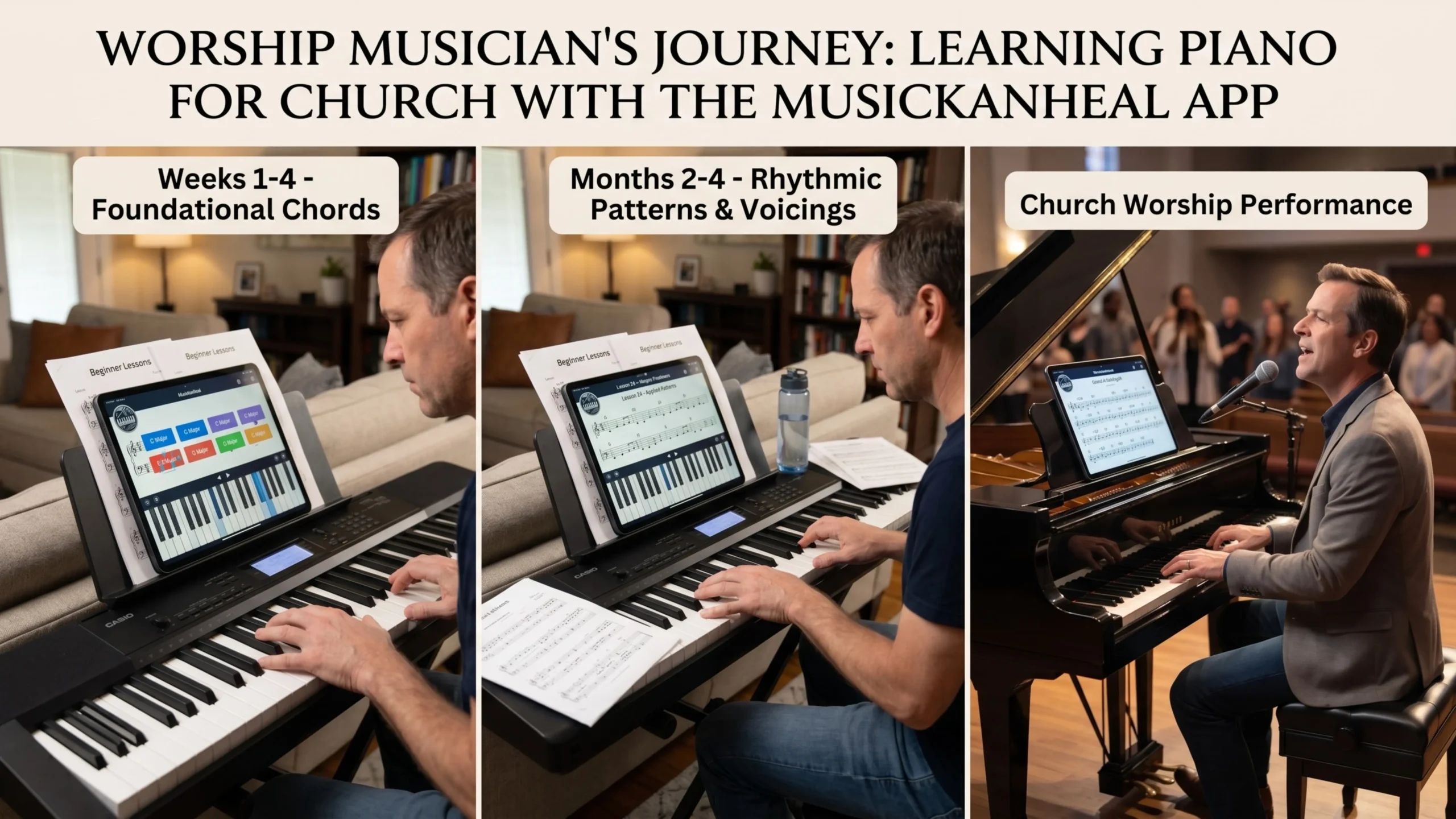
Realistic window: 6 weeks to 3 months — if you’re using the right method.
This milestone gets its own section because it’s the one most worship musicians and church players are actually asking about, and the timeline is dramatically different depending on how you’re learning.
If you’re learning through traditional sheet music—which is what most mainstream piano apps default to—you’re looking at months of notation study before you can follow a chord chart in a live setting. Reading sheet music is a second language. It takes time to become fluent enough to use under pressure.
If you’re learning through the Nashville Number System, the timeline compresses significantly. The Nashville Number System is what professional studio musicians use to play in any key without rewriting a song from scratch. It replaces complex notation with numbers 1 through 7, and once those relationships click, you can follow a chord chart—the way most worship bands actually operate—within weeks, not months.
For most worship contexts, you don’t need to sight-read sheet music under a spotlight. You need to hear a chord number called out and move there without hesitation. That’s a trainable skill, and a number-system approach gets you there faster than any sheet-music curriculum will.
What Speeds Up (or Kills) Your Progress with a Piano App
Beyond practice frequency, a few specific things have an outsized impact on how fast you actually improve.
What accelerates progress:
- Daily practice over weekend binges. Already covered, but worth repeating because most people ignore it.
- Practicing hands separately before combining them. It feels slow. It cuts learning time in half. Most beginners skip it.
- Choosing music you actually want to play. Motivation is not a soft factor here. If you don’t care about the song, you won’t practice it enough to actually learn it.
- Using an app with a method, not just a song library. An app that explains why the chord you’re playing is a “four chord” builds knowledge that transfers to the next song. An app that just shows you which keys to press builds nothing except familiarity with that specific song.
What kills progress:
- Chasing streaks instead of skill. Gamified apps are engineered to keep you coming back. That’s not the same thing as getting better. If you’re more focused on your daily streak than on whether your left hand is clean, you’re playing the game, not learning the instrument.
- Skipping songs you find hard. Apps make it easy to jump to something more satisfying when a section gets frustrating. That impulse is exactly backwards — the hard section is the one that will actually move your playing forward.
- Practicing the same song at the same pace every day. Comfort feels like practice. It isn’t. Real improvement comes from pushing slightly past where you’re comfortable, then pulling back to consolidate. Music educators refer to this as “deliberate practice”—a framework developed by psychologist K. Anders Ericsson (as detailed on APA PsycNet) showing that structured challenge, not repetition alone, is what separates rapid learners from those who plateau.
For a full breakdown of what the MKH app specifically teaches and how it stacks up against just following songs, see how MusicKanHeal enhances your piano skills.
So, How Long Does It Take to Learn Piano with an App?
Here’s a summary you can actually use:
| Goal | Realistic Timeline |
|---|---|
| First recognizable song | 1–3 weeks |
| Playing songs without the app guiding you | 3–6 months |
| Solid beginner — a few songs from memory, both hands | 6–12 months |
| Comfortable intermediate — playing freely, adapting | 1–2 years |
| Playing confidently at a church/worship setting | 6–12 weeks (number system) |
The timeline is real. So is the variance. Someone who sits down every day, works through the hard sections, and uses an app with a real method behind it will hit these milestones at the early end. Someone who practices when they feel like it, skips difficult parts, and treats the app as a game will hit them much later—or not at all.
The app is only one piece. The method behind it is another. And the consistency you bring is the one that matters most.
Frequently Asked Questions About How Long It Takes to Learn Piano with an App
How many minutes a day should I practice piano on an app?
Fifteen to twenty minutes a day is enough to make consistent, noticeable progress — provided you practice at least five days a week. Beyond that, you’re looking at diminishing returns until you reach an intermediate level with the endurance to use longer sessions productively. The research here is consistent across teachers and apps: frequency matters more than session length. Showing up every day for 15 minutes beats showing up twice a week for an hour.
How long does it take to learn piano with an app as an adult?
Adults are actually better equipped for app-based learning than people expect. You have clearer goals, better self-direction, and more patience for understanding why something works — not just how. The honest adult timeline: first recognizable song in 1–3 weeks, solid beginner level in 3–6 months, comfortable intermediate (playing freely in multiple styles) at around 1–2 years with consistent daily practice. Adults don’t learn slower than children — they learn differently, and apps suit that difference reasonably well.
Can I learn piano faster with an app than with a teacher?
For the early stages, a good app is genuinely competitive with a teacher — sometimes faster, because you can practice at your own pace without waiting for the next lesson. Where the gap opens up is around the intermediate level, when technique, posture, and musical interpretation start mattering more. A teacher catches bad habits before they’re ingrained. An app can’t watch your wrists. For pure speed in the first 3–6 months, a good app is a legitimate alternative. For long-term development beyond that, most serious learners eventually supplement apps with some form of human feedback.
How long does it take to learn piano with an app for worship music?
With a number-system-based app like MusicKanHeal, most beginners can follow a basic chord chart and play in a worship setting within 6–12 weeks of consistent practice. That timeline assumes daily practice and a focus on chord transitions rather than complex sheet music. The Nashville Number System makes this timeline possible because it teaches you the relationships between chords — meaning you can apply what you learn to any song in any key, not just the specific songs in the app’s library.
Why do most people stall after a few months of using a piano app?
Because apps are very good at making early progress feel effortless — and then the effortlessness disappears. Around month two or three, the songs get harder, the visual cues aren’t enough to carry you through, and progress slows perceptibly. Most people interpret this as hitting a ceiling. They haven’t. It’s the transition from reactive playing (following cues) to deliberate playing (understanding what you’re doing). The learners who push through this window — usually by slowing down instead of speeding up and focusing on difficult sections rather than avoiding them — are the ones who reach a satisfying level.
All rights are reserved. Copyright 2026 MusicKanHeal | musickanheal.com